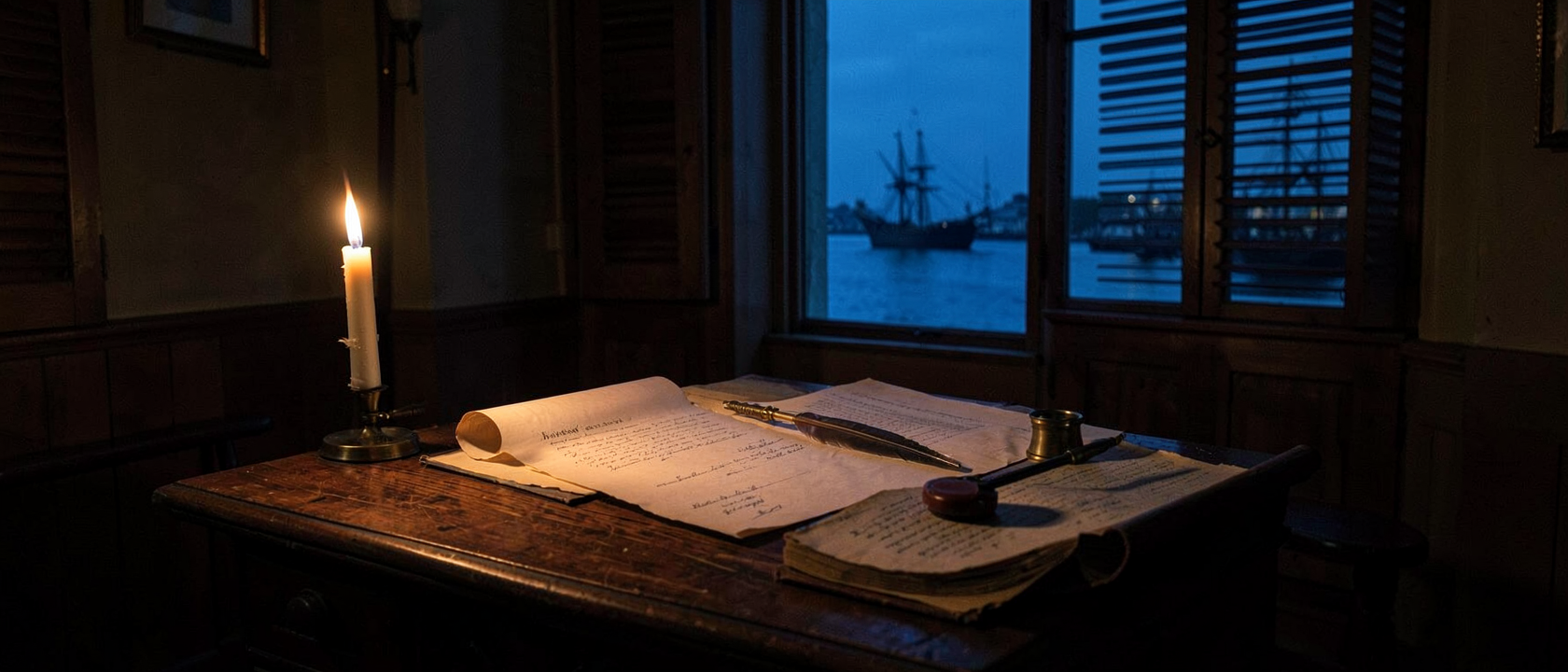
An affidavit sworn to settle a shipping account has become one of the few surviving records, in the words of the people who ran the ship rather than those who rose against it, of an uprising by enslaved people at sea. The document was never meant to tell that story. It was meant to balance a ledger.
A Lawsuit’s Paperwork
The affidavit survives at The National Archives in the United Kingdom under catalog reference C 114/158, filed among the private papers of Thomas Lumley and Company, a London merchant firm, submitted as evidence in an unrelated commercial lawsuit. It was sworn on June 19, 1807, in Kingston, Jamaica, before an official named Joseph Barnes. The signatories were the Bedford’s captain, Gilbert Wenman, its mate, Philip Leavy, and its surgeon, Patrick McKenna. The document takes the form of a “ship’s protest,” a standard maritime instrument used at the time to record loss before a notary or magistrate, most often for insurance or accounting purposes. Here it was used to account for missing human “cargo.”
The Night of February 2, 1807
According to the affidavit, around five o’clock in the evening the crew ordered the enslaved captives below deck as usual. Instead, the affidavit states, they seized the European crew on the main deck. Wenman fired his pistol at a man who had grabbed the ship’s boatswain. In the affidavit’s account, between seventy and eighty enslaved people then went into the sea. The crew lowered a boat and signaled for help by hoisting the ship’s ensign upside down. Fort Tantum and a merchant identified as Mr. Herbert, based at Lagoe, assisted in recovering many of them. The affidavit records a deficiency of twenty-nine men still missing afterward, plus one recaptured man noted as dangerously wounded. This is the fullest account the document gives, and it is told entirely from the deck, in the crew’s own words.
What the Affidavit Was For
No tribunal, inquiry, or independent witness produced this document. It is the crew’s own sworn statement, and its purpose, as The National Archives states, was to protect Wenman from liability and to itemize the missing captives as lost property. The affidavit records that Wenman later paid £138 15s in what it calls “redemption money” to recover a number of the escapees before the Bedford left the African coast. By the time the ship reached Kingston, over half the 223 people originally aboard had already been sold to Jamaican plantations, with others still held on the ship to keep sale prices high. There is no verdict anywhere in the file, because none was sought here. The affidavit was built to establish a loss, not to establish guilt or innocence.
The Pencil Marks
Two numbers in the document have been altered by hand, in pencil. The figure for how many escapees were recovered for £138 15s was changed from twelve to fifteen. The resulting deficiency was changed from twelve to fourteen. Nothing in the file says who made these corrections, or when, or on what authority. A court clerk, an insurer’s agent, and a later archivist are all plausible, and the surviving papers do not indicate which. Which set of figures was meant to stand, and whether either was ever finalized, is not something the surviving document settles.
The Ones Not Named
The affidavit gives no name for any enslaved person involved, recaptured or missing. The twenty-nine men recorded as unaccounted for are never distinguished from one another. No later paper in the file states whether they drowned, died during the recapture, or reached freedom on the Gold Coast. The National Archives, discussing the case, notes that twelve men may have escaped either by self-sacrifice or by returning to freedom, a possibility raised in commentary rather than a documented outcome. The record simply stops there, and nothing in C 114/158 picks it back up.
The Lawsuit Itself
The affidavit was preserved because it became evidence in a commercial lawsuit involving Thomas Lumley and Company, presumably over the Bedford’s financial losses. No ruling, settlement, or further correspondence from that suit appears in the surviving file. Whatever the case decided, or whether it was decided at all, is not part of what was kept.
The PASSAGE Project’s Reading
The National Archives published commentary on this file on August 3, 2026, through its PASSAGE project (Partnership for Transatlantic Slavery Scholarship, Archiving and Global Exchange), funded by Lloyd’s Register Foundation. The Archives describes the uprising as “a powerful act of mass resistance” and states that the enslaved people aboard the Bedford “challenged the system… in ways white abolitionists never had to.” That is an institutional reading written more than two centuries after the affidavit was sworn. It is attached to the document. It does not come from anything the 1807 testimony itself claims or was written to argue.
Four Things That Don’t Match
The affidavit is exact about pistol shots, pounds sterling, and shillings. It records nothing about who the twenty-nine missing men were. A pencil correction changes the arithmetic of the loss without changing the certainty of anyone’s fate. The lawsuit that preserved the document was about property, not people, and it never asked the question a modern reader wants answered. What survives from the night of February 2, 1807, is precise about money and silent about lives, and no other paper in the file closes that gap.