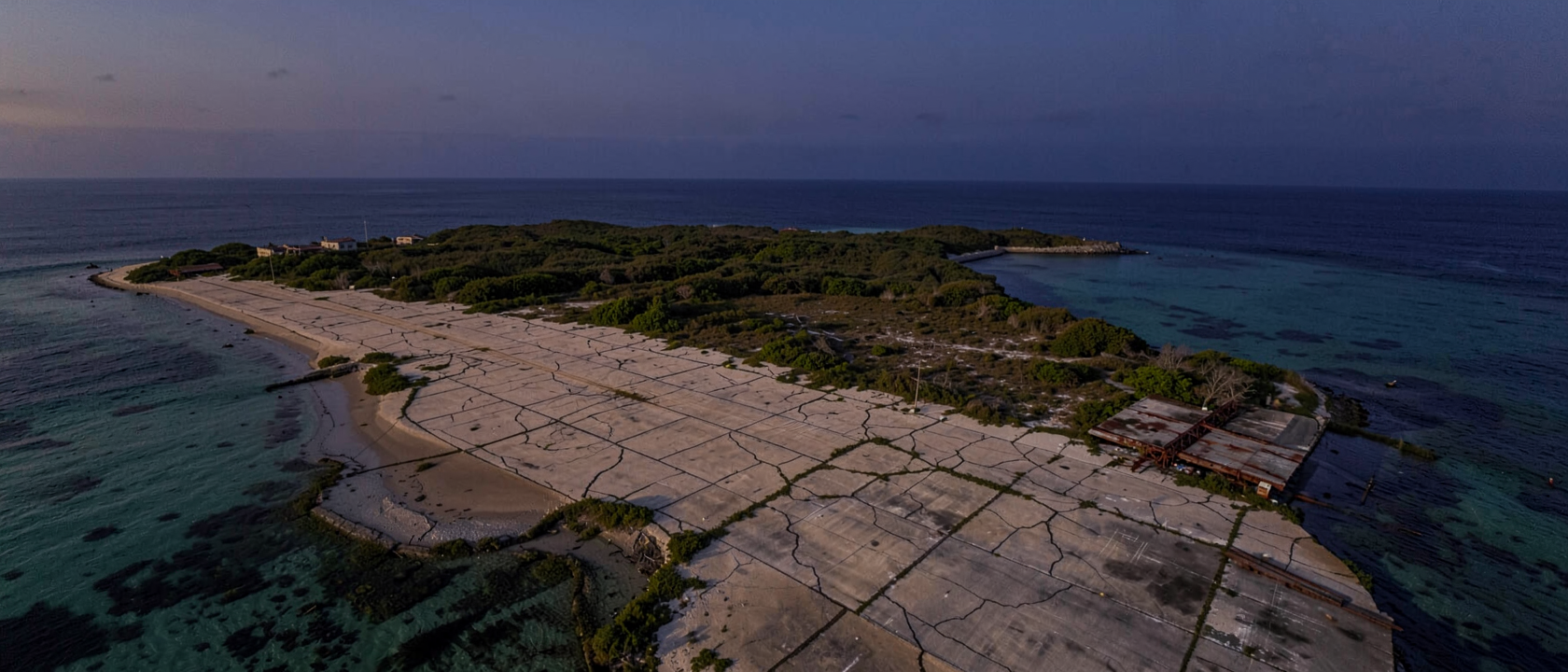
Some FOIA releases end without a bombshell. They end where the paperwork ends, and the honest move is to say so plainly. The Black Vault, the archive run by journalist John Greenewald, has spent years teaching readers to tell a document that settles something from one that simply records a process underway. Two new releases on the Air Force’s Rocket Cargo program, involving SpaceX and a remote Pacific atoll, belong to the second category. But there is a later development the record doesn’t mention on its own, and leaving it out would misrepresent where things actually stand.
Two Release Numbers, Two Sizes
The Department of the Air Force sent a response letter to The Black Vault in April 2026, closing out two Freedom of Information Act requests filed in July 2025. Case 2025-06383-F produced 822 pages (43.8MB) on site surveys and interagency coordination. Case 2025-06382-F produced 73 pages (6.52MB) on environmental compliance and wildlife consultation. The letter states that no classified material was located in either search, and that both releases are disclosed in part, with named FOIA exemptions applied to withhold the rest.
The Survey
The larger release describes a site survey of Johnston Atoll carried out in early 2024 by SpaceX personnel with rocket-landing experience, examining runway and taxiway conditions, mapping the island from the air, and running sonar over the harbor. The documents tie this fieldwork to the Air Force Research Laboratory’s Rocket Cargo Vanguard program, which is studying whether large reusable rockets can be used for military cargo delivery. The pages describe work done to find out whether landings there were feasible, not a decision that they would happen.
The Bird Problem
An internal email from February 2025, included in the release, raises a concern under the Migratory Bird Treaty Act, a federal law protecting most native bird species, and lays out two possible ways around it: applying for a special-use permit covering incidental “take” of birds, or seeking an exemption available for military readiness activities. The email reads as deliberation in progress, weighing options rather than announcing one. No later document in either release states which route the Air Force chose, or whether it chose either.
A Draft, Not a Decision
A draft Environmental Assessment circulated among reviewing agencies through late 2024. It included formal consultations under Section 7 of the Endangered Species Act, the provision requiring federal agencies to check with wildlife regulators before actions that might harm a protected species, covering green sea turtles, hawksbill sea turtles, and Hawaiian monk seals present at the atoll. The document exists in the release in draft form. Whether it was revised or finalized in the version circulated for comment is not part of what was disclosed.
“In No Way Final”
The clearest line in either release is a caveat, not a finding. An Air Force official, writing about that same draft Environmental Assessment while it circulated for agency comment, described it as “in no way ‘Final.'” The quote is worth citing directly, since it is the only place in the 895 combined pages where someone inside the process states plainly what stage the paperwork was at.
What Happened After the Draft
Here is the part the FOIA release itself does not cover, because it postdates the documents but predates the Air Force’s response letter. In a notice published in the Federal Register on July 9, 2025, the Department of the Air Force said it was holding the Johnston Atoll Environmental Assessment in abeyance while it considered whether the rocket cargo demonstration could be carried out somewhere else. An Air Force spokesperson, Laurel Falls, confirmed to Stars and Stripes around the same time that the service was exploring locations other than Johnston Atoll. On July 8, 2025, PopSci reported that Johnston Atoll was no longer slated to become the SpaceX test site. None of that is a cancellation. The Federal Register notice makes clear that a further notice would follow if the assessment restarts or is dropped for good. The program’s next site, or its fate, was still undetermined at the time of the abeyance notice.
What the Letter Actually Says
Read on its own terms, the Air Force’s April 2026 response letter to The Black Vault confirms three things: that a search was conducted, that nothing classified turned up, and that certain material, chiefly commercial details and internal deliberations, is being withheld under standard FOIA exemptions. It says nothing about the abeyance, the relocation search, or any other development after the documents it releases were written. That is not the letter’s job. It is answering a FOIA request, not narrating the program’s history.
Four Things the Record Doesn’t Answer
The contractual and technical terms of the Air Force-SpaceX arrangement are withheld under exemptions protecting commercial and deliberative-process information, so the record is silent on what SpaceX was specifically contracted to build or deliver. Whether the Migratory Bird Treaty Act question was ever formally closed, by permit, exemption, or otherwise, is not addressed in either release. Whether the Section 7 consultations on the two turtle species and the monk seal concluded, and with what result, is likewise absent from the disclosed pages. And nowhere in the 822 pages or the 73 pages is there a date, schedule, or timeline for landing operations. That absence matters more than it might otherwise, because by the time of the abeyance notice, Johnston Atoll itself was no longer the fixed plan.
What the FOIA release documents is a program being surveyed and reviewed at one specific site. What happened next, according to the Federal Register and public statements from the Air Force, is that the Johnston Atoll plan was set aside while other locations are weighed. Readers who can hold both of those facts apart, without collapsing “paused at this site” into either “cancelled” or “moving forward as planned,” are reading this the way it was written to be read.