The Signature on the Page
The document is one sheet, signed September 12, 1945, in Singapore’s Council Chamber. It names Field Marshal Count Hisaichi Terauchi, Supreme Commander of the Japanese Expeditionary Forces, Southern Regions, as the party surrendering unconditionally, and Admiral The Lord Louis Mountbatten, Supreme Allied Commander, South East Asia, as the party receiving it: all sea, ground, air and auxiliary forces under Terauchi’s command within Mountbatten’s theater.
The signature on the Japanese side is not Terauchi’s. It belongs to General Seishiro Itagaki, named in the document as Deputy Supreme Commander of the same forces. The instrument states that it is complementary to, and does not supersede, three earlier agreements: the Tokyo Instrument of Surrender of September 2, 1945, General Order No. 1 promulgated the same day, and the Rangoon Local Agreement of August 27, 1945.
What the City Saw
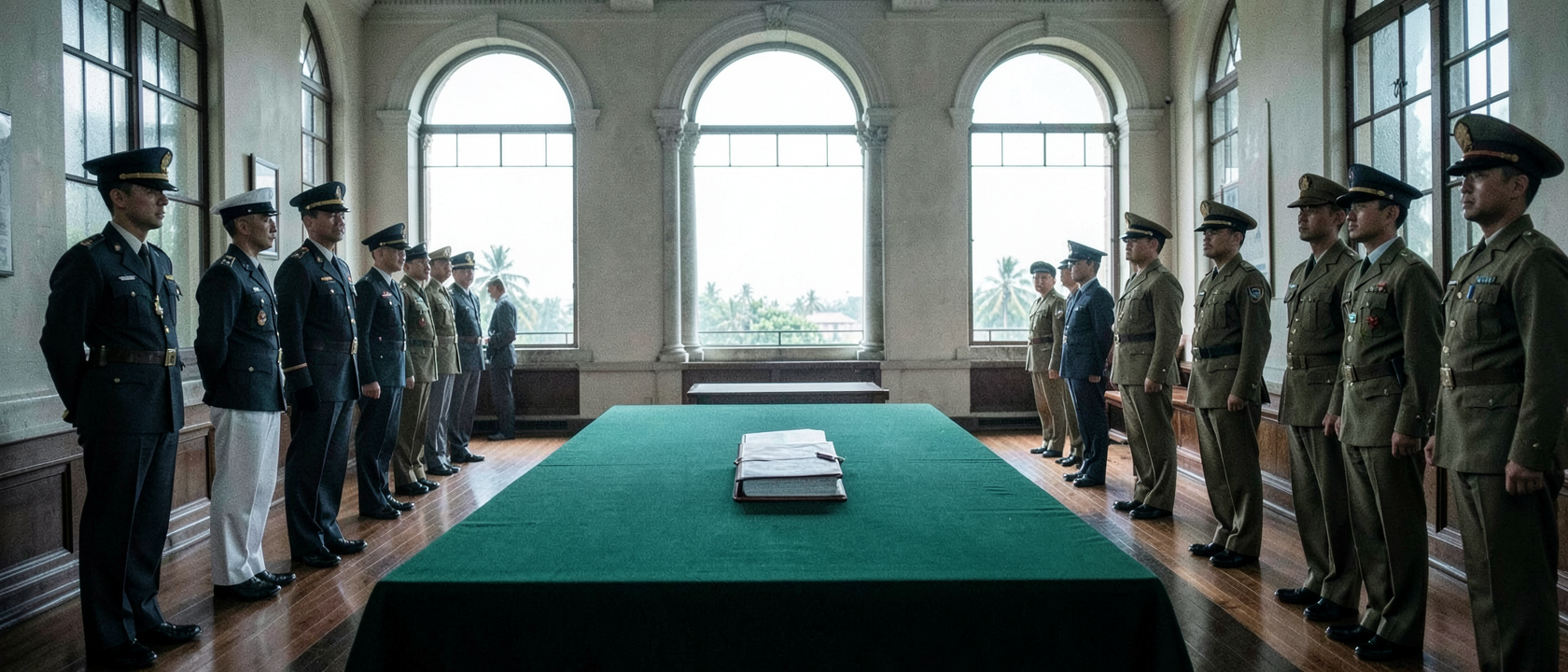
The ceremony is reported to have begun at 11:10 a.m. local time, with a 17-gun salute from the Royal Artillery and four guards of honor, drawn from the Royal Navy, the Royal Air Force, the Indian Army, and Australian paratroopers. Within minutes of the signing, the Union Jack went up over the Municipal Building to the British national anthem, the same flag lowered there at the 1942 surrender.
That is the sequence as reported: signing first, salute and flag after. The record describes what happened and in what order, without comment on what it meant to those present.
Why Terauchi Isn’t the Signature
The instrument itself gives no reason for Terauchi’s absence. But an explanation exists, just not inside this file. Singapore’s National Library Board records that Terauchi had suffered a stroke and could not attend the ceremony, and that he surrendered to Mountbatten in person on November 30, 1945, in Saigon, now Ho Chi Minh City. That account sits outside FO 371/46415 entirely; the document does not mention illness, and it does not mention Saigon.
A deputy signing for an absent commander was not unusual in September 1945. Signing authority was delegated routinely across the wider surrender process, and General Order No. 1 itself delegated authority across several theaters. Itagaki was already an established signatory for the region: on September 4, he and Vice Admiral Fukudome had signed surrender terms aboard HMS Sussex at Keppel Harbour, handing Singapore to Allied representatives, eight days before the Council Chamber ceremony. Seen against that pattern, and against the NLB’s account of Terauchi’s stroke, a deputy signing eight days later fits.
Where the Paperwork Stops
What the outside explanation doesn’t do is show up in the file. FO 371/46415, as it survives, carries no note, annex, or cross-reference recording why Terauchi was absent, and no line stating that Itagaki was specifically authorized to sign in his place. There is no reference to a delegation order and no note of where Terauchi was that day.
Such substitutions, when documented elsewhere in 1945, often carried a line of authorization somewhere in the paper trail. This file does not contain one. That is a fact about the document, not a claim that no authorization existed, only that this particular record doesn’t preserve it.
The Sequence That Led Here
Singapore’s signing sits at the end of a chain running five weeks. An atomic bomb fell on Hiroshima on August 6, 1945, and a second on Nagasaki on August 9, the day the Soviet Union declared war on Japan. Japan signaled its intent to surrender on August 10. On August 15, Emperor Hirohito announced acceptance of the terms set out in the Potsdam Declaration. The Rangoon Local Agreement followed on August 27, and the formal Instrument of Surrender was signed aboard USS Missouri in Tokyo Bay on September 2, alongside General Order No. 1.
The National Archives dates the Singapore ceremony ten days after Tokyo Bay; one other published account counts it as nine. The gap sits between sources, not within the document itself.
Two Men, No Aftermath
Beyond the stroke and the Saigon surrender, the instrument says nothing further about either man’s later history. There is no note of any subsequent tribunal proceeding for Terauchi or for Itagaki. Itagaki’s later record, like the detail of Terauchi’s illness, is kept elsewhere, not in this file. The silence here is a fact about the file, not a finding about what became of either man.
Consequences Never Tested, on Paper
The instrument sets out instructions for Japanese forces and states the consequences for disobedience. The file contains no record of those consequences being applied: no incident report, no follow-up correspondence.
That absence could mean compliance was total. It could equally mean such records sit in a different file and were not included here. The document does not distinguish between the two.
The Documents It Points To, and Doesn’t Cite
The instrument names three documents it is complementary to: the Tokyo Instrument of Surrender, General Order No. 1, and the Rangoon Local Agreement. It gives no catalog or reference numbers for any of them. FO 371/46415, as it stands, is one page naming three other agreements with no filing trail connecting them to it.
Whether those references sit in adjoining files outside this record is not something the document answers. What survives under this reference is a single signed page: a commander’s name, a deputy’s signature, and three agreements cited but not filed beside it. Readers who want the explanation for that gap have to go looking outside the file, exactly as the explanation for Terauchi’s absence had to be found outside it too.