
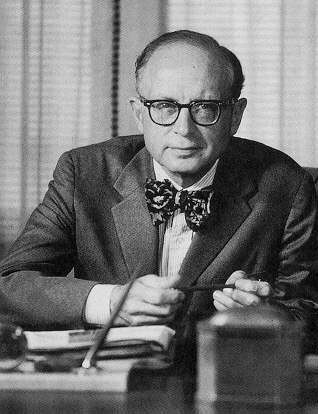
Daniel J. Boorstin was an American historian, writer, librarian, and sociologist who spent more than six decades reshaping how Americans understood their own past and the broader story of human knowledge. Born in Atlanta on October 1, 1914, he was educated at Harvard, Oxford’s Balliol College, and Yale Law School, and he went on to hold positions at the University of Chicago, the Library of Congress, the University of Cambridge, and the Smithsonian Institution. He served as the 12th Librarian of Congress from November 1975 to September 1987, during which time the Library’s annual appropriation rose from $116 million to $250 million and public use of the institution more than doubled. At the time of his death on February 28, 2004, he had authored more than 20 books published in at least 30 languages, with millions of copies sold worldwide.
Key facts
- Born: 1 October 1914
- Birthplace: Atlanta
- Died: 28 February 2004
- Place of death: Washington, D.C.
- Country: United States
- Occupation: librarian; historian; writer; sociologist
- Employer: University of Chicago; Library of Congress; University of Cambridge; Smithsonian Institution
- Education: Harvard College; Balliol College; Yale Law School; Central High School
- Awards: National Humanities Medal; Watson, Helen, Miles, and Audrey Davis Prize; Bancroft Prize; Pulitzer Prize for History
Early Life and Education
Boorstin’s parents, Samuel Aaron and Dora Olsan Boorstin, were Russian-Jewish immigrants who settled in Atlanta, Georgia. His father worked as a lawyer and served on the defense team of Leo Frank, whose lynching in 1915 prompted the family to relocate to Tulsa, Oklahoma.
Boorstin graduated from Tulsa Central High School in 1930 at the age of fifteen. He entered Harvard College, which awarded him a bachelor’s degree summa cum laude in 1934. While studying at Balliol College, Oxford, he simultaneously enrolled at the Inner Temple in London, passed the British bar examinations, and was called to the bar as a barrister-at-law in 1937. He then returned to the United States as a Sterling Fellow at Yale University Law School, earning a doctorate in judicial science in 1940.
Around 1940, while teaching at Harvard Law School, he met Ruth Carolyn Frankel. They married in April 1941, and Ruth became his most trusted editor throughout his career. Together they had three sons: Paul, Jonathan, and David.
Academic Career and Historiographical Outlook
Boorstin taught at the University of Chicago and held appointments at the University of Cambridge and the Smithsonian Institution.
He was a leading exponent of what historians called ‘consensus history,’ a post-World War II school of thought arguing that Americans shared an unconscious agreement about political and economic fundamentals, and that this shared ground meant European-style radicalism never gained the foothold in the United States that it did elsewhere. This interpretive framework shaped much of his early writing on American civilization.
Librarian of Congress
President Gerald Ford nominated Boorstin as the 12th Librarian of Congress on June 30, 1975. The Authors League of America supported the nomination, while the American Library Association opposed it on the grounds that Boorstin lacked experience as a library administrator. The Senate confirmed him without debate.
Boorstin served from November 1975 to September 1987, a tenure of twelve years. During that period, the Library’s annual appropriation climbed from $116 million to $250 million, and public use of the institution more than doubled. In January 1986, Boorstin announced that he would retire as Librarian of Congress on June 15, 1987.
Major Works
Boorstin produced two major trilogies. The second, known as the Knowledge Trilogy, traced the histories of scientific discovery, artistic creation, and philosophical and religious thought across world civilizations. The three volumes were The Discoverers (1983), The Creators (1992), and The Seekers (1998).
The Discoverers, published by Random House, ran to 745 pages and became a bestseller. The Creators followed in 1992, and The Seekers, published in 1998, was completed with the same careful editorial process that characterized all of Boorstin’s mature work: he wrote five typewritten manuscript drafts of The Seekers, each bearing the annotations of his wife Ruth, and those manuscripts were later added to the Boorstin Papers in the Library of Congress Manuscript Division.
Death and Legacy
Boorstin died of pneumonia on February 28, 2004, at Sibley Memorial Hospital in Washington, D.C., at the age of 89. He was survived by his wife Ruth, their three sons, six grandchildren, and three great-grandchildren.
His awards included the Pulitzer Prize for History, the Bancroft Prize, the National Humanities Medal, and the Watson, Helen, Miles, and Audrey Davis Prize. The more than 20 books he completed during his lifetime had been translated into at least 30 languages by the time of his death, with millions of copies in print.
Did you know
- Boorstin’s 1983 bestseller The Discoverers ran to 745 pages and was published by Random House. It was the first volume of what became known as the Knowledge Trilogy, a series covering scientific discovery, artistic creation, and philosophical seeking. (books.google.de)
- Boorstin wrote five typewritten manuscript drafts of his 1998 book The Seekers, each carrying the editorial annotations of his wife Ruth. Those manuscripts were subsequently added to the Boorstin Papers held in the Library of Congress Manuscript Division. (loc.gov)
Data sources
Data updated: 2026-10-31