The Repository
The archive runs to 6,237 pages. Most of it is email.
On February 1, 2022, The Black Vault, a privately operated document repository founded in 1996 by John Greenewald Jr. that publishes records obtained under the Freedom of Information Act (FOIA) and equivalent state open-records laws, published a collection of materials released by the DC Homeland Security and Emergency Management Agency (HSEMA). The collection covers District of Columbia government communications surrounding the attack on the U.S. Capitol on January 6, 2021, and its immediate aftermath. Compressed into a single ZIP file of approximately 256 megabytes, it contains five documents.
The release was produced under the federal FOIA and the District’s parallel open-records statute, the DC Sunshine Law. HSEMA offered requesters a single comprehensive email search in place of responding to individual filings, on the stated basis that the results would “almost certainly be broader” than any individual request would yield. A 16-page document in the archive, titled “District of Columbia Response to Bipartisan Committee Letter,” indicates the DC government was simultaneously answering investigatory requests from two Senate committees: the Committee on Homeland Security and Governmental Affairs, chaired by Gary Peters with Rob Portman as ranking member, and the Committee on Rules and Administration, chaired by Amy Klobuchar with Roy Blunt as ranking member. Both committees announced a joint bipartisan inquiry into the security failures of January 6, 2021, on January 8 of that year.
The Formal Request
On December 31, 2020, Mayor Muriel Bowser sent a one-page letter to Major General William J. Walker, the Commanding General of the DC National Guard, requesting Guard assistance for First Amendment demonstrations scheduled for January 5 and January 6, 2021. On the same date, HSEMA Director Dr. Christopher Rodriguez sent a separate two-page letter to Walker with substantially the same request, specifying the Guard’s intended role as crowd management and assistance blocking vehicles at traffic control points. The record does not show either letter requesting support in areas outside the District’s jurisdiction.
Walker forwarded the request to then-Secretary of the Army Ryan McCarthy in a letter dated January 1, 2021. McCarthy’s approval letter, dated January 5, 2021, authorized 340 total personnel, including 40 Quick Reaction Force members, to support the Metropolitan Police Department.
The Communication Network
The two large email files account for nearly all of the archive’s page count. The first spans 1,116 pages of emails from December 19, 2020, through January 6, 2021. The second covers 5,102 pages from January 7, 2021, through January 20, 2021, the date of the presidential inauguration. The December 19, 2020 start date corresponds to the date then-President Trump posted publicly about a planned protest in Washington, D.C. on January 6.
On the District side, HSEMA searched officials within the Office of the Mayor, including Mayor Bowser, Chief of Staff John Falcicchio, and the Mayor’s communications and legal teams, along with HSEMA itself, the Metropolitan Police Department (MPD), and the Office of the Deputy Mayor for Public Safety and Justice. The search also captured communications to and from federal domains belonging to the FBI, Department of Justice, Department of Defense, the Army, the National Guard, the Department of Homeland Security, the Secret Service, the U.S. Capitol Police, and the National Park Service. MPD officials named include Police Chief Robert J. Contee III, who had taken office as acting chief on January 2, 2021, along with senior figures from the MPD’s Homeland Security Bureau and Intelligence Division.
The Assessment of Risk
The release letter states that Search #1 targeted communications concerning the counting of Electoral College votes on January 6, 2021, and the potential for demonstrations, violence, or attacks in the National Capital Region on or around that date. Search #2 targeted the aftermath of January 6. What the emails themselves contain in detail is not described in the release letter.
In his March 3, 2021 testimony before the Senate committees, Walker stated that at 1:49 p.m. on January 6, he received a call from then-U.S. Capitol Police Chief Steven Sund, reporting that the Capitol’s security perimeter had been overrun. Walker’s testimony further states that approval to deploy Guard troops to the Capitol arrived at 5:08 p.m., approximately three hours and nineteen minutes after that call. The Senate bipartisan report found that the FBI did not issue any formal intelligence assessment specific to January 6. Late on January 5, 2021, the FBI’s Norfolk Field Office had circulated a Situational Information Report warning that individuals were traveling to Washington, D.C. with stated intentions of violence at the Capitol.
The Nature of the Redactions
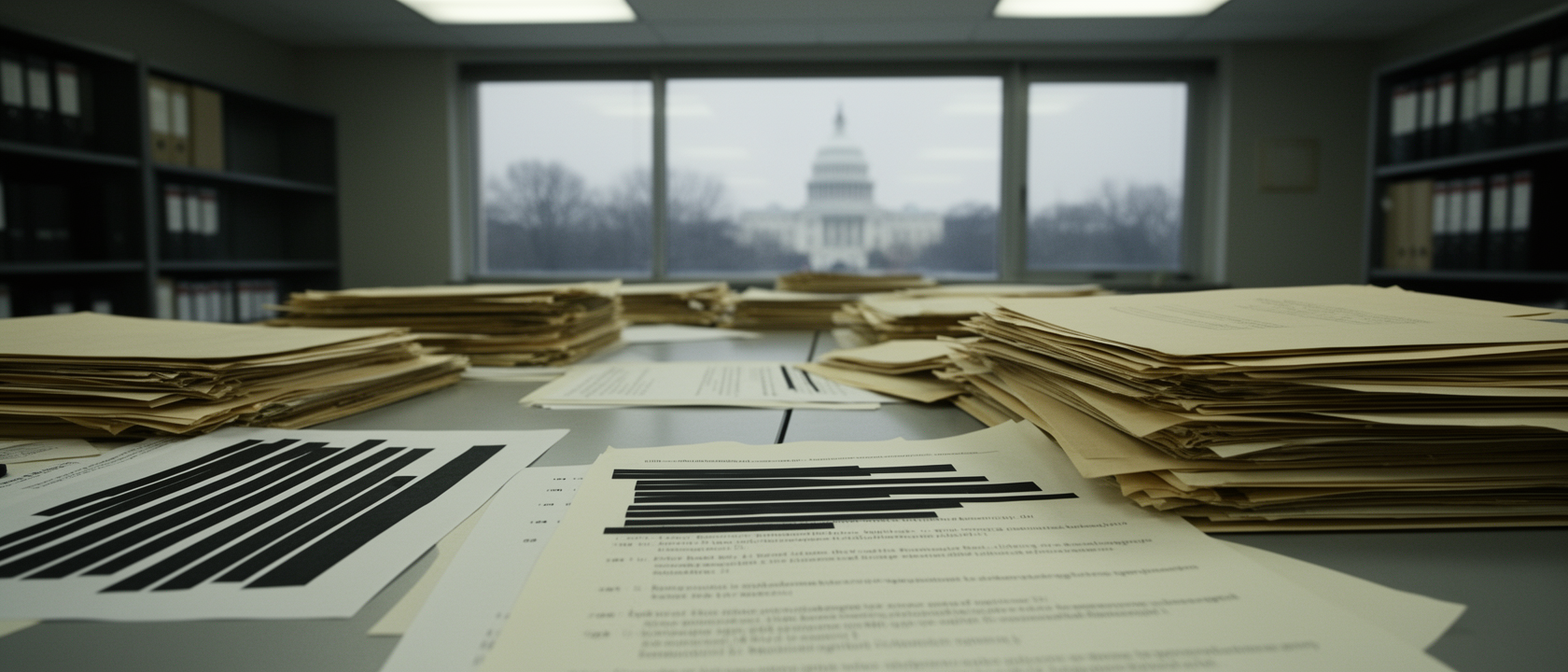
Both large email files carry the word “REDACTED” in their filenames. The release letter does not specify which FOIA exemptions were applied, does not indicate how many pages were withheld in full, and does not state the basis for any individual redaction. The collection as published provides no key to its own omissions. The DC government’s stated purpose in conducting a broad, consolidated search was to satisfy the combined weight of multiple FOIA and legislative requests in a single production. The archive that resulted is raw correspondence, captured within defined date windows, released in redacted form. Nothing about the redactions, on its own, indicates what was removed.
The Evaluative Void
The 6,237 pages do not include a final analytical report. No document in the published collection sets out what the formal requests from Mayor Bowser and Dr. Rodriguez produced in terms of actual response, what internal assessment any DC office made, or what conclusions were reached about the coordination that took place before and during January 6.
Walker told the Senate committees on March 3, 2021, that he found the requirement to submit a “concept of operation” to the Secretary of the Army before deploying the Quick Reaction Force to be unusual, and that the delay left him frustrated and stunned. The bipartisan Senate report described the events in terms of security and intelligence failures, insufficient preparedness, and a slow response. Both of those assessments come from outside the HSEMA archive.
The record establishes that formal requests were made six days before the Capitol was breached, that communications flowed between District offices and multiple federal agencies across a window of more than a month, and that the released documents were redacted before publication. What the collection does not contain is any documented internal reckoning with what those communications produced or failed to produce. Whether such an evaluation exists elsewhere in the District’s records, or was ever written, is not answered by the published material.