What Arrived in the File
The document carries no date of composition, no author’s name, and no case number. Its title is straightforward: “U.S.–Soviet Discussions, House of Scientists, Moscow December 28–30, 1967.” Its classification marking, at creation, was Confidential, the lowest of the three standard tiers of U.S. classified designation, routinely applied to procedural and diplomatic records of this kind. Three undated attachments accompany the main text: a meeting agenda, Appendix 1, and Appendix 2.
The original papers are held in the Harvard University Archives as part of the Paul M. Doty Papers, collection HUM 177, box 49, folder 5. William Burr of the Nuclear Documentation Project at the National Security Archive at George Washington University catalogued the record as Document 17 within Briefing Book No. 782 and posted it publicly on December 10, 2021. Archivists place its composition at approximately January 1968, though the document itself gives no date. How it entered the public record, whether through formal declassification review, a Freedom of Information Act request (the statutory mechanism by which members of the public may compel release of federal records), or some other channel, is not described in the available source material.
What the Record Says Happened
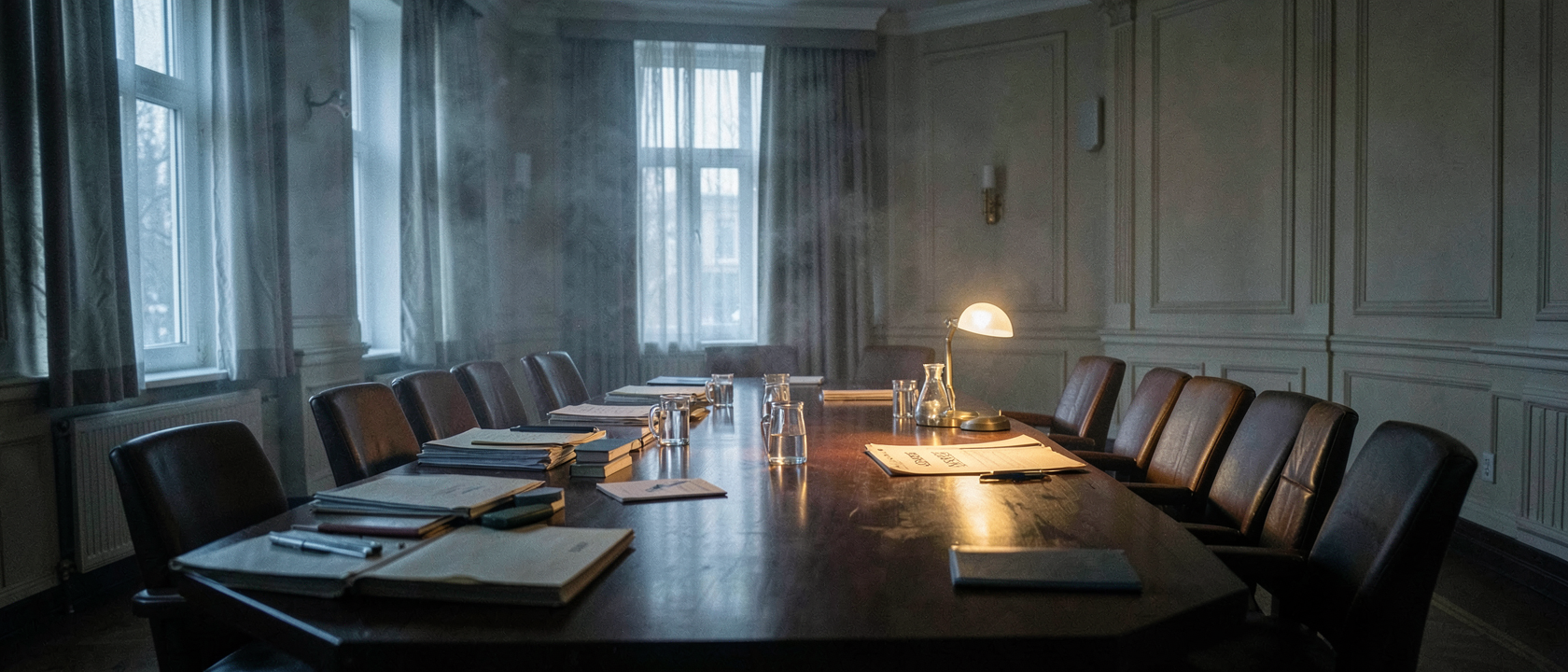
The meetings ran across two and a half days, December 28 through 30, 1967, at the House of Scientists in Moscow, organized under the Soviet-American Disarmament Studies group, known as SADS, which Paul Doty and Mikhail Millionshchikov had established together in 1964. Millionshchikov, first vice-president of the Soviet Academy of Sciences, led the Soviet side. The U.S. delegation included Franklin A. Long of Cornell University, George Rathjens of the Institute for Defense Analyses, Jerome B. Wiesner (then MIT’s provost), and Henry Kissinger. Sociologist Talcott Parsons was invited but did not participate in the strategic discussions. The document notes that the Soviet side included officials connected to Soviet national security structures, with a fuller list in one of the appendices. Georgi Arbatov, appointed director of the newly formed Institute of the USA in November 1967, made an appearance.
The record states that the primary subject was strategic nuclear matters; discussion of the Vietnam War also arose, at Soviet initiative. No simultaneous interpretation was available; everything was rendered consecutively between English and Russian, and the document notes that statements attributed to Russian participants are therefore based on those translations. The record’s editors observe that it likely captures the general character and basic content of the discussions, but do not claim word-for-word accuracy. The probable author, as the archivists identify it, is Benjamin H. Brown, who served as secretary to the U.S. SADS group from 1967 to 1975. Wiesner prepared notes on the pre-departure meetings with U.S. government officials.
The Architecture of Formality
On October 14, 1967, Millionshchikov wrote to Doty inviting him and his associates to Moscow as guests of the Soviet Pugwash Committee. Before departure, on December 5 and 6, 1967, Doty’s group received briefings from National Security Adviser Walt Rostow, Deputy Under Secretary of State Foy Kohler, Herbert Scoville of the Arms Control and Disarmament Agency, Raymond Garthoff of the State Department, Morton Halperin of the Department of Defense, and Secretary of Defense Robert McNamara. Wiesner documented those sessions; the McNamara meeting is absent from his notes because he could not attend. According to the record, Doty told McNamara that he had been informed the proposed discussions were cleared with Soviet Premier Aleksei Kosygin, a claim about what Doty had been told, not a settled fact about Kosygin’s involvement.
Expenses for U.S. participants, including honoraria, were covered by the Ford Foundation through the American Academy of Arts and Sciences. A CIA report cited in the archival record explains that, with the Vietnam War ongoing, China could make political use of any Soviet Academy expenditure if it became known, so Pugwash USSR covered local expenses instead. A prior informal contact had helped set conditions for the December meeting: a discussion among Kissinger, Doty, and Millionshchikov in June 1967.
Why a Document Like This Usually Exists
A Confidential record of structured bilateral talks between American and Soviet participants in late 1967 is consistent with the standard administrative output of Cold War scientific and strategic exchange programs. The SADS group was a formal, recurring structure, and meetings of this kind generated classified summaries as a matter of course. Classification at the Confidential level was routinely applied to protect sources, conceal what each side knew, or avoid diplomatic friction, not necessarily to guard operationally sensitive material.
The record does contain one substantive finding worth noting. Many Soviet participants expressed appreciation that the U.S. side accepted, as a given, that any arms control negotiations would need to address both strategic offensive missiles and defensive systems together. The NSA editors characterize this as significant: Soviet officials had previously resisted acknowledging limitations on anti-ballistic missile systems, in part because figures including Kosygin had publicly defended defensive weapons as morally justified. Topics left open for future discussion include the meaning of a “thin” or limited ABM deployment and the relationship between defensive and offensive missile counts.
The Atomic Heritage Foundation later claimed that SADS work “played a valuable role in negotiations that resulted in the Anti-Ballistic Missile Treaty of 1972.” That is a claim made afterwards; the record itself draws no line to any later agreement.
What Is Missing, Listed as Missing
The discussions were intended to remain private. Word leaked nonetheless, and the New York Times published a brief account after speaking with Doty. What the Times reported, and whether the record addresses that breach in any detail, the available source material does not say.
The content of Appendix 1 and Appendix 2 is not reproduced or summarized in the NSA’s editorial description. The full roster of Soviet participants cannot be independently verified from what is publicly available. The date on which the Confidential marking was reviewed, downgraded, or formally removed, and the authority under which that happened, is not stated in the posted record. No Russian-language transcript has been identified against which the consecutive translations of Soviet participants’ statements could be checked.
Those are the gaps as the paperwork currently stands, facts about the record’s incompleteness, not claims about what the missing portions contained.