
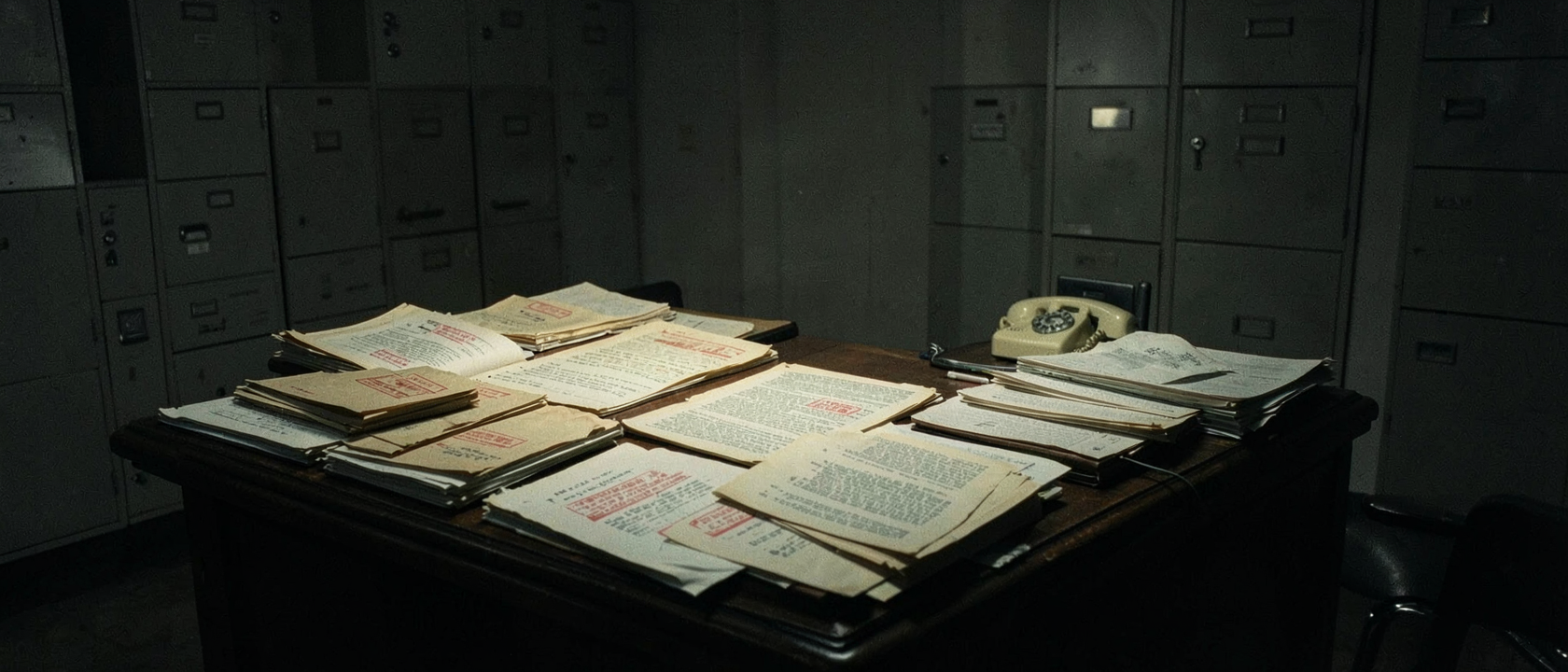
Five Minutes
The file preserves one word from him: “Farewell.” A Soviet dissenter named Chernyshov spent five minutes in front of a panel of doctors before they ordered his compulsory psychiatric treatment, according to a case history quoted in a U.S. intelligence report with an information cutoff of January 31, 1972. The panel’s own reasoning appears in the same passage: “The main thing for us is that you shouldn’t think at all.” Beyond his surname and that exchange, nothing further about him is in the record.
The Document
The report is titled “Controlled Offensive Behavior, USSR (U),” carrying short title and case number ST-CS-01-169-72 and Defense Intelligence Agency task number T72-01-14. Published in July 1972, it names its author on the cover: Captain John D. LaMothe of the Army Medical Service Corps. It was produced by the Medical Intelligence Office within the Office of The Surgeon General, Department of the Army, and approved by the Defense Intelligence Agency’s Directorate for Scientific and Technical Intelligence. It was classified Secret, then exempted from the standard declassification schedule under Executive Order 11652, placed in exemption category 3, and given a fixed automatic-declassification date of December 31, 1990, under a “controlled dissemination” marking restricting further copying until then.
Copies now sit in the CIA’s Records Search Tool database (CREST) under at least four separate document numbers. A copy in the CIA’s own online reading room runs 177 pages. The version researcher John Greenewald released through his outlet, The Black Vault, on December 19, 2023, pulled from CREST as TIFF scans and converted to PDF by a separate archival project, runs 178 pages and 8.67 megabytes. Neither release explains the one-page gap.
What It Describes
The report defines “controlled offensive behavior” as Soviet research into human vulnerability as it applies to influencing or altering behavior. The Black Vault, which published the document, describes the underlying Soviet work as spanning biophysics, psychology, physiology, and neuropsychiatry. Confirmed sections in the table of contents cover odor, sound (infrasonic, sonic, and ultrasonic noise), sensory deprivation, and electromagnetic effects, closing with an appendix of Soviet personnel and research institutes. One section recounts an April 1960 address by a Soviet scientist named Vasilev, who told colleagues that unreported telepathy experiments had run under Stalin more than two decades earlier, paired with a note that the U.S. Navy had separately denied testing telepathic communication aboard atomic submarines.
A further section addresses “mental reorientation” of political dissenters, stating that this material draws on a growing body of samizdat, Soviet underground self-published writing, including case histories of detainees compiled by Abraham Brumberg that trace the path from arrest to confession. Citing that material, the report states that the KGB, the Soviet security and intelligence service, carries out the search, arrest, and initial investigation. One case the report quotes directly involves Chernyshov, whose exchange opens this piece. The Black Vault’s own summary goes further, describing medical experts issuing diagnoses it calls false, a court confirming them, and the detainee held until judged “cured,” which it says usually means a confession of mental aberration. That description is the publication’s characterization of the report’s content, not a passage quoted from the document itself.
What the Report Says About Itself
The document states its own purpose plainly: a review and evaluation of Soviet behavioral research, meant to help develop countermeasures protecting American or allied personnel. It emphasizes the individual over the group because it says Soviet research does the same, and it explicitly declines an in-depth study of psychology and psychiatry, suggesting those subjects be taken up separately. It does not certify that any described technique worked, or that a specific diagnosis was false rather than genuine. It reads as a planning survey, not a finding that closes a case.
The Denial, Once Removed
The Black Vault’s summary also states that the Soviet government denied these allegations, saying only the dangerous or the newly ill were institutionalized, and that the international psychiatric community had voiced concern over Soviet practice. Both positions sit in that summary without being weighed against one another. Whether the 1972 report itself records the Soviet denial in those terms, rather than that being the publication’s own characterization, could not be independently confirmed for this piece.
What Doesn’t Track
A few threads stay open. The one-page difference between the CIA’s reading-room copy and The Black Vault’s release goes unexplained in both. Chernyshov’s full name, and what became of him after that five-minute hearing, are not part of the record; his case is quoted for its procedure, not its outcome. Separately, at least one outside website has circulated a different case number for what it calls the same 1972 report, DST-1810S-387-75, which does not match the ST-CS-01-169-72 designation on the official CIA and Black Vault copies. That number could not be verified against the CIA’s own materials and should be treated as unconfirmed.
A Collection Called Stargate
The report now sits in what is cataloged as the Stargate Collection, the intelligence community’s umbrella term for its long-running study of remote viewing, the claimed ability to describe a hidden or distant target through clairvoyance, precognition, or telepathy. Related program names filed in the same collection include SCANATE, GONDOLA WISH, DRAGOON ABSORB, GRILL FLAME, CENTER LANE, and SUN STREAK. That framing belongs to the archive the document has landed in, not to the report’s own stated purpose. Only the Vasilev anecdote touches paranormal research; the rest of the document is a conventional survey of drugs, sound, light, and sensory conditions.
The report is not anonymous, and it never was. Its cover names an author, a task number, an approving office, and the year it was due to lose its exemption from declassification. What stays unresolved is narrower and, in its way, harder to close: what became of Chernyshov, why one surviving copy runs a page longer than another, and which of two case numbers now attached to this title actually belongs to it. A reader who wants to check any of that can go to the same two public copies this piece drew from, the CIA’s reading room and The Black Vault’s release, and count the pages themselves.