Some files get released because a court order forces the issue. This one exists because a researcher asked for it, and the Air Force said yes.
The paperwork
The release is cataloged as FOIA case 2025-01757-F, filed under the Freedom of Information Act, the federal law requiring agencies to hand over records on request, subject to specific exemptions. The Air Force turned over 65 pages, a document sized at 7.3 megabytes, along with a separate video archive of 59.1 megabytes containing base security and mobile patrol footage. The requester was John Greenewald of The Black Vault, who published the material on July 11, 2025. None of this requires interpretation yet. It is the object itself: a page count, a file size, a name, a date. Anyone can file the same request and check it against what follows.
December 13: a shutdown ordered from the tower
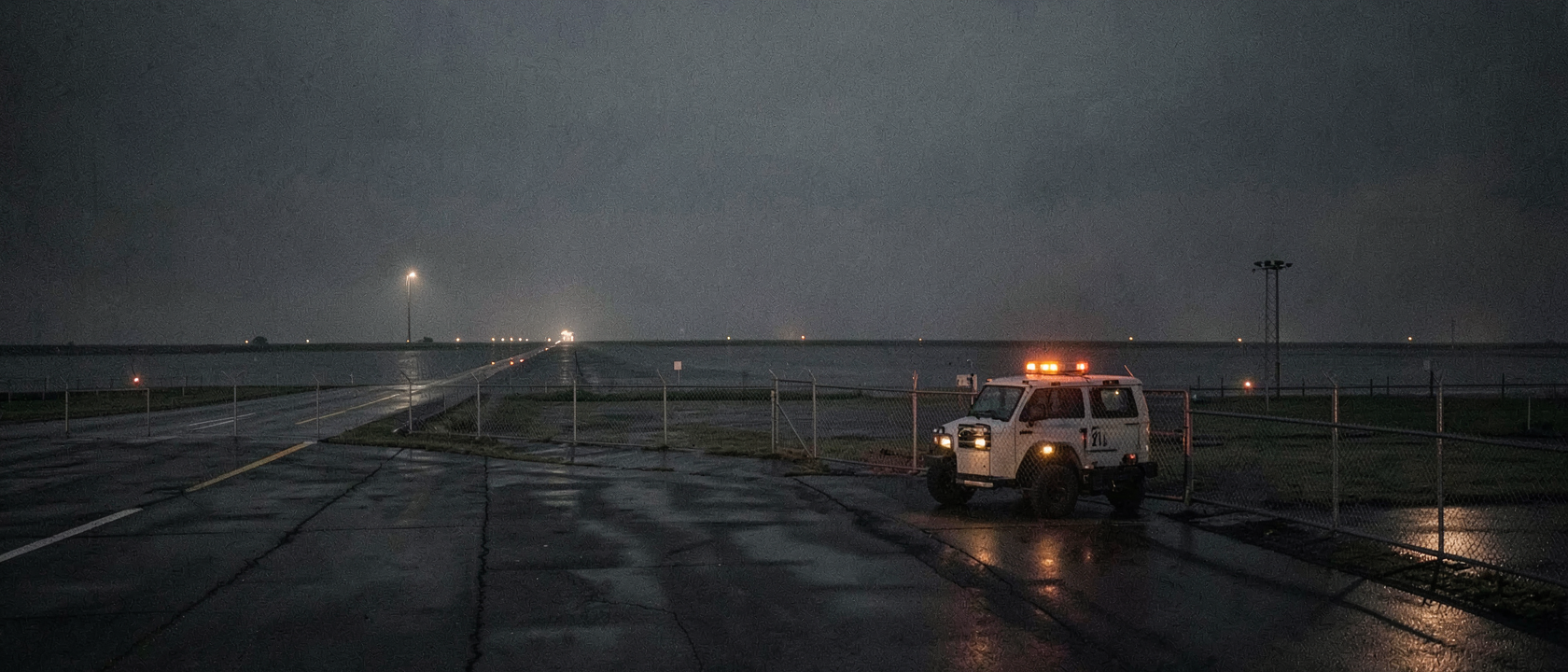
The first incident, as logged, opens at 10:08 p.m. on December 13, 2024, when patrols near the Hot Cargo Pads at Wright-Patterson Air Force Base spotted a small drone hovering and moving toward the West Ramp. Sworn statements describe it as a black, four-propeller quadcopter roughly 6 inches (15 cm) across, marked by alternating red and green lights. It was later reported over Fire Station #2 at an altitude of about 20 feet (6 meters). Other patrols logged four quadcopters flying in a tight diamond formation, and a separate report of three more small unmanned aircraft in the same pattern. At 10:30 p.m. the control tower ordered a full airspace shutdown. A sweep of Area A, Area B, and the base perimeter found no operators and no debris. The response was closed out at 10:40 p.m. Base officials later told reporters the closure ran roughly four hours, into the early hours of December 14, and CNN and The War Zone both centered their contemporaneous coverage on that same overnight window.
A second wave, dated differently by different sources
The FOIA file itself logs a second, longer episode dated December 16 into the morning of December 17. Whether that is the correct date for a distinct event, or whether it reflects some overlap with the December 13–14 closure that made it into the public record under a different label, is not something the file resolves. Worth flagging plainly: most of the contemporaneous news coverage, CNN, Fox19, The War Zone, Air Force Times, describes only the one confirmed closure, centered on the night of December 13 into December 14. The December 16 date comes from the Black Vault’s own account of what the FOIA release contains, not from independent outside confirmation. That gap between what the file says and what outside reporting says is itself part of the record, and it stays unresolved here.
As the FOIA release dates it, a civilian near Airway Road and Harshman Avenue reported multiple drones moving slowly over Area B at 9:38 p.m. on December 16. Base patrols then logged sightings independently: near the National Museum of the U.S. Air Force, three unidentified objects hovering above Gate 26A at 10:56 p.m. and two more above the Area B gym at 11:12 p.m. At 11:43 p.m. an officer reported an aircraft descending toward the Area A flightline, stopping at roughly 500 feet (150 meters) before climbing and disappearing. More objects were tracked moving from Gate 26A toward Bass Lake by 12:10 a.m. Visual contact was lost by 12:30 a.m. and the response was formally closed at 1:00 a.m. per the file, on December 17.
What was concluded, and what wasn’t
Security forces ran thermal-imaging sweeps and ground searches on both nights logged in the file. Air traffic control and the FAA confirmed that no authorized aircraft were operating in Wright-Patterson airspace during either incident. The file names no likely operator, no probable purpose, not even a favored guess. There is no line suggesting a hobbyist, a contractor’s test flight, or an unreported exercise. The response is logged and closed as a security and safety measure, not as an investigation that reached a conclusion. The ordinary explanations a case like this usually gets simply are not in the record, not because they were cut out, but because the document never offers one.
The maneuver nobody explains
One detail in the file has no companion sentence anywhere else in it. At 11:43 p.m. on the night logged as December 16, two separate patrols independently reported an object descending toward the Area A flightline, stopping around 500 feet (150 meters) short, then ascending and vanishing from view. The record confirms the observation was made twice. It does not attempt to describe what kind of aircraft does that, or why. Nor does the file say whether the drones from December 13 were the same craft returning days later, a coordinated follow-up, or something unconnected entirely. Both possibilities sit in the same file, unaddressed.
No debris, no chain of custody
Ground crews searched the areas where sightings were reported: the Hot Cargo Pads, Area A, Area B, Gate 26A, and the vicinity of Bass Lake. None of it produced a recovered component. There is no chain-of-custody log in the file, the paperwork that would normally track physical evidence from recovery through storage, because there was nothing physical to log. That is a fact about what the searches found, not a hint about what they might have missed.
The Logan Airport line
Air Force Times separately reported that Boston police arrested two men accused of flying a drone dangerously close to Logan International Airport in the same general period, after an officer using drone-detection equipment traced the aircraft to its operators. The Black Vault cited that arrest as regional context for the wider wave of drone reports that December. The Wright-Patterson documents themselves do not mention Logan, Boston, or any other installation. The connection is a reporter’s framing, attributed by name, not a line in the file.
The shape of an unresolved file
Put together, the 65 pages establish that something was tracked over multiple nights in December 2024, watched by multiple independent patrols, and taken seriously enough to shut down airspace at least once, confirmed, and according to the file’s own account, twice. They establish that thermal imaging and ground sweeps came up empty. They do not establish who was flying anything, why, whether the incidents were connected, or even, on the second date, precisely when it happened relative to what other outlets reported. That is not a case closed under a euphemism. It is a case with the paperwork finished and the questions still open, which is a more ordinary outcome than this kind of story usually gets.