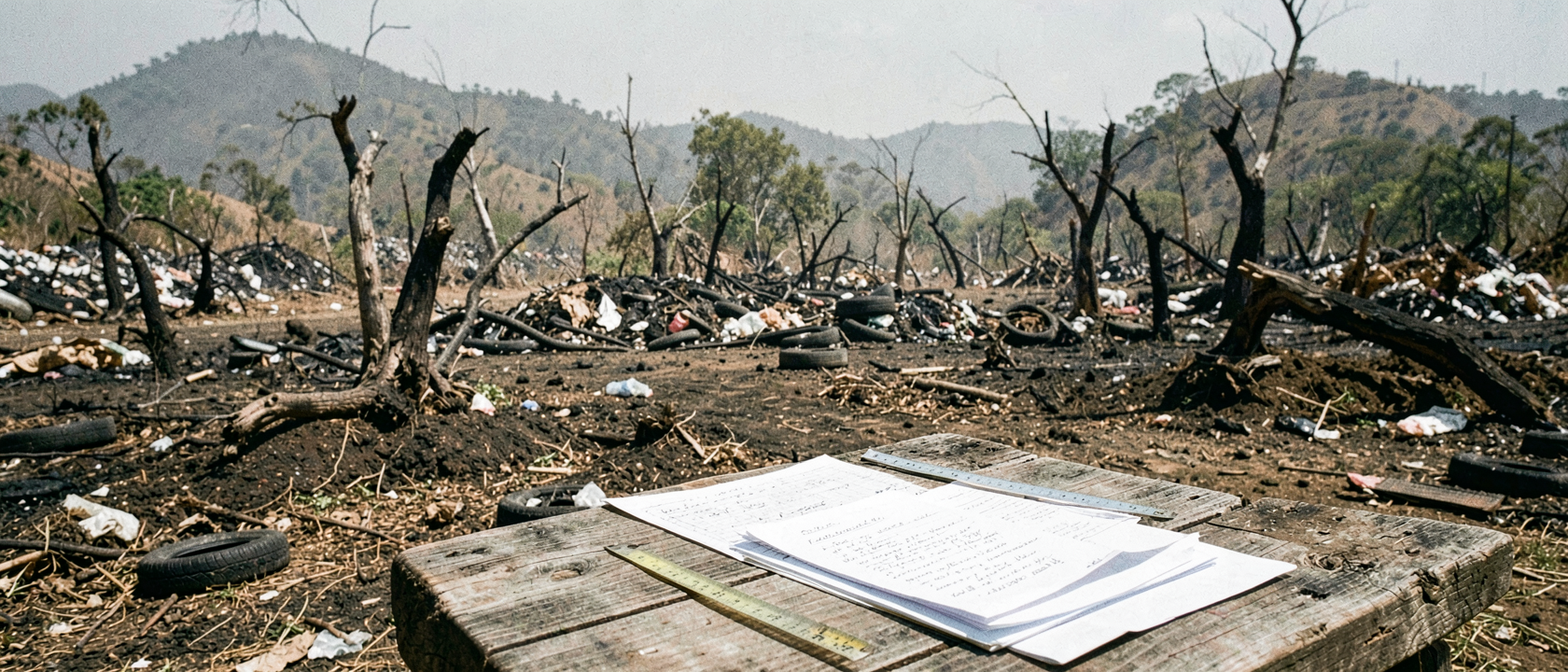
In one photograph taken before the night investigators say forty-three bodies were burned, a plastic bottle sits half-buried in trash on a hillside above Cocula, Guerrero. In a second photograph, taken after that date, the same bottle is still there, still intact, without a mark on it. A fire safety engineer laid the two images side by side and used the match as one data point among several. What he built from it sat inside an international investigation’s report for nearly seven years before he explained, on the record, what he thought it meant.
The Appendix
In September 2015, the GIEI (Grupo Interdisciplinario de Expertos Independientes, the Interdisciplinary Group of Independent Experts), a panel appointed in November 2014 by the Inter-American Commission on Human Rights, published its first report on the disappearance of 43 students from Ayotzinapa’s teachers’ college. Attached to it was a technical appendix by José Torero Cullen, then teaching fire safety engineering at the University of Queensland in Brisbane, Australia; he later became head of the Department of Civil, Environmental and Geomatic Engineering at University College London, having previously analyzed the World Trade Center collapse, the 2005 Windsor Tower fire in Madrid, and the 2017 Grenfell Tower fire in London. The GIEI had asked him one narrow question: could a fire at the Cocula municipal dump have incinerated 43 bodies, as the government’s investigation claimed. Excerpts of an interview with Torero, recorded May 18, 2021, by National Security Archive analyst Kate Doyle and Reveal News reporter Anayansi Diaz-Cortes, were not published until January 28, 2022, alongside the archive’s three-part podcast series, “After Ayotzinapa.”
What the Government Said Happened
The 43 students disappeared after local police in Iguala, Guerrero, attacked them on the night of September 26, 2014, and into the early hours of September 27, leaving six people dead and dozens injured. Mexico’s federal prosecutor’s office, the PGR (Procuraduría General de la República), released its account in January 2015, later known as the “historical truth”: the students had been killed, their bodies taken to the Cocula dump, incinerated there in a single fire, and the remains bagged and dropped into a nearby river. It was presented as the government’s central finding, based on detainee statements and forensic work. It was this specific claim, the fire at Cocula, that Torero was asked to test.
The Site Examination
Torero visited the Cocula dump on July 12, 2015, working from photographic evidence supplied by an Argentine forensic team. He mapped radiation and fire-spread patterns across the slope and found no scorch marks on the trunks of the surrounding trees. Leaves burned off in a fire grow back within about 10 months, he noted, but a fire hot enough to scar a trunk leaves a mark that does not heal. Debris at the site included partly burned tires and plastic, which he judged consistent with a series of small fires rather than one large one. Most directly, he matched bottles visible in photographs of the dump taken before the alleged incineration date with the same bottles, undamaged, in photographs taken afterward.
The Fuel Math
Separately, Torero modeled how much fuel a body needs to burn down to the point of leaving no organic material. Drawing on operating crematoria and historical open-air pyres, he calculated that incinerating one body requires roughly 1,543 pounds (700 kg) of wood, or 683 pounds (310 kg) of tires, sustained over about 12 hours. Scaled to 43 bodies, that becomes about 33 short tons (30,100 kg) of wood, or nearly 15 short tons (13,300 kg) of tires, burning for around 60 hours in a fire bed roughly 39 by 8 feet (12 by 2.5 m), with a flame at least 23 feet (7 m) high and a smoke plume rising more than 984 feet (300 m). The versions of events the PGR had obtained described a fire lasting about six hours, a fraction of what his model required. Pig-cadaver burn tests, run after the site visit to model multi-body fires, reinforced the point: burning several bodies together takes more fuel per body, not less.
The Conclusion and What It Undercut
Announcing his findings alongside the GIEI’s full report on September 6, 2015, Torero said the hypothesis that 43 bodies were burned at the Cocula dump was “impossible.” His conclusion, folded into the report, was that a fire of the scale the government described could not have occurred at that site. That put his analysis directly against the PGR’s own fire investigation, though the specific technical errors in that earlier work are not detailed in the record itself. Torero later summed up his own message more plainly: to “stop looking in the dump and start looking elsewhere.”
What the Record Does Not Say
Torero’s appendix answers one question: whether a fire at Cocula could have consumed 43 bodies. It does not say what happened to the students if they were not burned there, and it does not address how or when they died. Both questions sit outside what he was asked, and qualified, to determine. The GIEI’s report did not establish where the students’ remains might be. Nor does the available material resolve whether anyone mounted a genuine technical challenge to Torero’s data or methods, as distinct from public criticism of the man himself. That distinction, between a rebuttal and a complaint about the messenger, is not settled in what has been published.
What Was Said About It Afterward
Mexican media coverage at the time focused on how little time Torero spent at the dump: by his own account, about an hour. According to the National Security Archive’s reporting on the interview, that detail, rather than his fuel calculations or burn tests, became the basis for dismissing his conclusions. Torero told Doyle and Diaz-Cortes that critics referred to him only as “this Peruvian,” without engaging with what the report actually said. He maintained the work was strictly scientific and that he would have reported an incineration at Cocula if the physical evidence had shown one. The GIEI published five more reports after this one, the last on July 25, 2023, and the fate of the 43 students remains, in the government’s own investigative record, unresolved.