The Publication
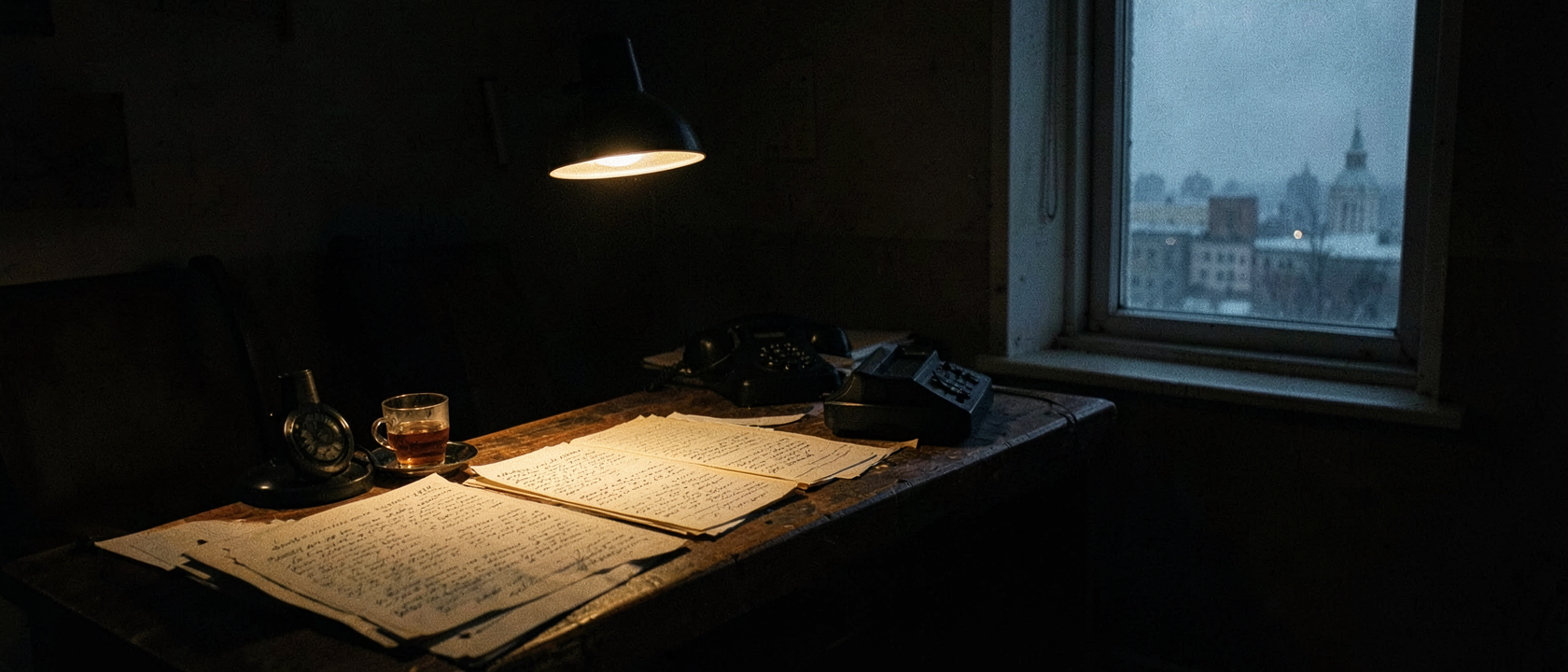
The National Security Archive at George Washington University has released English-language volumes of Anatoly Chernyaev’s private diary each May 25 since 2012, choosing that date because it is also Chernyaev’s birthday. On May 25, 2023, the series reached the 1983 volume, translated by Anna Melyakova and described by the Archive as appearing in English for the first time. It is not a declassified government record: Chernyaev donated the originals, handwritten, along with typewritten transcriptions prepared by his partner Lyudmila Pavlovna Rudakova, to the Archive in 2004. No classification history attaches to them because none existed. The diary was private from the beginning.
What Chernyaev Wrote
In 1983, Chernyaev held the position of Deputy Director of the International Department of the CPSU Central Committee. His direct superior was Boris Ponomarev, who had headed the department since 1957. Several passages have drawn particular attention.
One concerns Ponomarev directly. Chernyaev described his superior as petty and vain, possessed of a police-and-propaganda cast of mind, fearful, and constitutionally willing to abandon any principle when pressed. Separately, Chernyaev described his own position using fable language: he was, he wrote, doing everything he could to dress a king who was entirely, completely naked.
A second passage addresses Korean Air Lines Flight 007, the Boeing 747 shot down by a Soviet Su-15 interceptor on September 1, 1983, with 269 people aboard. Writing from inside the Central Committee, Chernyaev recorded his judgment that the episode had exposed, with what the translation renders as monstrous obviousness, the degree to which the military establishment had come to dominate Soviet politics and daily life. Official investigators concluded that the aircraft had strayed into Soviet airspace due to a navigational error by the crew; the Soviet military treated the deviation as an intelligence mission and responded accordingly. What the diary records is Chernyaev’s private reading of the institutional dynamic behind that response, not a finding about events on the ground.
A third passage turns outward. Chernyaev wrote that everything human civilization had built could fall victim within minutes to a nervous breakdown suffered by either superpower leader. He named no leader. The entry reads less as political analysis than as a private acknowledgment of how thin the structural margin felt from his vantage point within the apparatus.
Other entries fill in the picture of that year. Chernyaev recorded Yuri Andropov’s visit to the Ordzhonikidze Factory, at which a worker asked the General Secretary where he had been all these years, and Andropov replied that he had been in the same place as the worker. By late September 1983, Chernyaev’s colleague Karen Brutents reported back from a meeting in Crimea that Andropov needed people to hold him up. Andropov died on February 9, 1984.
The Ordinary Explanation
The Archive frames the diary as straightforward insider testimony: a senior Central Committee official writing privately about events he was positioned to observe at close range. Chernyaev’s role in 1983 placed him in exactly the institutional context the entries describe. The register of the passages is confessional rather than official, personal rather than analytical. Nothing in them reads like a document prepared for a reader other than the author.
Where this explanation runs out is not in what the passages say, but in what the published source cannot tell you about the diary as a whole.
The Selection Problem
The 1983 diary covered an entire year. The Archive notes that Chernyaev did not write consistently: the entries contain stretches of several weeks where nothing was recorded, and the source does not say why. Whether the highlighted passages are characteristic of the full text, or chosen because they are exceptional, cannot be determined from the source alone. Any published excerpt carries this structural limitation.
The source also does not state whether Melyakova’s translation renders the complete 1983 diary or an abridged portion. The distinction matters for anyone reading these passages as broadly representative of Chernyaev’s thinking that year.
What the Record Does Not Say
The passage in which Chernyaev described dressing a wholly naked king does not name the figure within the published excerpts. Ponomarev was his direct superior that year, but the published source does not make that connection explicit inside the passage itself.
The military establishment Chernyaev described as exercising overwhelming pressure over the KAL response is not further identified. Whether he named specific individuals or bodies in the full diary entry is not stated.
No individual entry in the published source carries a specific calendar date, so placing entries in sequence against the events of 1983 requires inference rather than a chronology the record provides.
Whether Chernyaev made any entry addressing the NATO exercise Able Archer 83, which ran from November 7 through November 11, 1983, and which produced genuine alarm within portions of the Soviet military and intelligence apparatus, has not been confirmed in the available Archive materials. It may appear in the full diary, or fall within one of the undated gaps. The source does not say.
The Nature of the Document
Private diaries do not generate official responses, and none is described in the source. The events Chernyaev wrote about were documented extensively in other Soviet and American records, but the published source makes no connection between those records and the diary passages. A private document written for no audience is simply not the kind of record that produces a formal institutional counterpart.
What the diary provides is a contemporaneous account of how one senior Central Committee official experienced the texture of 1983 from inside the apparatus, what he believed about what he saw, during a year he described elsewhere in the same pages as one of physical decline and what he called a “strategic fatigue from life.” The published record ends there.