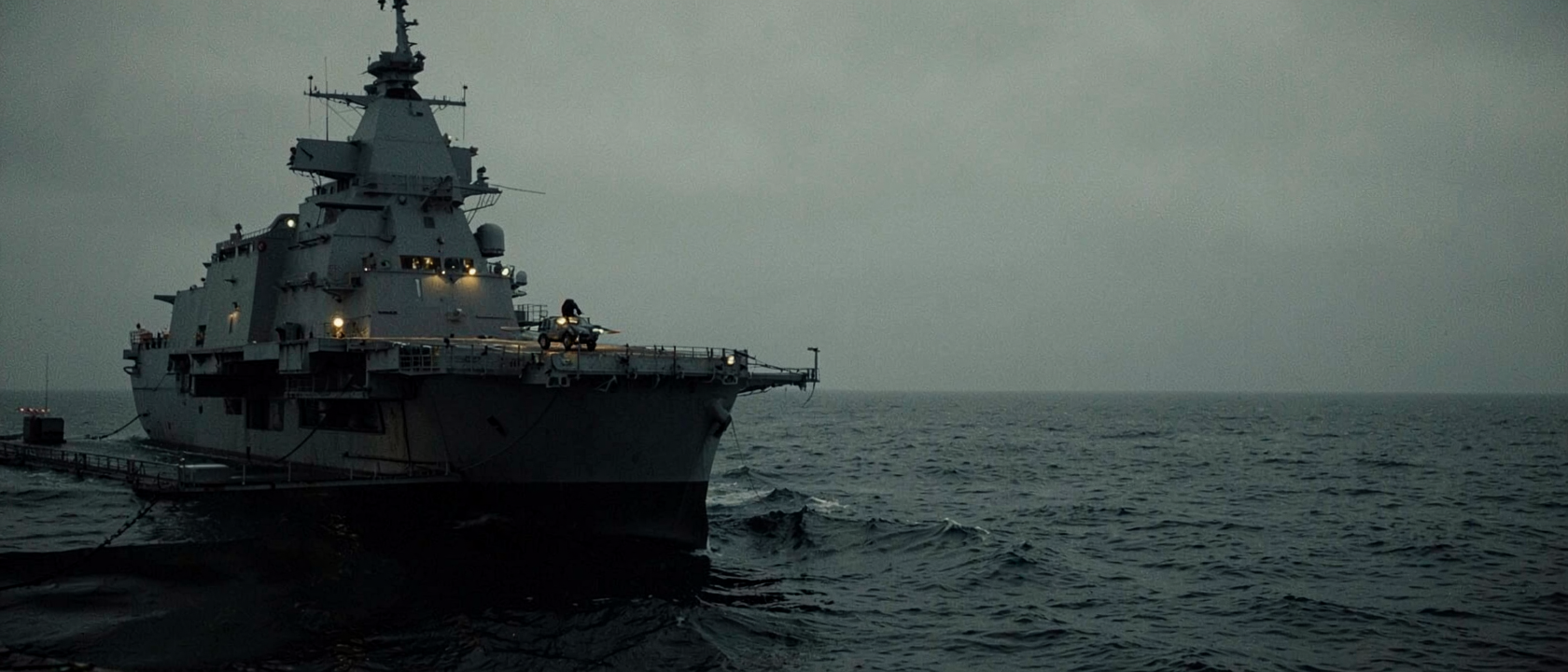
Two people asked the same Marine Corps office for records about the same ship, and they got two different answers, weeks apart, in 2022. One was told there was nothing to find. The other was handed a redacted slide deck. Both files are now public. Neither one explains why the office answered the way it did.
Two requesters, one office
In 2022, researcher Kyle Warfel filed a Freedom of Information Act (FOIA) request with a Marine Corps FOIA office. His request, case DON-USMC-2022-006943, came back with a responsive document: a printed, PowerPoint-style presentation, 16 pages long, 1.5 megabytes as a file, heavily redacted. Warfel gave permission for The Black Vault, a public archive of declassified and FOIA-released material, to publish it. The site posted the file on May 24, 2022. Separately, journalist Dave Beaty went back to that same office and obtained a copy of that same presentation.
What was reported over the Kearsarge
The document concerns sightings reported aboard USS Kearsarge (LHD-3), an 843-foot (257 m) Wasp-class ship, during a training period from October 18 to 26, 2021, in the Atlantic off the East Coast, involving a Navy amphibious squadron and a Marine integration training unit. Beaty first reported the sightings publicly on March 27, 2022, and later laid out a fuller account in a piece titled “The 2021 USS Kearsarge Sightings.” According to that reporting, personnel operating a counter-drone system on deck, described as the LMADIS, tracked two objects trailing the ship at a distance Beaty put at roughly half a mile. Kearsarge is reported to have radioed higher command to ask whether the Navy or Marine Corps had drones operating nearby and was told, “not ours.” Crew members reportedly assumed the objects were drones and treated the episode as part of pre-deployment training. All of this is what was reported at the time, by witnesses and by Beaty relaying them; none of it is confirmed or contradicted by the presentation itself.
The other request
Before that presentation surfaced, Beaty had already filed his own request on the same subject, case DON-USMC-006344, with the same office. On March 24, 2022, the office told him it had located no responsive records. He made that denial public on Twitter on April 29, 2022. Weeks after that denial, Warfel’s separate request to the same office produced the 16-page presentation, and Beaty then obtained the same document from the office that had told him nothing existed. One request, one denial, one office; a second request, one release, the same office. What connects them is the subject matter. What separates them is the outcome.
What the sixteen pages show
The presentation itself is real, formatted like an internal briefing, and consistent with what a Marine Corps FOIA office would produce for that kind of document. Beyond that, very little is visible. The redactions cover essentially all substantive content: no slide titles, no imagery, no data points are legible in the pages made public. Secondary write-ups, drawing on unnamed sources, have described maps attributed to the 22nd Marine Expeditionary Unit showing the objects approaching from the port side before one moved toward the starboard bow, and have said photographs or video stills were once part of the file. None of that can be checked against the released pages, where the corresponding panels are covered in black. The existence and format of the document are confirmed; its content, in the parts that would matter, is not.
The gap, held open
What sits behind the redactions is not described anywhere in the material that has been made public, and nothing here proposes what it might say. That is a fact about the paperwork, not a fact about the incident. It matters because this presentation is the only physical document both requesters obtained on the Kearsarge sightings, and it is unreadable in exactly the place that might explain why one FOIA search found it and the other did not. The gap does not point anywhere; it simply sits between the two requests, unresolved.
Same office, two answers
Why one requester got “no records” and another got a redacted release, from the same office, weeks apart, on the same subject, is not explained in either FOIA response. FOIA offices do sometimes process near-identical requests inconsistently for administrative reasons: different search terms, a request routed to a different reviewer, plain human error. Beaty later said that a Marine Corps official identified as Major Noonan told him by phone that the difference came down to wording. His own request, Beaty said he was told, had used the word “unauthorized” before UAP, UAV, UAS, or drones, while Warfel’s phrasing had not, and that difference changed what the search returned. That account came from a phone call relayed by Beaty afterward, not from a written correction in either case file, and it does not appear in the FOIA responses themselves. Separately, Beaty’s other pending requests for the ship’s deck logs, command operations reports, and messages referencing drones all came back with no records found, aside from the slide deck. Whether an Unidentified Aerial Phenomena Task Force (UAPTF) report on the incident exists at all remains unresolved; no FOIA response reviewed here confirms or denies it.
What Beaty said afterward
On April 29, 2022, in the same post in which he disclosed his own “no records” result, Beaty wrote on Twitter that he wondered whether a UAPTF report on the incident had gone directly to the Navy rather than the Marine Corps, and said he had been told that such a report “exists 100 percent.” He attributed that to unnamed sources and said he was waiting on a separate Navy FOIA request. That is a claim made after the fact, not a document, and nothing obtained through FOIA in this record corroborates it. It stands apart from the presentation, the case numbers, and the dates, as something Beaty says he was told, not something the paperwork shows.