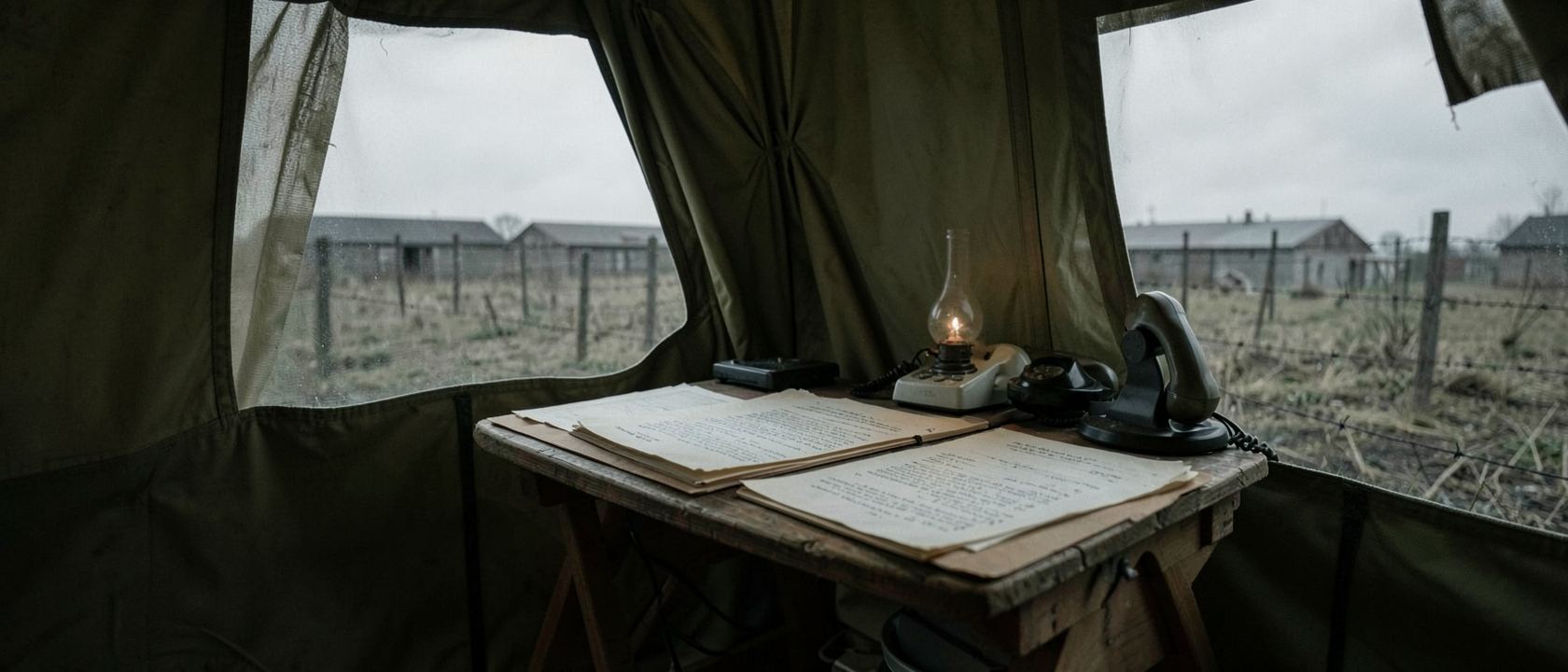
A War Diary Entry, Not a Report Written After
The document held today at the National Archives in London under the catalogue reference WO 171/4773, titled “Report on Belsen Camp,” was not written with hindsight. It is a war diary entry, filed close to the events it describes, by Lieutenant-Colonel R.I.G. Taylor of the 63rd Anti-Tank Regiment, Royal Artillery. Taylor had received written orders from B.G.S., 8 Corps, on April 13, 1945, to take command of the camp area, two days before the inspection the report goes on to describe. The writing is procedural throughout, closer to a log than a narrative, which is part of what makes it useful: it reads like a man recording what he did, roughly in the order he did it.
What Taylor Found
On April 15, 1945, Taylor, Major Barnett, and the German Camp Commandant, Oberst Harries, entered Camp 1 and were received by the SS officer running it, Josef Kramer. Taylor’s report describes around 40,000 prisoners held across six wired-off blocks, food supplies estimated to last three days, and no sanitation of any kind, not even latrine trenches. It records six or seven corpses in what had been a potato patch, apparently shot recently, and two large piles of naked bodies in the women’s camp, with open pits further on. Gunfire was heard intermittently as the officers walked through. The report also states that dying prisoners cheered them as they passed. Both details sit in the same short passage, unremarked on by Taylor beyond the fact of their happening.
Kramer’s Contradiction
Taylor’s report records what Kramer said during that meeting, not an independent account of what he had done. Kramer told Taylor that SS staff had kept their weapons only, in his words, because disarming them would leave them “overpowered by the internees,” and that SS personnel alone were running the cookhouses and camp administration. On the subject of prisoner records, Kramer gave two different answers in the same conversation: first that some 2,000 files had survived, then that all records had been destroyed on orders from Berlin. The report does not say which was true, or why the account changed. A later study by the U.S. Holocaust Memorial Museum states that the SS did succeed in destroying many of the camp’s personnel files, which supports the second claim without settling why the first one was made at all.
Arrests and Burial
Taylor’s stated conclusion, as recorded in the report, was narrow: the SS served no useful function in running the camp. On April 17 he ordered the arrest of the remaining staff, 28 men and 25 women, and put them to work carting bodies to a mass burial pit, on the same rations the internees had received before liberation. The report notes one suicide the first night, two failed suicide attempts, and two staff shot while trying to escape. Kramer was questioned several times by the Field Security Police and moved to the POW camp at Celle on April 18. This was a relief and disarmament operation, executed within days under orders already in hand. It was not a forensic inquiry into how the camp had reached that condition, and the report never claims to be one.
The Numbers Don’t Match
Kramer put the camp population at roughly 40,000, and that is the figure Taylor’s report carries forward. The National Archives’ own contextual note on the file gives a population nearer 70,000 at the time of liberation. Taylor’s report does not flag the discrepancy; it simply repeats the smaller number, supplied by the man in charge of the camp and given without any check against an independent count. Whether the gap reflects undercounting, confusion between sections of the camp, or a figure from someone with no accurate way of knowing is not something the document resolves.
The Gunfire No One Explains
The gunfire heard during the April 15 walk-through appears once in the report and is never returned to. No source is given, not guards, not prisoners, not a nearby unit. It sits in the same sentence as the cheering, mentioned and then left. There is no redaction here and no missing page; the sentence is complete as written. The record simply does not say what caused the noise, and nothing in the file suggests it was followed up.
Staff the Record Doesn’t Name
Taylor’s report lists 53 SS staff arrested on April 17, 28 men and 25 women. Kramer had told him around 25 SS personnel were administering the camp, though a nominal roll produced on request showed 50 names. Set against the 53 arrested, the numbers are close enough to raise no obvious alarm on their own. What the file does not provide is a full accounting of the original roll against who was actually taken into custody, or what happened to anyone not swept up on April 17. This is a gap in the paperwork. It is not evidence that anyone escaped or was released; the record is simply silent on the point.
A Later Claim, Kept Separate
Taylor’s report also records, as a statement rather than a confirmed finding, that a released British internee from the Channel Islands said he had seen cannibalism in the camp, and that Major Barnett had seen a corpse with several fleshy parts removed. Both details are in the file, but they are attributed as testimony, not established by any further investigation within the document itself. They belong to the same category as Kramer’s own statements: things people told Taylor, written down because he heard them, not verified because he could.
What the report settles is limited to what Taylor did between April 13 and April 18, 1945: taking command, inspecting the camp, arresting the SS staff, and passing Kramer to the Field Security Police. What it leaves open, it leaves open plainly, without comment. The gunfire, the population figure, the fate of staff beyond the 53 named, and Kramer’s contradiction over the records all sit in the same short document, unresolved, exactly as Taylor left them.