
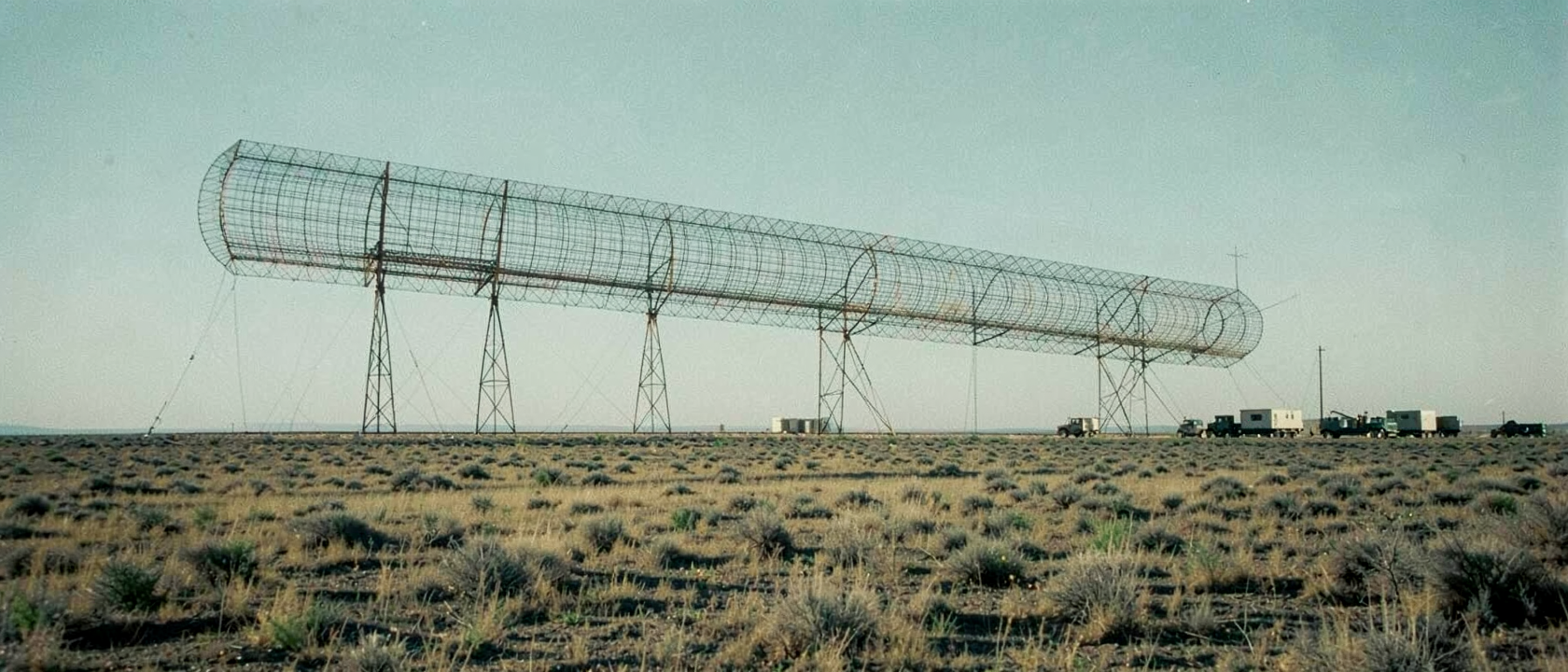
A wire antenna a thousand feet long, suspended in open air on an insulating tower, sounds like something out of a weapons test range rather than a laboratory parking lot. In 1973 it was exactly that: a machine built to recreate the electromagnetic pulse of a nuclear detonation without detonating anything.
Two Volumes, No History
The record is two technical reports prepared by Physics International Company of San Leandro, California, delivered to the Defense Nuclear Agency in August 1973. Volume I (ADA013620) runs 234 pages on system overview and design; Volume II (ADA013621) runs 221 pages of appendices and supporting data. The contractor’s internal number for the work is PIFR-372-D-VOL-1, with two authors credited, H. Aslin and R. Ryan. The work ran from September 1, 1971, to October 16, 1972, under Army contract DAAK02-72-C-0059, following a request for proposal issued in March 1971 by Harry Diamond Laboratories, through a division called Laboratory 1000, which at the time reported administratively to the U.S. Army Mobility Equipment Research and Development Center at Fort Belvoir, Virginia.
Both volumes carry the original distribution statement, “Approved For Public Release; Distribution Is Unlimited.” The record does not state when, or whether, either volume went through a formal declassification review before the pair surfaced on June 8, 2025, through The Black Vault’s declassified document archive, run by researcher John Greenewald. No review authority or FOIA case number accompanies that release. The documents appear already unclassified at the point of printing, and the file simply doesn’t say what happened to them in between.
What TEMPS Was Built To Do
At the center of the system sat a bilateral Marx generator, a staged capacitor bank that charges in parallel and fires in series to multiply voltage, feeding peaking capacitors that sharpened the output further. Together they produced a pulse exceeding 6 megavolts, rising to peak in 8 nanoseconds and decaying over 300 nanoseconds.
That pulse drove a cylindrical wire-cage antenna, 1,000 feet long (305 meters) and 30 feet (9.1 meters) in diameter, built from 36 wires. It combined a biconical high-frequency launcher with a “late time” section acting as a rod-to-plane transmission line, terminated at both ends with matched resistive loads to limit reflections. Pulser and antenna hung together from a dielectric, guyed support structure at elevations up to 66 feet (20 meters), built free-standing to minimize site preparation. At 164 feet (50 meters) from the antenna, the radiated field exceeded 50 kV/m. The stated purpose: a transportable ground system able to reproduce, on command, the electromagnetic flash of a high-altitude nuclear detonation.
Two Names for the Test Sites
Field verification took place at the Harry Diamond Laboratories site in Woodbridge, Virginia, and at a second location that the report’s own summary identifies as Camp Parks, California, though at least one independent account of the program names the initial test site differently, as Fort Bragg, in Mendocino County, California. The discrepancy sits unresolved between the two sources; nothing in the material reviewed here settles which name the original report itself uses. Either way, the report states that testing confirmed the expected pulse fidelity, rise time, and field uniformity, but gives no exact dates for either round of trials.
Appendix A, credited to Stanford Research Institute, modeled several antenna configurations against real ground conditions, weighing impedance, reflection, and field uniformity. Its finding: a constant-impedance cylindrical wire-cage antenna with matched resistive terminations outperformed the alternatives across varying heights and site conditions. Appendices B through G cover testing of individual capacitors, Marx generator switches, and wire-wound resistors under pulse stress, comparisons of solid-dielectric, gas-graded, and liquid-graded peaking capacitors, and measurements of inductance, prepulse behavior, and timing jitter.
The Verdict on the Page
The report’s own conclusion is short: the system met its design goals. No anomaly is logged, and no failure mode is left open. Nothing in either volume records a dispute between Physics International and the Defense Nuclear Agency. A machine was specified, built, and tested, and the paperwork says it worked, and nothing more.
The Ordinary Explanation
None of this needs a hidden motive. EMP simulators were a recognized class of Cold War hardware. The military needed ways to test aircraft, missiles, and electronics against nuclear flash effects without detonating an actual weapon, and TEMPS fits that program logic: a laboratory specifies a system, a contractor builds and reports on it, the report goes to the sponsoring agency, and it sits afterward in a technical library. The “Approved For Public Release” statement already printed on the 1973 cover sheets suggests the file was never tightly held to begin with; it may simply have gone unnoticed until it was cataloged decades later. Missing names and missing dates, in a mid-1970s defense-contracting report, fit ordinary paperwork habits of the period rather than any special effort to conceal the program.
What the Record Doesn’t Say
The report names the sponsor, the Defense Nuclear Agency, the originating laboratory, Harry Diamond Laboratories, the contractor, Physics International, and two individuals on the contractor’s side, Aslin and Ryan. No one on the government side is named: no DNA project officer, no technical monitor, no reviewing authority appears in either volume. Exact dates are also missing for the trials, and even the name of one test site is contested between the two sources available. The 2025 release adds a further gap, no stated review authority and no FOIA case number, despite both volumes having been marked for public release when they were written. None of that is evidence that something was withheld. It describes what the surviving paperwork does not contain.
Why This One Travels
What makes TEMPS worth sitting with is the shape of what’s known against what isn’t. The machine is fully described: the voltages, the wire count, the antenna geometry, the two test sites, the verdict, and none of it is in dispute. What’s missing is entirely human: who at the Defense Nuclear Agency signed off on the program, when the trials actually happened, what one of the test sites was really called, and why a report marked for public release in 1973 took roughly fifty-two years to reach anyone outside the file cabinet. A reader after the engineering has all of it here. The one after the people behind it finds almost nothing, and the record does not pretend otherwise.