
A.P.3257 and the Northern Corridor
A photograph of storage hangars sits partway through a British Air Ministry report on the Berlin Airlift, captioned as nothing more dramatic than a hedge against failed rail deliveries. The hangars are the least interesting thing in the file. Elsewhere, in a single clause about flight corridors, the report mentions a break in its own system and never explains it. The report as a whole was also kept from public view for three decades, for reasons the file does not state.
The Document
A.P.3257, formally “A Report on Operation Plainfare (The Berlin Airlift), 25th June 1948, 6th October 1949,” was written at Bielefeld, Germany, by Headquarters British Air Forces of Occupation (B.A.F.O.) and issued by the Air Ministry’s A.C.A.S. (Ops.) branch, the Assistant Chief of the Air Staff for Operations, in April 1950. The National Archives holds it under reference AIR 10/5067. Its cover carries two markings: “RESTRICTED,” and “CLOSED UNTIL 1981.” A bookseller’s description of a surviving copy credits the compilation to Air Marshal Thomas Melling Williams, Commander-in-Chief of B.A.F.O. at the time, who later received the United States Distinguished Service Medal for his role in the airlift. The file had already been used in military-history research assisted by Sebastian Cox, then head of the RAF Air Historical Branch, and cited in a 2008 study, well before it reached a general audience through The National Archives’ Education Service, in a video presented by Records Specialist Dr William Butler on June 15, 2023.
The Operation It Describes
The report covers Operation Plainfare, the British name for the airlift (the Americans called the same effort Operation Vittles), across the period given in its own title: June 25, 1948, to October 6, 1949. Early on, it states, aircraft flew in and out of Berlin on the same corridor, taking the shortest route available. As traffic increased, the Air Ministry’s fix was directional: every aircraft in a given corridor would fly one way only. British Zone aircraft entered Berlin by the Northern Corridor, American Zone aircraft by the Southern Corridor, and all aircraft left the city by the Central Corridor. The report states this arrangement held for the rest of the operation, with one exception addressed below.
The Growing System
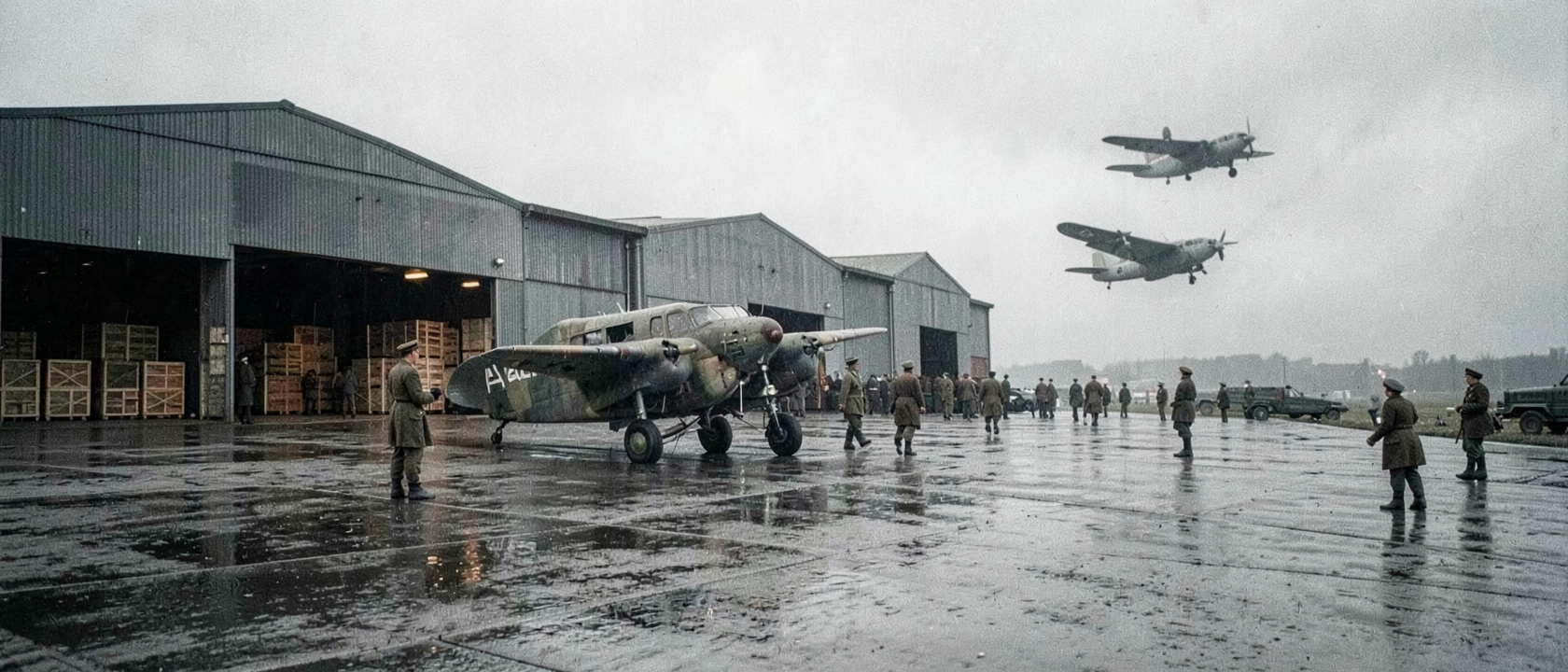
As more airfields came into use, the Ministry assigned each one its own route and altitude, producing what the report calls a three-dimensional traffic pattern, detailed in diagrams and in an appendix labeled Appendix H. One photograph reproduced in the Education Service material shows a row of large storage hangars at the airlift bases, captioned as holding emergency stocks of food and coal in case normal rail resupply into the Western zones broke down. The report presents the hangars as ordinary contingency planning, not as a response to any incident it describes.
The Report’s Own Conclusion
A.P.3257 is not an inquiry into a failure. It moves thematically through chapters on the task, the aircraft and crews, air operations, communications, equipment, personnel, and freight handling, closing with a Summary of Lessons Learnt. Its implicit finding, carried by that structure rather than stated as a verdict, is that segregated, directional corridor routing solved the safety and volume problems created by the operation’s scale. British aircraft alone flew more than 32 million miles (51.5 million kilometers) and logged over 200,000 flying hours, helping sustain a city of more than two and a half million people through a winter. No accident is cited in the material summarized here, and no operational failure is left unresolved.
The Minor Exception
The report states that the directional pattern held “for the rest of the operation” except for one “minor exception” in the Northern Corridor. It gives no date, no cause, no duration, and no indication of what aircraft or procedure was involved. It is the only departure recorded in an otherwise fully regularized system, and the file never explains why something minor enough to go undescribed was worth mentioning at all.
Appendix H, Unreproduced
The detailed altitudes and flight paths assigned to each airfield are said, in the body text, to live in Appendix H. Those diagrams are not reproduced anywhere in the material released through the Education Service presentation. What survives in public view is a reference to a reference. Nothing more can be said about Appendix H’s contents from the source at hand.
The Thirty-One Years
The cover sets two dates against each other: issued April 1950, closed until 1981. The National Archives’ own teaching material raises the length of that closure only as a discussion question for students; it supplies no answer. No document in the file states a reason, whether protecting a source, guarding a capability, avoiding embarrassment, or simple administrative scheduling. A separate B.A.F.O. report finished around the same time was restricted to limited circulation for a plainer reason, a postwar shortage of newsprint in Britain, and no copy of that second report has been located. Nothing ties that shortage to A.P.3257’s own closure; it stands only as a reminder that ordinary constraints governed paperwork from the same operation. Separately, the Education Service’s own summary describes the airlift period as running from June to September 1948, shorter than either the report’s title dates or the more commonly used end date of September 30, 1949, a discrepancy the material does not address.
Who Signed Off
Within the file itself, responsibility is institutional: “Air Ministry” and “Headquarters B.A.F.O.” A bookseller’s description of a surviving copy names Air Marshal Thomas Melling Williams as the officer under whom the report was compiled, but no document reproduced in the Education Service material names an individual who chose RESTRICTED status or set 1981 as the release year. For a report built almost entirely from named corridors, named zones, and flying hours set down in neat tables, the decision that kept it from public view for three decades has, in the surviving record, no name attached to it at all.