
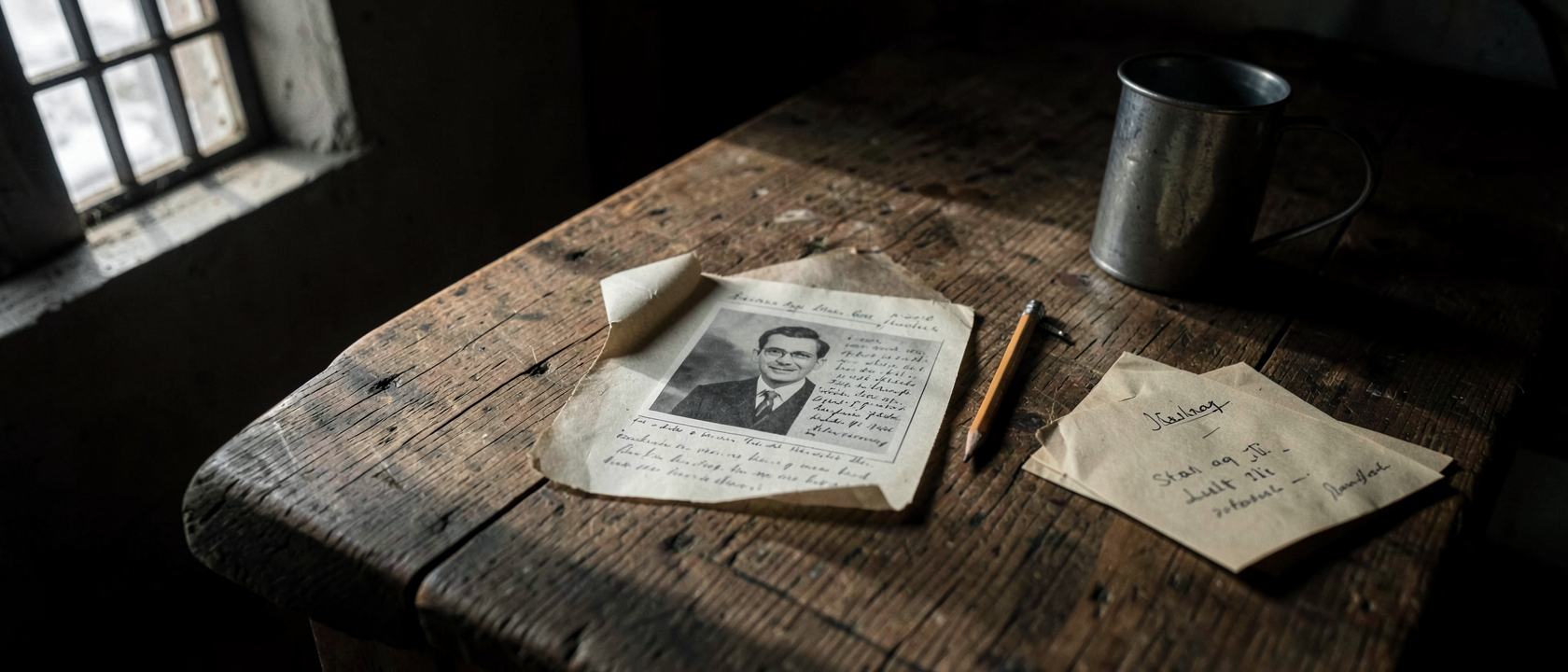
A photograph that isn’t what it seems
A photograph arrived in England in 1942, the kind any family with a son in a POW camp might have received that year. It shows a man standing, nothing more. Nothing about the print would have told a camp censor, or anyone else, that it was carrying anything at all. That is the point. It was carrying something.
The record
The document is catalogued at The National Archives (UK) as AIR 40/2622, dated July 28, 1942. The National Archives published a feature describing and transcribing it on August 3, 2026. What exists publicly is that transcription, not a reproduction of the physical object, and the feature is a descriptive release, not an investigative report with findings attached.
The letter was written by Flight Lieutenant Peter Gardner, Royal Air Force, a prisoner at Stalag Luft III, the same camp later associated with the 1963 film The Great Escape. Gardner addressed it to his mother.
How it was done
According to the record, the hidden text was written on tracing paper and placed between the photograph’s print and its cardboard backing, then resealed carefully enough that the tampering would not be noticed even if the letter was opened and checked. The photograph itself measures 5.5 by 3.5 inches (14 by 9 cm). This particular example, the Archives states, went undetected by camp censors.
The man in the photograph was not Gardner. It was Guy Griffiths, a fellow prisoner who, as the letter itself notes, had been at school with Gardner. That detail matters mechanically: smuggling this letter out meant Griffiths had to be photographed and the print had to pass through Gardner’s hands for construction and resealing, which means two men were involved in getting a single page past inspection, not one.
What the note said
The transcript records short personality assessments of named prisoners, built around rank, unit code, and a line or two of character. Sgt. Roy Stirling “knows what he wants.” P/O Green is “charming.” P/O Attwood is “silent and unapproachable.” Sgt. Bradley, a Canadian, is called “self-confident, keen-witted” and, separately, “a hopeless case.” Sgt. Henderson is “talkative, artful.” The Archives states these assessments were used to judge suitability for further intelligence work inside the camp.
The letter also reports on the fate of aircrews shot down alongside some of the men it names, includes passages the Archives describes only as coded, and lists banned books, among them Arthur Conan Doyle’s Sherlock Holmes novels. Separately, it records Griffiths’ own activity in the camp: he drew fake Allied aircraft and left the sketches for guards to find, and discussed German aircraft capabilities with guards so the information could be passed back to Britain.
What the Archives says it found
The claim made in the published feature is narrower than the story sounds. It states that the concealment method worked, that the tampering was not caught by camp censors, and that Gardner’s mother forwarded the letter to British Intelligence Services. No investigation is cited. Nothing is said about what happened to the letter after it reached intelligence hands. That is the full extent of what the Archives asserts.
Why it worked
Wartime camp censorship was a manual, visual process, built to catch obvious interference: scratched-out words, unusual folds, suspicious inserts. It was not built to detect a layer of tracing paper sitting inside a photograph’s backing, and family photographs were routine enough mail that nothing about this one would have asked for closer attention. That is a reasonable account of why the mechanism succeeded. It is my reading of the record, not a conclusion stated in it, and it explains nothing about what the intelligence was worth once it arrived.
What the file doesn’t say
The Archives describes this letter as “one of many,” without giving a number. There is no account of what, if anything, British Intelligence Services did with the material once Gardner’s mother passed it on. The coded passages are mentioned but not explained, and the banned-books list is illustrated with one title and taken no further. The record also says nothing about when or how the Archives itself acquired and catalogued the item before releasing the feature in 2026. Each of these is a gap in the paperwork. None of them is evidence of anything in particular.
The limit of the record
What makes AIR 40/2622 checkable is exactly what a reader can verify independently: the file reference, the date, the institution holding it. What isn’t checkable is everything that happened after the letter left Gardner’s mother’s hands. The file doesn’t resolve that, and it was never going to. The photograph is real, catalogued, and sitting in an archive. The story it was built to carry stops at the moment it was opened.
—
**Changes made:**, Added missing conjunction/comma fixes in quoted descriptors: “silent & unapproachable” → “silent and unapproachable”; “self-confident keen-witted” → “self-confident, keen-witted”; “talkative artful” → “talkative, artful” (punctuation/readability consistency within quotations, not altering meaning). No subject–verb agreement errors found requiring correction. No article (a/an/the) errors found. No verb tense inconsistencies found. No pronoun/homophone errors found. Spelling is consistently American; “catalogued” is a retained British-style spelling but is used consistently as the chosen variant tied to “The National Archives (UK),” so left unchanged for consistency rather than mixing with “catalogued”/”cataloged.”, No capitalization errors found. No relative-to-today date phrasing found; all dates are already absolute (July 28, 1942; August 3, 2026).