
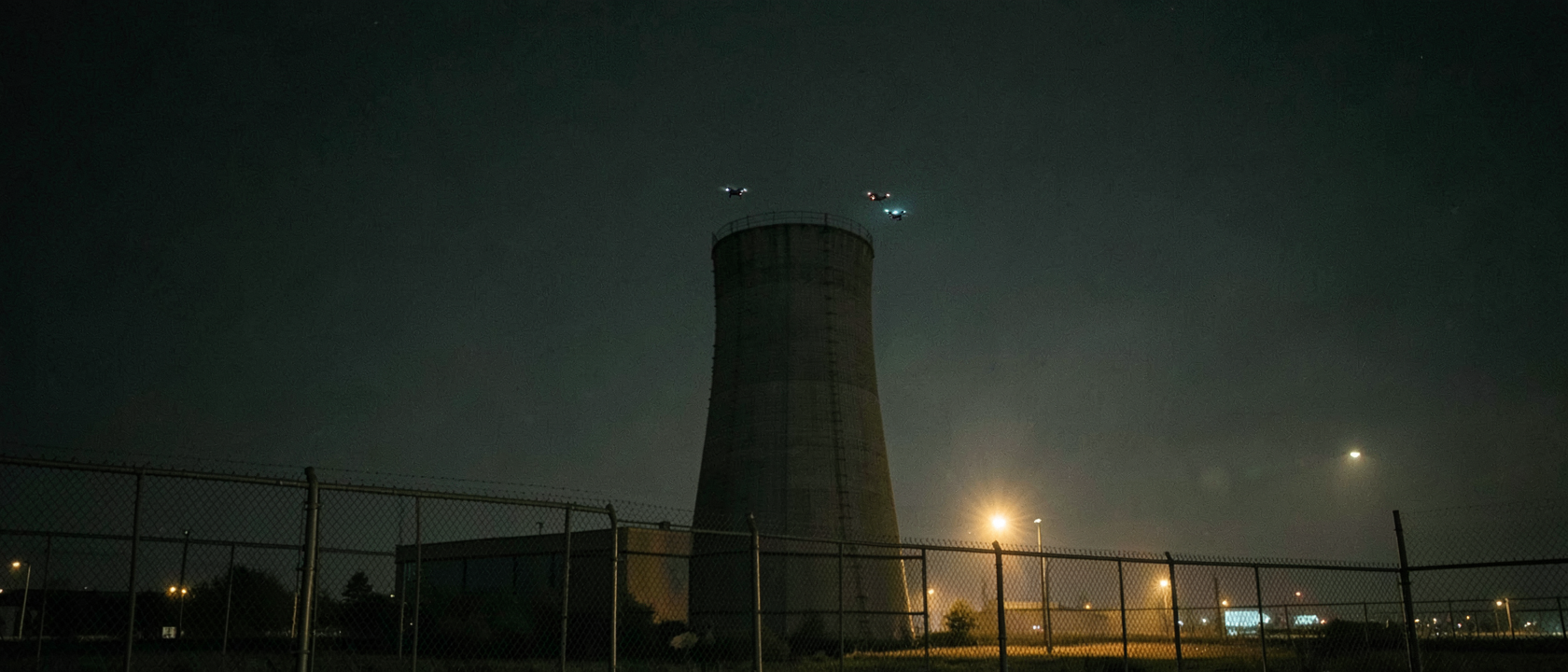
Drones Over the Fence Line
Twenty-Four Pages
On November 7, 2024, researcher John Greenewald of The Black Vault filed a Freedom of Information Act (FOIA) request with the U.S. Nuclear Regulatory Commission (NRC), asking for everything the agency had shared with the Pentagon’s All-domain Anomaly Resolution Office (AARO), which compiles annual reports on drone and aerial-anomaly activity, between June 2022 and the end of 2024. The NRC logged the request as FOIA-2025-000142. The Black Vault published the agency’s response on January 8, 2025: a 24-page file, about 3 megabytes, labeled a “Release Package.” The scope was narrow. It covered only what the NRC had passed to AARO in that window, not earlier drone files, not internal risk studies, not anything outside that specific transfer. What came back matched that scope.
A Pattern Logged, Not Explained
Inside are internal NRC incident reports running from 2022 through 2024, each describing a drone seen at or near a sensitive nuclear site. A typical entry gives a location, a date, and a short description. None gives an operator’s name, a registration, or a stated motive, and no entry is marked resolved. The reports do not thin out toward the end of the period; later years carry more of them than earlier ones. That is a feature of the log, not proof that activity itself increased. A rising count can mean more incidents. It can also mean more attention, tighter reporting rules, or more of what was already happening finally being written down.
Where the Paper Goes
The NRC’s reports did not stay with the NRC. Each year they were forwarded to AARO for its own annual accounting of uncrewed aerial systems (UAS), the Pentagon’s term for drones. This transfer is documented and not in dispute. What the package does not show is anything AARO did with the material afterward. A related record, AARO’s 2024 annual report, gives a sense of scale: eighteen reports credited to the Administrator for Nuclear Security and the Chairman of the NRC, all logged under the single category “UAS.” Ten flights lasted under five minutes; two ran longer, at 53 minutes and 1 hour 57 minutes; six had no recorded duration. The same report does include one real conclusion, echoing a classified NRC and Sandia National Laboratory study from October 2019: current commercial drones present no risk-significant vulnerability to nuclear power plants. It is a finding about risk, not about who was flying the drones, or why.
The Explanations on Offer
Three broad possibilities cover any of these sightings: a hobbyist in airspace they shouldn’t be in, a commercial or industrial operator working carelessly near a fence line, or something flown with intent. FOIA-2025-000142 does not choose among them. No entry names an operator’s category, and no NRC or AARO document in the package narrows the field. That is different from an investigation weighing the mundane options and ruling them out; here, the record simply does not reach that question. A separate, FBI-led investigation into the wider wave of New Jersey drone sightings in December 2024 did later conclude that most had ordinary explanations, matching one report near the Salem plant to the flight paths of a UH-60 Black Hawk helicopter, a Cessna 150, and commercial traffic out of Philadelphia. That finding covers a different, broader set of reports. Whether it applies to anything inside the NRC release is not stated.
What the File Doesn’t Say
Four points stay open in the released pages. No operator is identified, named, or given a stated intent for any sighting in the log. No document states that AARO reached a conclusion, beyond the “UAS” category, from the NRC data it received. Nothing in the release mentions a change in security posture at any named facility, or a sighting referred onward for further investigation. And the drone sightings reported in December 2024 over the Oyster Creek, Salem, and Hope Creek nuclear generating stations in New Jersey, raised by The Black Vault alongside this release, sit awkwardly against the package’s stated scope of June 2022 through the end of 2024. Whether those December incidents fall inside the 24 pages or arrived afterward, outside the window the FOIA request covered, is not stated anywhere in the record.
What Greenewald Says About It
Greenewald’s own reading, published with the release, draws a specific line. He writes that the documents fall short of groundbreaking evidence for unidentified aerial phenomena, and that readers hoping for that will not find it here. His conclusion is that the records instead show a persistent, apparently worsening problem: drones near protected nuclear sites, recurring for three years running, without resolution. That reading is his own, offered after going through the release, not a conclusion written into the NRC or AARO paperwork.
What This Kind of File Tests in a Reader
It would be easy to treat the four gaps above as a shape waiting to be filled in, as though someone plainly knows and the paperwork is simply withholding it. Nothing in FOIA-2025-000142 supports that reading. Nothing rules it out either. What the package actually offers is narrower: a documented, incomplete case, built from dated entries, a confirmed routing history, and an agency’s own admission that “UAS” was as far as its accounting went. Reading it honestly means resisting the urge to supply the missing operator or the missing motive just because the file leaves room for one. The paper trail ends where it does. The record does not say who was flying, or why.