
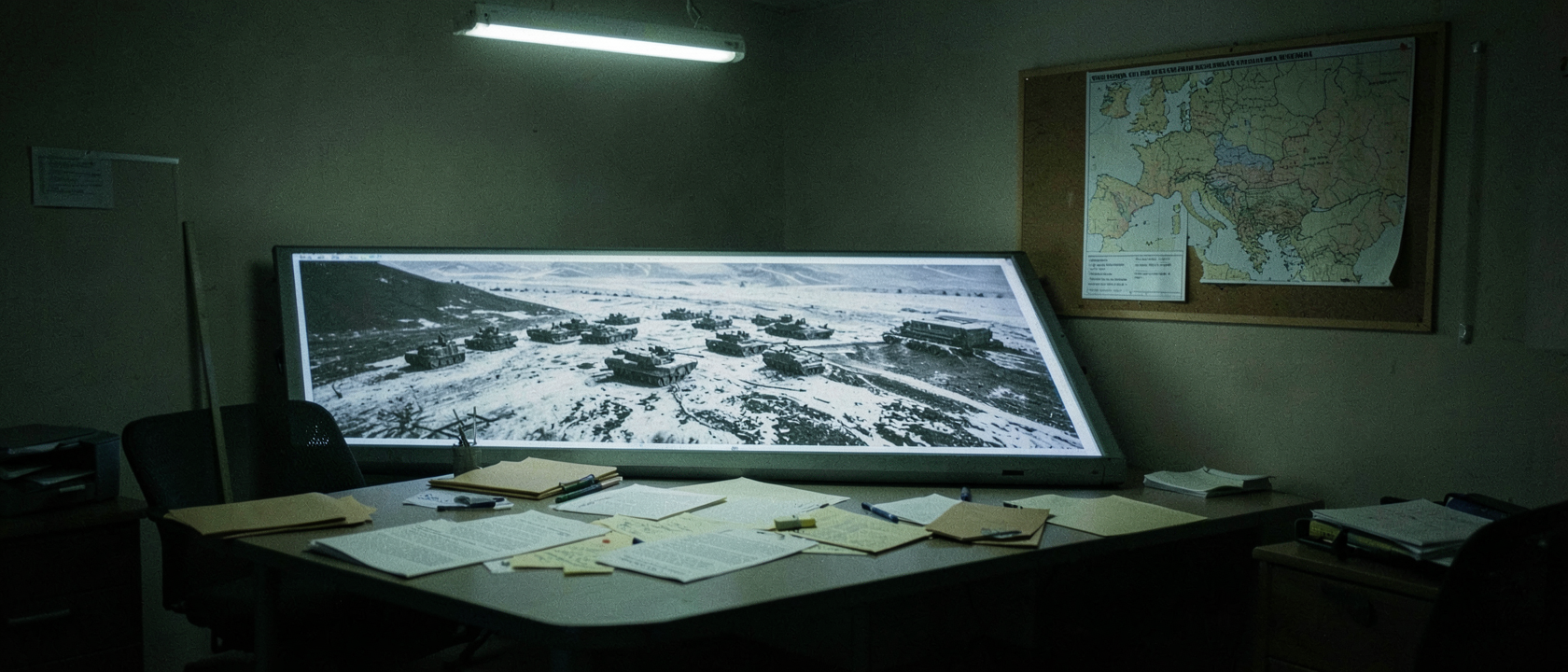
A satellite photograph is just a photograph until someone adds arrows, place names, and a number. The document at the center of this piece is exactly that kind of hybrid: pictures taken by a commercial satellite company, annotated with Russian unit types, and topped with a troop estimate that reads like a headline. What the record does not say is almost as interesting as what it does.
The Object in the Archive
The item is an OCR (optical character recognition) transcript of an annotated satellite-imagery graphic hosted by the National Security Archive, a nongovernmental research institute at George Washington University that holds the largest collection of declassified U.S. documents outside the federal government itself. The Archive lists it under media ID 29516 and gives a publication date of November 26, 2021. The imagery is credited “© 2021 DigitalGlobe,” a commercial satellite provider. No author, analyst, or agency seal appears anywhere in the transcribed text. The document itself carries a printed heading dated December 3, 2021, a week after the Archive’s listed posting date. The record does not explain the gap between those two dates.
What the Photos Show
Three dated satellite passes anchor the graphic. An image dated June 16, 2021, and a second dated November 26, 2021, are captioned as showing newly deployed first and second Battalion Tactical Groups, or BTGs, in an area near Yelnya and Boyevo, in Russia’s Western Military District. Yelnya is a town in Smolensk Oblast; the coordinates given for Boyevo are garbled in the OCR, with two different longitude readings attached to the same stated latitude of 51°29’14″N, so it is unclear whether this points to one site or two. A separate pair of images, dated November 9 and November 16, 2021, covers Novoozernoye in Crimea, at roughly 45°24’10″N, 033°08’52″E, under the Southern Military District. These are captioned as showing newly arrived tanks and artillery at what had previously been an empty deployment area. Each caption describes only what appears in its own frame.
The Numbers Attached
A separate heading, dated December 3, 2021, carries the figures the document is known for: 50,000 to 70,000 personnel “currently” present, a projection of up to 100 BTGs totaling 175,000 personnel, and a further note that up to 50 reservist regiments could add another 100,000. These are stated as ranges and projections, not a counted total. Nothing in the transcript shows how the satellite-observed units in Box 2 convert into these figures. There is no formula, no stated BTG strength used as a multiplier, and no indication of how many separate image sets fed into the estimate. The numbers sit on the page beside the pictures. They are not shown growing out of them.
The Tactic Described, Not Shown
One line in the graphic goes further than caption and count. It states that recently arrived equipment could be withdrawn from the border “to obfuscate intentions and create uncertainty,” or left behind at training ranges to allow a rapid future buildup. This reads as guidance for interpreting future imagery, a warning about how to read an apparent pullback. It is not a report of something observed. No withdrawal, no equipment left at a range, and no remobilization appears anywhere else in the transcript. The tactic is named. An instance of it is not.
No Verdict Rendered
The document contains no finding of Russian intent, no confirmed troop total, and no language of conclusion, no “it is assessed that” or “we judge.” The bracketed estimates in Box 3 are the closest it comes to a judgment, and they are framed as potential, not actual. This fits the document’s apparent function: a snapshot graphic meant to sit alongside analysis produced somewhere else, not the analysis itself. The Washington Post reported on December 3, 2021, that U.S. intelligence had assessed the Kremlin was planning a multi-front offensive that could involve up to 175,000 troops, the same figure that appears in this graphic. That reporting, like the document, attributes the estimate to unnamed U.S. officials rather than a named agency or analyst.
What the Paperwork Doesn’t Say
Several things are absent from the transcript as a matter of paperwork, not as a hint of anything hidden. There is no named author or analyst. There is no agency letterhead or classification marking, so whether this originated inside the U.S. intelligence community or as a derivative briefing is not settled by the text itself. There is no methodology section connecting observed BTGs to the 175,000 figure. And there is no page history showing which body produced the graphic before the Archive received it for hosting. Each of these is a gap in the document, logged as such. None of them is evidence of what the missing pages might have said.
The Line Between Described and Demonstrated
Return to the obfuscation line in Box 4. The document asserts that Russian forces might pull equipment back from the border while leaving it staged at training ranges nearby, ready for a fast remobilization. That is a described capability, written into the graphic as something to watch for. Within this file, it is never shown happening. No image, caption, or date records equipment being withdrawn, logged at a range, or redeployed. The record states the tactic exists. It does not demonstrate an instance of it. Where the document ends, that line stays exactly where it started: a capability on paper, with no event attached to it.