
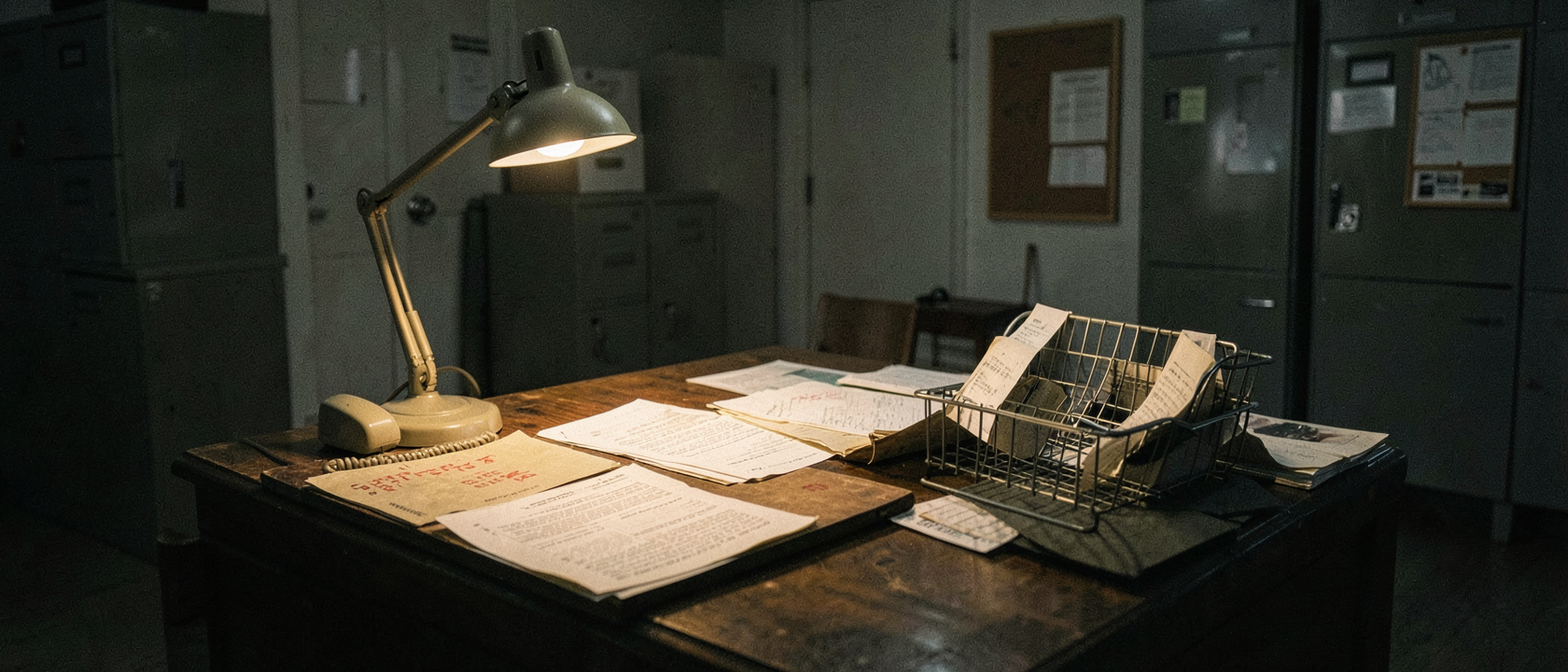
A Telegram Marked FLASH
Telegram No. 1626, internally numbered Tel. No. 622, went from the Foreign and Commonwealth Office to the British Embassy in Washington on July 21, 1969, by the American date. It carries a double classification: RESTRICTED, meaning limited circulation within government, and CYPHER/CAT A FLASH, meaning it was sent in code and marked for the highest routine precedence available to diplomatic traffic. FLASH did not mean secret in content; it meant the message had to move to the front of the queue and be handled immediately on arrival. The National Archives’ own teaching notes state that the telegram was registered in British government files two days later, on July 23, 1969; that date comes from the Archives’ summary of the document rather than from a second, independent record. The file is held today under catalogue reference FCO 55/351 at The National Archives in Kew. It is signed only “Stewart.” The file gives no further identification of who that was.
The Message Itself
The telegram instructs the embassy to deliver a message from Prime Minister Harold Wilson to President Richard Nixon, for the three Apollo 11 astronauts, Neil Armstrong, Buzz Aldrin and Michael Collins, and “all associated with” the mission. Wilson’s text offers “warmest congratulations” on what it calls “the magnificent success of the Apollo 11 mission,” and calls the flight “an inspiration to us all.” The telegram is explicit on timing: the written message was not to reach the White House until it was certain the astronauts were safely back inside what the telegram itself calls the “mother-ship,” the command module in which they had been orbiting the Moon. The document also states, as a matter of fact and without elaboration, that Wilson had already spoken to Nixon by telephone earlier that same afternoon, before the written message was sent at all. Wilson’s text even says as much: he had told Nixon “how excited everyone was in the United Kingdom,” but held back the formal message until the astronauts were confirmed safely back in the mother-ship.
Where It Went
Appended to the telegram is a short distribution list: the American Department, the Science & Technology Department, the News Department, and copies to 10 Downing Street. This tells us how the message was meant to circulate once cleared for release, not how anyone reacted to it. The American Department would have tracked the diplomatic exchange itself; the Science & Technology Department had an obvious interest in a space mission; the News Department would have managed eventual publication; Downing Street received copies because the words were the Prime Minister’s own. The list is a routing slip, not a response.
The Silence After
The file stops there. It contains no note of how the American Department, the Science & Technology Department, the News Department or Downing Street reacted on receiving their copies. There is no acknowledgment recorded from Washington, and no note of exactly when the hold on delivery was lifted once the astronauts were confirmed safe inside the command module. None of this is evidence that something was withheld. It is simply what the surviving paperwork does not include.
A Mooncake for the Moon
A separate 1969 item from the Hong Kong Government Information Services, cataloged CO 1069/468 and titled “Mooncakes for Apollo Astronauts,” has nothing to do with the Wilson-Nixon exchange. It is a photograph and caption showing bakery signboards in Hong Kong, then a British Crown colony, depicting the moon goddess Sheung Ngor handing mooncakes to the four pictured astronauts. The caption connects the landing to the Moon Festival, a three-day, three-night tradition said to commemorate an Empress’s flight to the moon roughly 3,000 years earlier. This is a commercial and cultural response from local bakeries, not a government statement, and it belongs in the record only as a contrast: two 1969 documents about the same event, produced by entirely different hands for entirely different purposes.
One Inference, Labelled as Such
The National Archives’ own teaching notes on the telegram offer one interpretive line: that the reference to the earlier phone call “suggests some personal rapport alongside the formal diplomacy” between Wilson and Nixon. The notes present this as a reading of the document, not as something the telegram proves. The telegram records that the call happened. It does not record what was said, how either man sounded, or whether the relationship behind it was warm or merely correct. The inference is reasonable and modest. It is still an inference.
What the File Doesn’t Try to Answer
The Archives flag three gaps of their own accord. The telegrams immediately before and after No. 1626 in the numbered series are not part of this collection, so the surrounding traffic is unseen. Whether the Prime Minister’s papers in PREM 13/3012, which cover message exchanges around the Apollo 11 splashdown, contain a fuller account of the Wilson-Nixon phone call is not confirmed in this material. And the telegram, concerned entirely with timing and delivery, records nothing about how excited or indifferent the British public was about the landing. These are noted as limits of the source, not as questions the file is holding back the answers to.