
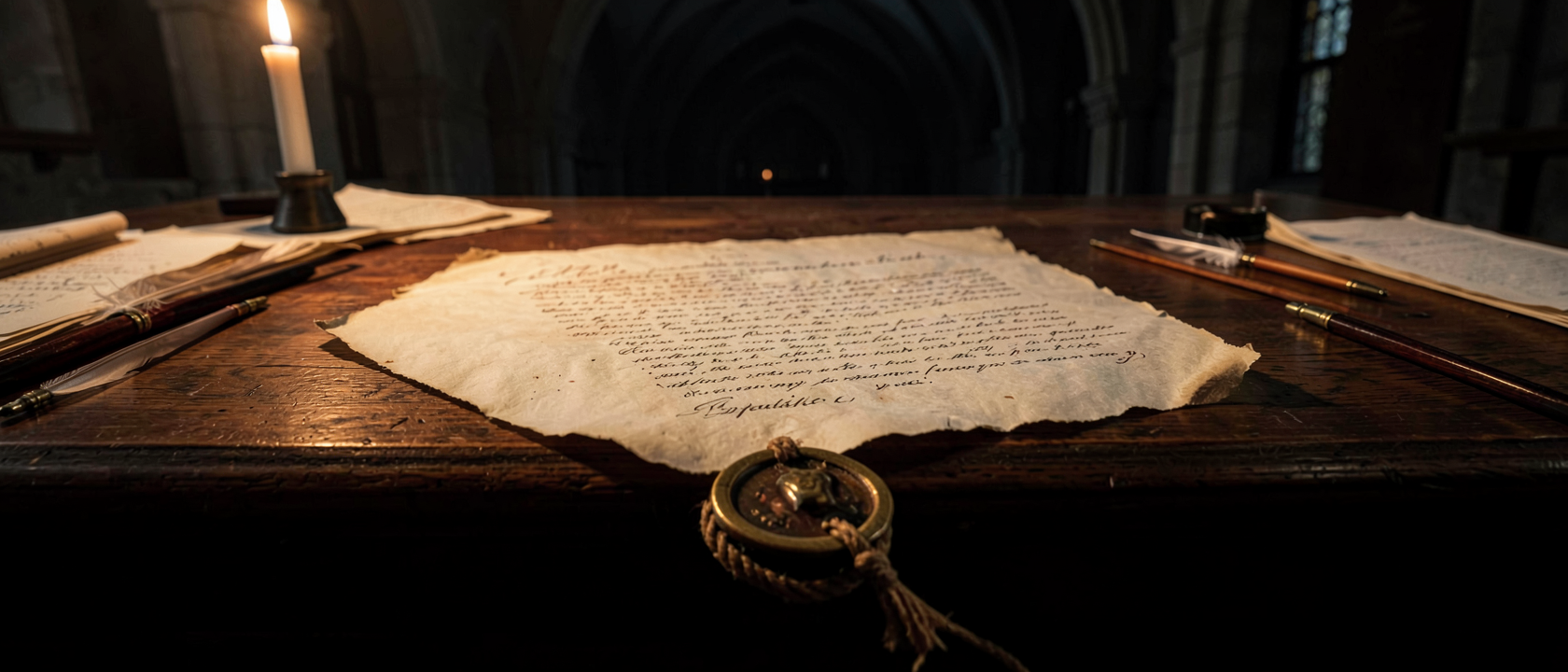
Wax that shouldn’t have lasted
A disc of resin and beeswax, pressed with a royal design, is still attached to its parchment after more than three centuries, not something archivists expect to find intact. It survives on a letter patent held at The National Archives in Kew under the catalogue reference C 106/153, filed within a broader collection of Irish Crown records dated 1584 to 1690. The patent was issued in the name of Charles II, granting land to a man named John Farrell. The record gives no month or day for the grant, only “the 1670s.”
The seal is the Great Seal of Ireland, the instrument used by the Dublin Castle administration, until 1922, to authenticate state documents in the same way the Great Seal of the Realm did in England. Rather than printed or stamped in ink, it was cast in a resin-and-beeswax mixture and fixed physically below the folded document. On most surviving Irish patents of this kind, that object is long gone. What is left, in the ordinary case, is a plain clerk’s copy entered on a patent roll: no seal, no portrait, no ornament.
What the grant actually says
Set the seal aside and the patent is unremarkable business. It states where Farrell’s land lay, the conditions attached to holding it, and the annual rent owed to the Crown. This was the daily traffic of Chancery in Dublin, which had operated since the late 12th century as an extension of the Crown’s government in Ireland, collecting taxes, granting land, and issuing paperwork of exactly this kind by the thousand. Nothing in the surviving text marks Farrell’s grant as unusual. A portrait of Charles II sits at the head of the document, standard for a royal letter patent of the period, before the text moves into the terms of the grant itself.
What makes C 106/153 stand out is not its content. It is that it survives at all as an original, sealed and decorated, rather than reduced to a copy in a bound roll.
The hearing nobody named
At some point in the early 18th century, the patent left Ireland. The National Archives’ own account states that it was sent to London as evidence in a case before the Westminster Court of Chancery, heard through the standard procedure of the day: a suit referred to the Masters in Chancery, officials who took evidence in equity cases and reported findings back to the court. Farrell’s patent was one of many documents submitted as part of that hearing.
That is the whole of what the record gives. No case name survives in the material available. No parties are named. No reference number for the suit itself has come down with the patent. The document moved from a Dublin land grant to a London courtroom, and the paperwork explaining why has not surfaced.
Into the archive
After the hearing ended, nobody came back for it. The National Archives states plainly that the patent was never reclaimed. It sat, presumably among other case exhibits, until the 1840s, when it was formally taken into the institution’s collection, where it remains among hundreds of papers concerning land in Ireland.
Between the early 18th century and the 1840s lies a stretch of roughly a century or more that the material simply does not address. Where the document was kept, who if anyone held it, and how it reached the archive are not stated. This is a gap in the paperwork, not a hidden episode. Nothing in the file describes what happened in the interval, and nothing should be inferred from that silence beyond the fact that it exists.
How the institution frames it
The National Archives does not present the document as a puzzle to be solved. Its stated reason for featuring C 106/153 is comparative: original letters patent issued directly to a recipient are rare, because in most cases only the clerical copy on the patent roll survives, stripped of seal and decoration. On that basis, the institution’s claim is about physical survival, not intrigue. It is a modest claim, and the object supports it. A wax seal that made it through more than three centuries attached to its parchment is unusual on its own terms, without anything else needing to be added to the story.
Four things nobody wrote down
Against that modest claim, four points stay open in the file itself. The name and number of the Chancery case that brought the patent to Westminster is not given. No reason is recorded for why it went unclaimed once the hearing closed. The exact year of issue within the 1670s is not specified, only the decade and the reign. And nothing further is said about John Farrell: no occupation, no residence, no family, no record of what became of the land he was granted. Each of these is an absence in the paperwork, not a suppressed fact. There is no sign this information was ever recorded and then withheld; it may simply never have been written down in the material that survives.
An aside, kept at arm’s length
Separate from the case file itself, The National Archives’ own material makes one further claim, in passing and without elaboration: that a related patent roll “plays a starring role in the development of scientific methodologies.” No document is cited to support that, no source is named for the claim, and it is not clear from the available text which roll is meant or which methodology. It is set out here as something said about the material afterward, not as a fact established by the Farrell patent or anything connected to it.
What remains is the object itself: a sealed grant to a man about whom almost nothing else is known, produced once in a courtroom whose case number was never recorded, sitting in a public archive since the 1840s, catalogued and available to anyone who asks for C 106/153.