
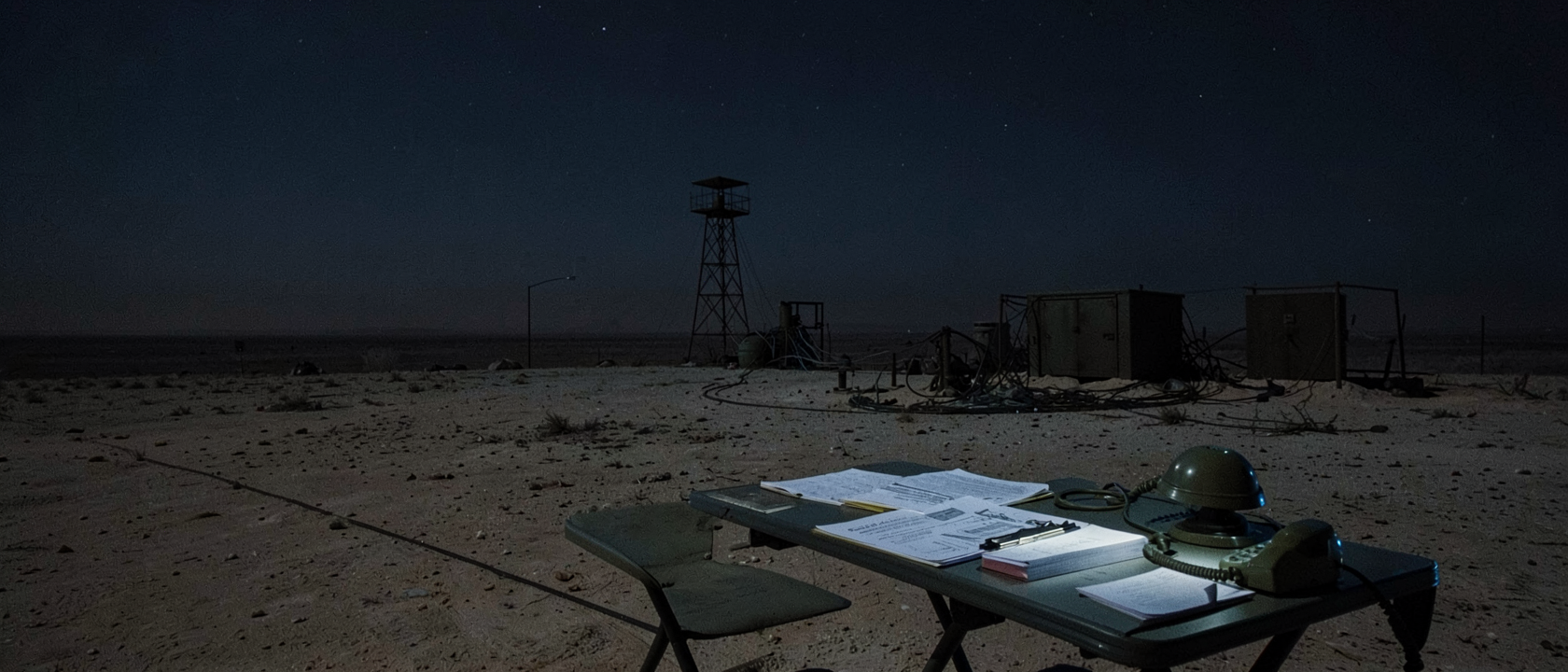
A family near a gully Los Alamos crews called Hot Canyon spent weeks after a 1945 nuclear test being checked by military doctors, without being told what for. Two hundred and sixty miles (418 km) away, in Trinidad, Colorado, an instrument recorded gamma radiation from the same event. Both facts sit in the same set of Manhattan Project documents, released by the National Security Archive in 2024, with an expanded edition in 2025.
The paper trail
The record includes a Los Alamos Laboratory report, written about six weeks after the July 16, 1945, Trinity test, describing “a swath of fairly high radioactivity” on the ground; an earlier memo from J. O. Hirschfelder and John Magee warning of fallout risk; Arthur Breslow’s monitoring notes from the day of the blast; a letter Dr. Stafford Warren sent General Leslie Groves days later; and a draft press release prepared in case of public inquiry, attributing any hazard to an exploded ammunition magazine, “gas shells.”
The warning and the threshold
Weeks before the test, Hirschfelder and Magee told project leadership that fallout could be heavy enough to force evacuation of nearby towns. On July 10, 1945, J. Robert Oppenheimer signed off on a trigger point: evacuation if residents absorbed 60 to 100 roentgen, a unit measuring radiation exposure, about fifty times the daily limit of 0.1 roentgen set for project workers. An Army detachment stood ready with tents, food, and vehicles, a decision on paper, made before anyone knew what the test would actually produce.
July 16 and the readings that followed
When the device detonated at 5:29 a.m. on July 16, 1945, Breslow logged a radiation count “rising rapidly” and noted the danger of an immediate evacuation. None was ordered, and the detachment was disbanded. Within days, Warren wrote to Groves describing a hazard band almost 30 miles wide (48 km) extending nearly 90 miles (145 km) northeast of the site. Six weeks on, a report from Victor Weisskopf and colleagues confirmed gamma radiation reaching Santa Fe, Las Vegas, New Mexico, Raton, and Trinidad, Colorado, 260 miles (418 km) from ground zero. Cattle grazing on Chupadera Mesa, 28 miles (45 km) northeast, developed beta burns. The Ratliff family, living close to Hot Canyon, was examined by Los Alamos medical staff and found healthy at the time.
Why no evacuation: the explanation on file
The project’s own position, as recorded, was that the July 16 readings did not reach the level requiring evacuation. Groves had agreed to the monitoring and evacuation plan mainly to limit legal exposure; secrecy remained, in his own stated priority, paramount, and no protective action was to be taken unless people were already seriously injured. That explanation is specific, and it is on paper. What the record does not show is the actual count measured against the 60-to-100-roentgen threshold at the moment the decision was made. The number that triggered the plan exists; the number read against it, in this set of documents, does not.
The 1948–49 UCLA survey
Three years after the test, the Atomic Energy Commission funded the UCLA Atomic Energy Project to survey the contaminated ground. Its 1948 field survey, published in 1949, concluded there was no “significant immediate hazard” to people or animals outside the crater area and Chupadera Mesa, though the study did not rule out effects that might appear only years later. This is the first formal scientific finding in the record, separate from the wartime operational calls made in 1945.
The 1951 report that reached no conclusion
A second UCLA report, issued in early 1951, went further. It detected plutonium, an alpha-emitting radioactive element, in soil, plants, and airborne material as far as 85 miles (137 km) from the site, then stopped. The report states it could not determine the “biological significance” of what it had found. That sentence is the record’s own dead end, not a conclusion anyone drew later.
What the file never says
The documents never return to the Ratliff family after the initial health check. They say nothing about monitoring or follow-up for others known to have been in the fallout path, including girls at a camp mentioned only in passing elsewhere in the record. The 1951 plutonium findings are not revisited in any later document included here. Even the test’s basic yield stays unsettled: the Department of Energy’s official figure is 21 kilotons, while a 2021 technical reassessment put it at 24.8 kilotons, a smaller, separate uncertainty beside the larger ones. The National Security Archive notes its compilation would have included further internal environmental studies had Department of Energy access policy not changed, a limit on the paperwork rather than evidence of what the missing studies contained.
A later scientific finding, and what people have said since
One finding came later but belongs with the evidence, not with the arguments made about it. The National Cancer Institute, working decades after Trinity, determined that fallout from the test contributed to an excess number of thyroid cancers in the surrounding region. That is a scientific conclusion reached through its own research, not an opinion offered after the fact.
The commentary that followed is a separate category. Historian Janet Farrell Brodie has written about the UCLA Alamogordo studies, bringing reports that sat largely unread for decades to wider attention. New Mexico downwinder advocates argue that 33 counties, including tribal areas, saw exposure levels higher than some counties already covered by the Radiation Exposure and Compensation Act, the federal law compensating people exposed to fallout and uranium-mining contamination in a specific list of counties that so far excludes New Mexico. Brodie’s work and the advocates’ argument are both things said about Trinity after the fact, not findings written into the wartime or postwar record itself, and it is worth keeping that distinction, because the file does not make it for you.