
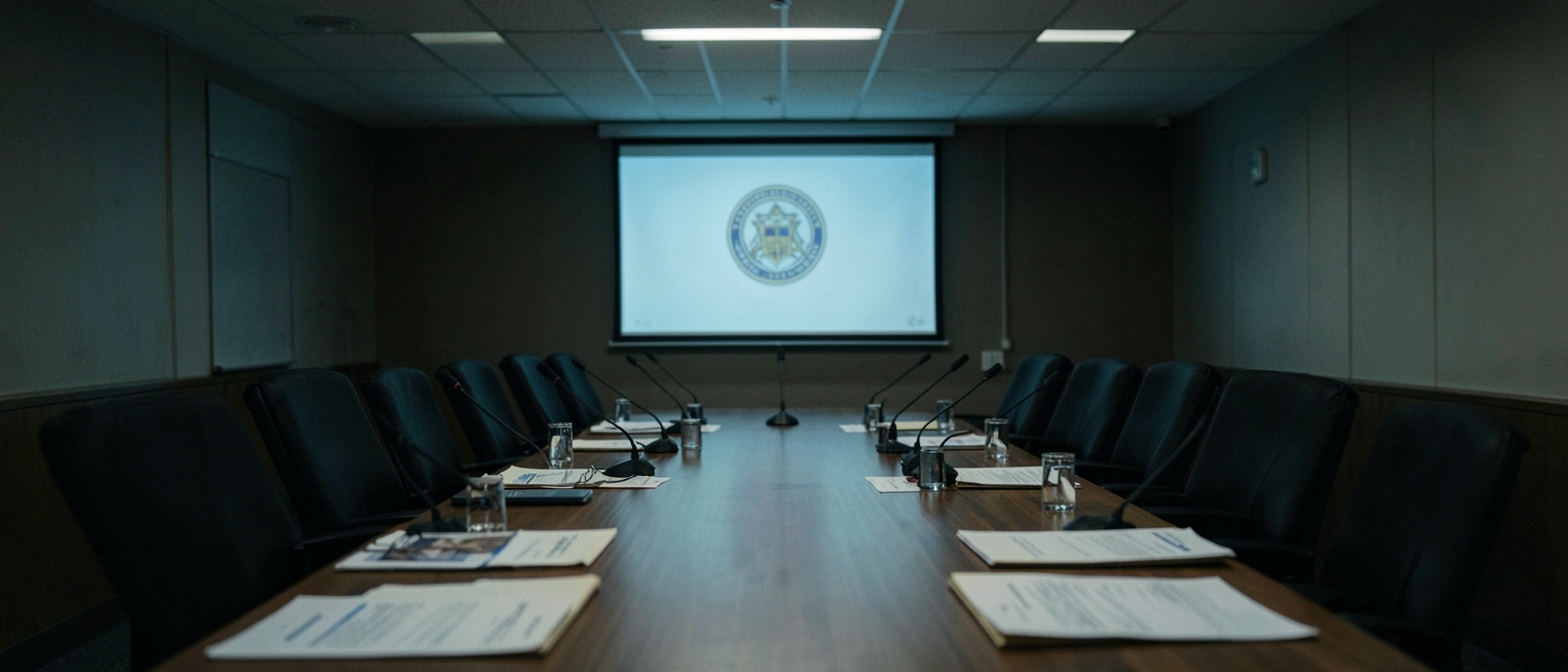
A Pentagon roundtable does not usually leave a public trace. This one did, because no camera was in the room: reporters were briefed off-camera on October 31, 2023, and the record of what was said exists only because researcher John Greenewald obtained a transcript and posted it on The Black Vault the following day. There is no video, no audio, just the written account of an hour in which AARO’s director answered questions he had not previously answered in public.
The Occasion
The stated reason for the briefing was procedural. AARO director Dr. Sean Kirkpatrick took the questions, with Susan Gough of Defense Press Operations moderating the session, to announce Phase 2 of the office’s secure reporting mechanism, authorized under Section 1673 of the fiscal year 2023 National Defense Authorization Act. The law had already required the Pentagon to issue public guidance on how to reach the mechanism by June 2023, a deadline met initially with a simple email address for people who had already briefed Congress. What launched on October 31 was a website, aaro.mil, open to current and former government employees, service members, and contractors who say they have direct knowledge of alleged UAP programs reaching back to 1945. Submissions are meant to feed AARO’s Historical Record Report, due to Congress in June 2024. The form itself, Kirkpatrick said, is an initial point of contact only, not a channel for classified material, though he added that AARO is legally able to receive classified information at any level once a case warrants it.
Two Questions the Portal Didn’t Answer
Reporters used the announcement to raise two matters that had nothing to do with the new website. One was David Grusch’s public claim that he had tried to reach AARO and gotten no response. The other was the 2004 F-18 Super Hornet sensor video, the footage tied to pilot David Fravor’s congressional testimony in July 2023. Neither question was new. What was new was that Kirkpatrick addressed both, by name, on the record, in this transcript.
Kirkpatrick on Grusch
Kirkpatrick told the room that AARO has interviewed more than thirty people over the course of its work. On Grusch specifically, he said AARO extended four or five invitations over roughly eight months, and that each was declined. He said he has had no UAP-related conversation with Grusch since the two spoke briefly, on an unrelated matter, while Kirkpatrick was serving in Space Command’s intelligence directorate about five years earlier. This is Kirkpatrick’s account, given under his own name at this briefing. It is not an independently verified sequence of events, and the transcript does not contain Grusch’s side.
The 2004 Video: What Didn’t Survive
On the Super Hornet footage, Kirkpatrick said no sensor data survives beyond the single released clip, and that reaching a conclusion from that clip alone is unlikely. He explained the mechanism: before 2023, flight sensor data was routinely overwritten within about 24 hours unless someone had a specific reason to flag it for retention, and no such order was issued in 2004. That is a concrete, checkable claim about a records policy, not a statement about what the sensor saw.
The Fix, and Its Limit
The gap has since been closed procedurally. A Joint Staff general administrative message, a GENADMIN, issued in May 2023 now directs all services to retain sensor data from reported incidents and forward it to AARO. That addresses future cases. It says nothing about how much sensor data the 2004 incident actually generated, or whether a retention request was ever made and refused at the time. Kirkpatrick’s explanation accounts for why nothing is available now. It does not account for what, if anything, there once was to lose.
What the Transcript Leaves Open
Three things are unresolved, each for a different reason. Asked whether any of the thirty-plus people AARO interviewed overlap with individuals Grusch has referenced, Kirkpatrick said, “we don’t know that,” which is not a denial. Whether additional 2004 sensor data ever existed cannot be checked, by his own account of the retention policy. And a planned Phase 3, meant to open the reporting mechanism to the general public, is mentioned only as something AARO is exploring, with no design or date attached.
A Claim That Doesn’t Match
Grusch later told NewsNation that he had reached out to AARO and received no follow-up, and that he had briefed Kirkpatrick before Kirkpatrick became director. Both statements sit directly against Kirkpatrick’s version in this transcript: the four or five declined invitations, the single unrelated conversation years earlier. No document in the public record adjudicates between them. They are two accounts that cannot both be entirely correct, and nothing here says which one is wrong.
Where the Record Stands
Kirkpatrick announced his retirement from AARO in early December 2023, with the announcement following shortly after this briefing, and a deputy director, Timothy Phillips, was named on November 8, 2023. The Historical Record Report’s first volume, covering 1945 through October 31, 2023, was published in March 2024, ahead of its statutory deadline. It does not resolve the 2004 video. The transcript that prompted this piece remains what it was on November 1, 2023: a record of a process update, two pointed exchanges, and a named gap in the paperwork that nobody in the room claimed to be able to fill.