
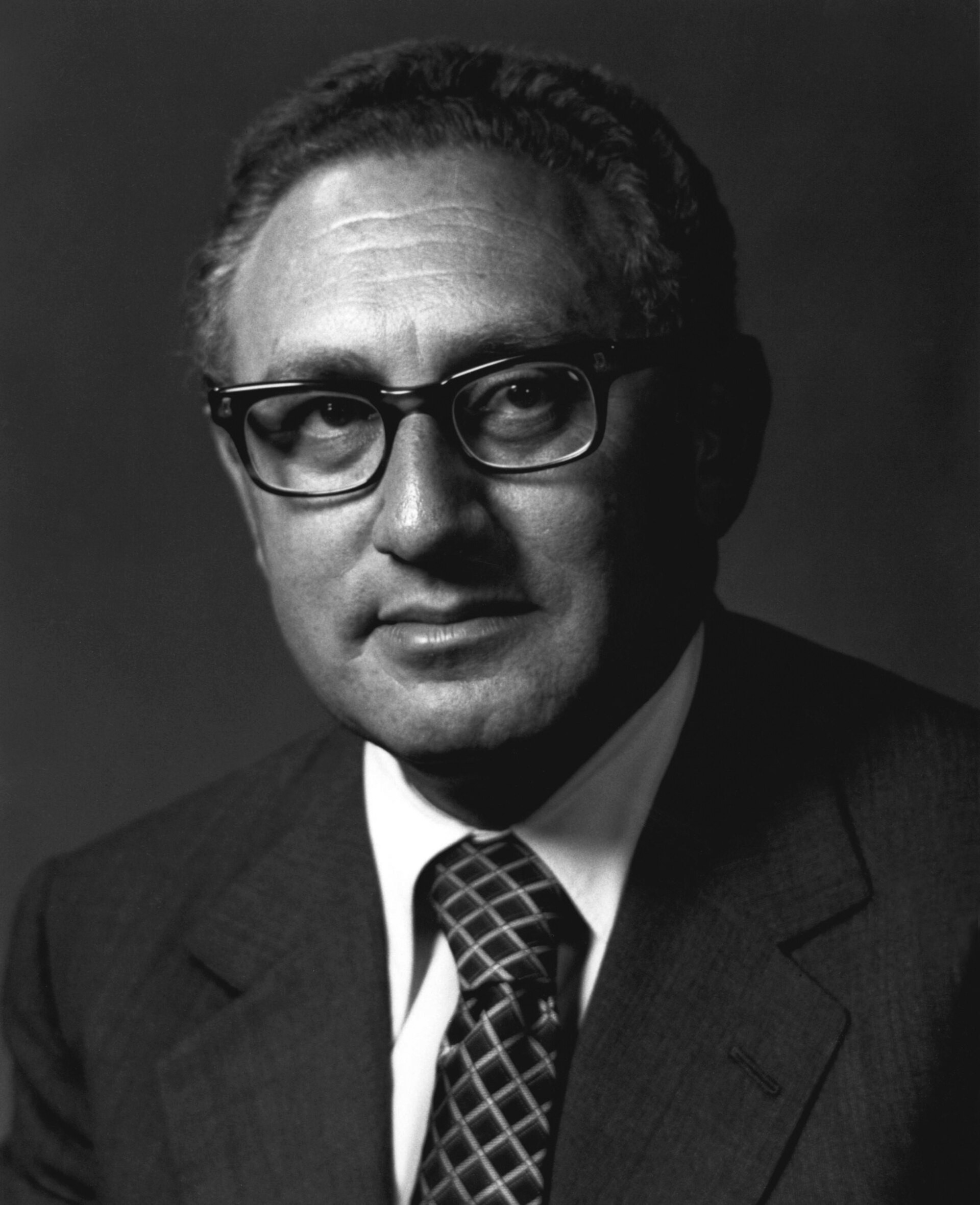
Henry Kissinger was an American diplomat, political scientist, and writer who served simultaneously as the 7th National Security Advisor and the 56th Secretary of State, making him the first person to hold both offices at once and the first Secretary of State born on foreign soil. Army during World War II, and went on to shape American foreign policy for decades through his roles at Harvard, the Nixon administration, and his own consulting firm. His career produced some of the most consequential diplomatic maneuvers of the twentieth century, among them the secret opening of relations with the People’s Republic of China in 1971, but it also drew lasting criticism over covert actions in Chile and Southeast Asia. He died on November 29, 2023, in Kent, Connecticut, at the age of 100.
Key facts
- Born: 27 May 1923
- Birthplace: Fürth
- Died: 29 November 2023
- Place of death: Kent
- Country: German Reich; United States
- Occupation: politician; political scientist; diplomat; writer
- Field: international relations; political science; politics; foreign policy
- Employer: Harvard University; Georgetown University; Kissinger Associates; Rockefeller Brothers Fund
- Education: George Washington Educational Campus; City College of New York; Harvard University; Harvard University
- Awards: Bronze Star Medal; Guggenheim Fellowship; Nobel Peace Prize; Knight Grand Cross of the Order of Merit of the Italian Republic
Early Life and Education
Kissinger was born Heinz Alfred Kissinger on May 27, 1923, in Fürth, Bavaria. His father Louis was a schoolteacher and his mother Paula, née Stern, was a homemaker.
After emigrating to the United States, Kissinger attended George Washington Educational Campus and the City College of New York before enrolling at Harvard University, where he completed his undergraduate and graduate studies. His undergraduate thesis ran to 383 pages and prompted the Government Department to impose a page limit on future undergraduate dissertations. The limit has since been known informally as the Kissinger Rule.
Military Service
During World War II, Kissinger served in the 84th Infantry Division and the 970th Counter Intelligence Corps Detachment. He participated in the Battle of the Bulge and was awarded the Bronze Star Medal for his service.
Academic Career
From 1954 until 1971, Kissinger was a member of the Harvard University faculty in both the Department of Government and at the Center for International Affairs. He served as Associate Director of the Center from 1957 to 1960. Alongside his faculty position, he founded and directed the Harvard International Seminar from 1952 to 1969, a summer program that brought together young leaders from around the world.
His 1957 book Nuclear Weapons and Foreign Policy, published for the Council on Foreign Relations by Harper and Brothers, argued against the doctrine of massive nuclear retaliation. The book became a bestseller and brought him national prominence, establishing him as a serious voice in strategic studies well before he entered government.
National Security Advisor and Secretary of State
Kissinger served as the 7th National Security Advisor from January 20, 1969, to November 3, 1975. On September 22, 1973, he was simultaneously confirmed as the 56th Secretary of State, a position he held until January 20, 1977. No one had previously held both offices at the same time, and as Secretary of State he was the first person in that role to have been born outside the United States.
Among the most significant diplomatic events of his tenure was the secret trip to Beijing in July 1971. Flying from Pakistan, Kissinger met with Premier Zhou Enlai and arranged for President Nixon’s visit to China, which took place in February 1972. The Beijing channel opened a new phase in Cold War geopolitics and altered the strategic relationship between the United States and the People’s Republic of China.
On October 16, 1973, the Nobel Committee announced the Nobel Peace Prize jointly to Kissinger and North Vietnamese negotiator Le Duc Tho for negotiating the Vietnam ceasefire. Tho declined the prize; Kissinger accepted. The award was widely contested, given the ongoing conflict at the time of the announcement.
Controversies and Legal Record
Critics accused Kissinger of war crimes in connection with the covert support for the 1973 military coup in Chile against democratically elected President Salvador Allende. Those accusations were debated throughout his lifetime and were never resolved by any court.
In 1969, Kissinger instructed the FBI to wiretap his own National Security Council deputy Morton Halperin without a court order. When Halperin learned of the surveillance in 1973 during the Watergate investigations, he filed a lawsuit against Kissinger. The case drew attention to the pattern of illegal wiretapping Kissinger had authorized beginning in 1969, which also targeted journalists and other aides.
Later Career and Writing
After leaving government in January 1977, Kissinger remained active as an author and consultant. In 1980, he won the National Book Award in the history category for the first volume of his memoirs, The White House Years. His writing and advisory work continued through Kissinger Associates and extended well into the twenty-first century.
Death and Burial
Kissinger died on November 29, 2023, at his home in Kent, Connecticut, at the age of 100. He was interred at Arlington National Cemetery. In his will, he had requested that a monument be erected at his burial plot, directing his executors to pay all amounts necessary for that purpose. Arlington National Cemetery rules prohibited private monuments, and only a standard grave marker was permitted.
Did you know
- As a Jewish child in Fürth, Kissinger was forbidden from attending public soccer matches, yet he played for the youth team of SpVgg Fürth, one of Germany’s top clubs at the time. Years later, as a senior U.S. official, the German Embassy would relay his hometown team’s match scores to him every Monday. (kids.kiddle.co)
- Kissinger’s undergraduate thesis at Harvard ran to 383 pages, a length the Government Department deemed extraordinarily long, prompting it to introduce a page cap for all future undergraduate dissertations. The cap has since been known informally as the Kissinger Rule. (bostonglobe.com)
- During his secret July 1971 trip to Beijing, Kissinger faked a stomach illness at an official visit in Pakistan to slip away undetected. A decoy motorcade with wailing sirens was set up to maintain the cover story while he flew to China. (factsanddetails.com)
- Kissinger’s will requested that a monument be erected at his burial plot in Arlington National Cemetery, with his executors directed to pay all amounts necessary. Cemetery regulations prohibited private monuments, and the request could not be honored; only a standard grave marker was placed at the site. (yahoo.com)
- In 1969, Kissinger instructed the FBI to wiretap his own National Security Council deputy Morton Halperin without a court order. Halperin discovered the surveillance in 1973 during the Watergate investigations and subsequently filed a lawsuit against Kissinger. (ca.rollingstone.com)
Data sources
- Wikidata
- biography.com
- kids.kiddle.co
- nobelprize.org
- biography.wiki
- history.state.gov
- history.com
- china.usc.edu
- nsarchive.gwu.edu
- nationalbook.org
- findagrave.com
Data updated: 2026-10-26