
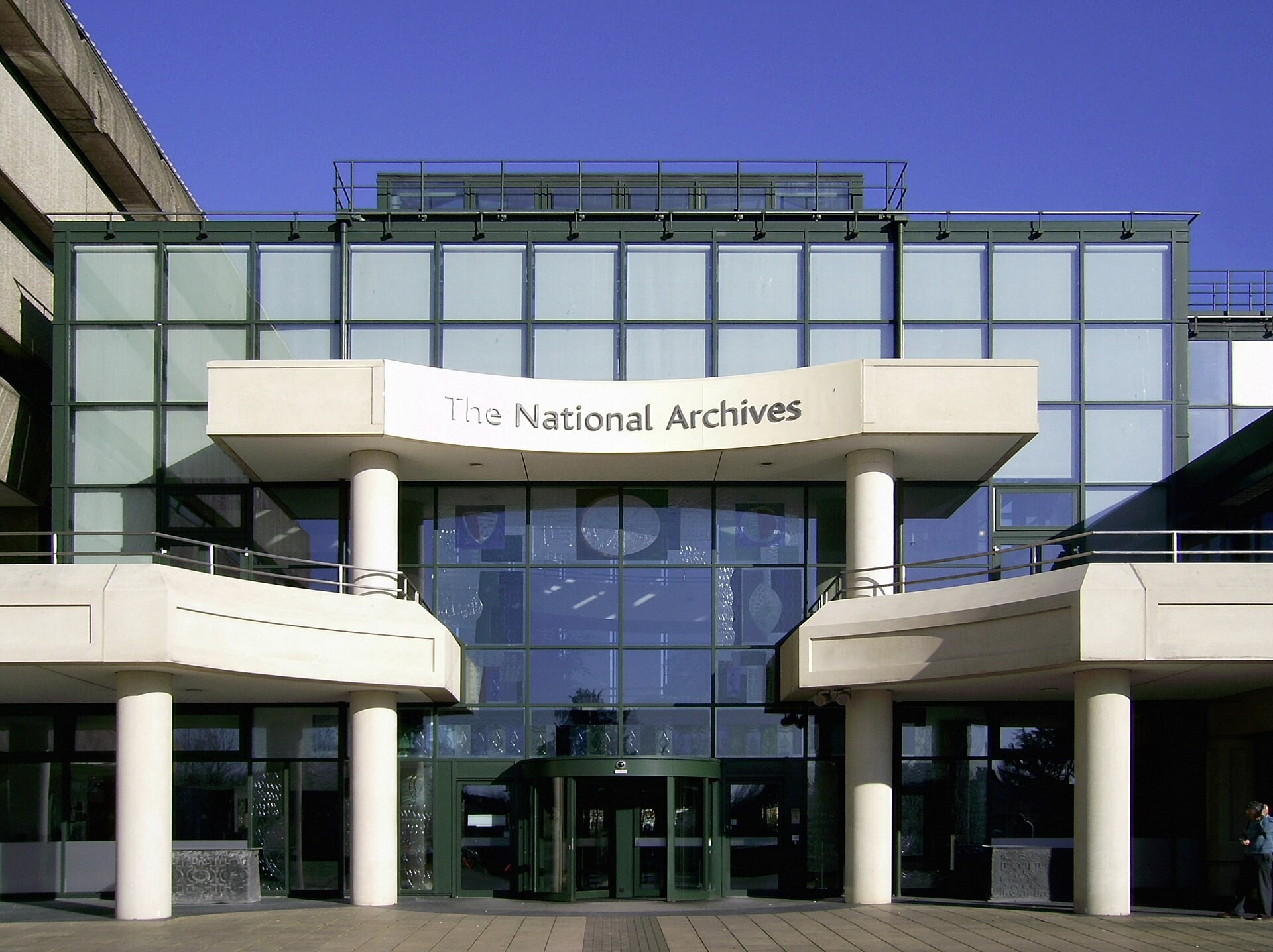
The National Archives is the official archive and publisher for the UK Government and for England and Wales, holding a collection of more than 11 million historical government and public records. Based at Kew in west London, it operates as a non-ministerial government department with 679 members of staff. Its remit runs far beyond storage: it sets sector-wide standards for digital preservation, manages Crown copyright, and makes vast quantities of primary material freely available online. The organisation in its present form was established in April 2003, though its institutional roots stretch back nearly two centuries.
Key facts
- Country: United Kingdom
- Founded: April 2003
- Headquarters: Kew
- Type: national archives; non-ministerial government department
- Employees: 679
- Website: https://nationalarchives.gov.uk/
Origins and predecessors
The direct predecessor institution, the Public Record Office, was established by an Act of Parliament in 1838. Its founding purpose was straightforward: to keep the public records safely in one place. Before that point, state papers had accumulated across a scatter of separate locations, including the Tower of London and the Chapter House at Westminster Abbey. Centralising them was a practical administrative decision as much as a scholarly one.
The National Archives as a distinct body came into existence in April 2003. On 31 October 2006 it expanded further, merging with the Office of Public Sector Information, which itself contained Her Majesty’s Stationery Office. The merger brought four formerly separate organisations together under one body and consolidated responsibility for public sector information licensing alongside the archival function.
The collection and how to reach it
The collection runs to more than 11 million records as of the 2024–25 annual report. Accessing them does not require a visit to Kew. The National Archives operates Discovery, its online catalogue, which holds more than 37 million descriptions of records held both at Kew and at more than 3,500 archives across the country. More than 9 million of those records are available for direct download.
In April 2022, the organisation launched Find Case Law, a free online service giving access to court judgments from the UK Supreme Court, the Court of Appeal, the England and Wales High Court, and various tribunals. The launch was significant for a specific legal reason: it marked the first time that the storage and preservation of such judgments was guaranteed under primary legislation. Find Case Law is provided in partnership with the Ministry of Justice, His Majesty’s Courts and Tribunals Service, and the Judicial Office, with free access intended to support open justice, legal practice, research, and public understanding.
Crown copyright and licensing
The National Archives manages Crown copyright and Crown database right under Letters Patent granted to the Keeper of Public Records. Most licensing of Crown copyright material is handled through the Open Government Licence (OGL), a non-transactional licence that the organisation developed and continues to maintain. The OGL allows broad reuse of government-produced material without requiring individual permissions or fees, making it a practical tool for anyone working with public sector information.
Sector leadership and digital archiving
Beyond its own collection, the National Archives fulfils a sector leadership role for archives across England. Its Our Digital Century programme set out a three-year action plan running from 2023 to 2026, aimed at strengthening digital archiving skills, knowledge, and practice across the wider sector. The international dimension of that ambition is expressed in Archives for Everywhere, an international strategy launched in June 2023 that focuses on documentary heritage at a global scale and supports collaboration with archives in other countries.
Recent activity and collection growth
The 2024–25 annual report recorded the organisation’s most successful year for grant income, with £2.04 million received, a 95 percent increase on 2023–24 and 215 percent on 2022–23. Among the larger awards in that period was £5.6 million from the National Lottery Heritage Fund, the Wolfson Foundation, and the Pilgrim Trust for the Archives Revealed programme.
During 2024–25, the National Archives also signed a partnership agreement to facilitate the relocation of the Parliamentary Archives collection to Kew, and transferred more than 2 million records as part of the transfer of historical military service personnel records from the Ministry of Defence.
In 2025–26, the organisation attracted a record number of visitors to its Kew site, including through the exhibition MI5: Official Secrets. In the same year it awarded 116 grants to galleries, libraries, archives, and museums, totalling £1.93 million — a 110 percent increase on the grant awards made in 2024–25.
Did you know
- Saul Nassé, who became Chief Executive of The National Archives in July 2024, was the youngest-ever editor of the BBC science television programme Tomorrow’s World, which ran for 38 years. (publictechnology.net)
Data sources
- Wikidata
- cain.ulster.ac.uk
- family-wise.co.uk
- nationalarchives.gov.uk
- discovery.nationalarchives.gov.uk
- localgovernmentlawyer.co.uk
- caselaw.nationalarchives.gov.uk
- wired-gov.net
Where it appears
Data updated: 2026-10-27