
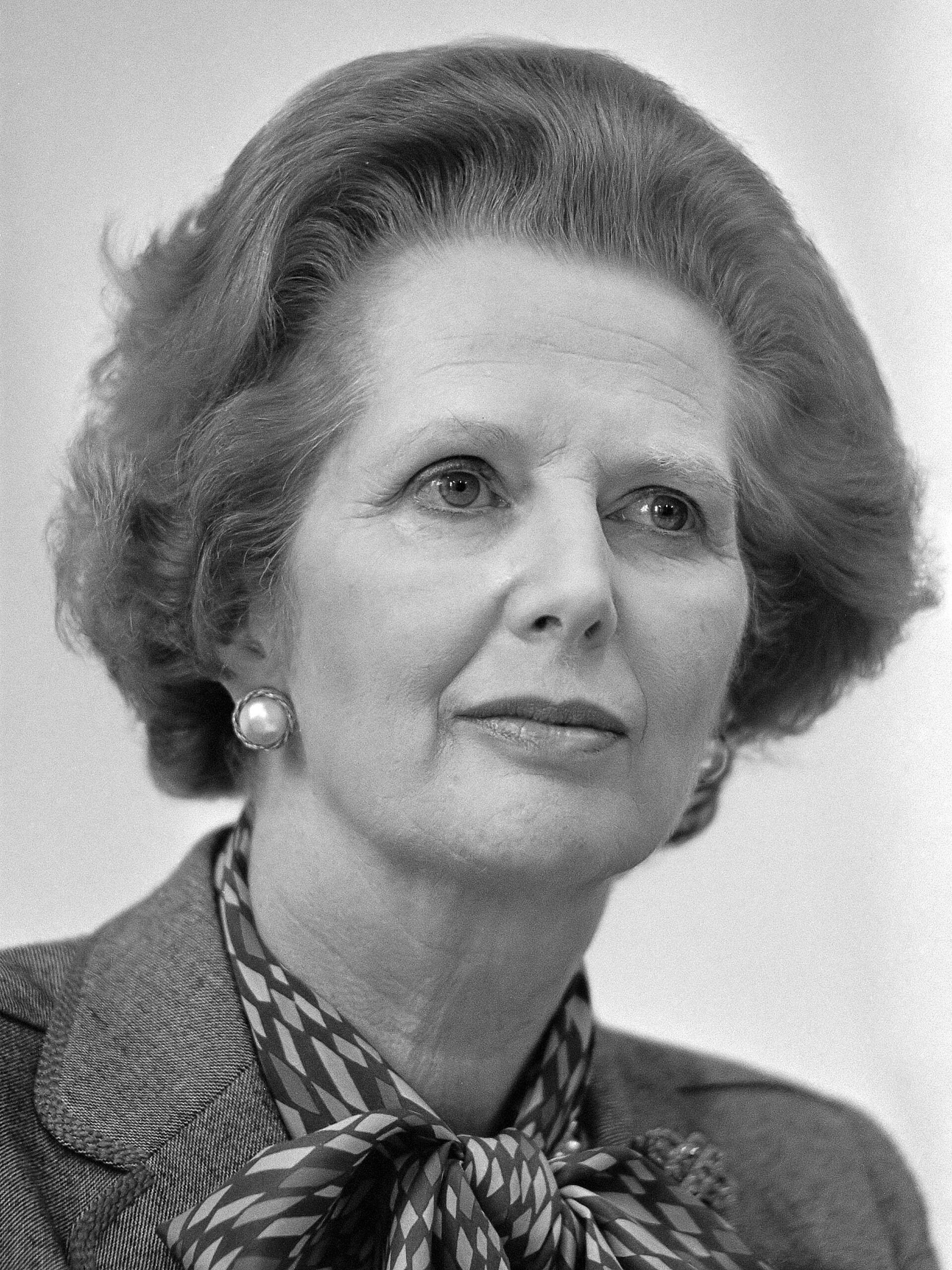
Margaret Thatcher, born on 13 October 1925, was a chemist turned barrister turned Conservative politician who served as Prime Minister of the United Kingdom from 1979 to 1990. Trained at Somerville College, Oxford, and the City Law School, she brought an unusually varied professional background to high politics. Her government reshaped the British economy through large-scale privatisation, selling 1.5 million publicly owned residential units to tenants and tripling the number of individual stockholders by the end of the 1980s. She died on 8 April 2013 at The Ritz London.
Key facts
- Born: 13 October 1925
- Birthplace: 2, 4 And 6, North Parade
- Died: 8 April 2013
- Place of death: The Ritz London
- Country: United Kingdom
- Occupation: politician; chemist; autobiographer; barrister
- Field: politics; chemistry
- Education: City Law School; Kesteven and Grantham Girls’ School; Somerville College
- Awards: Order of Merit; Presidential Medal of Freedom; Knight of the Garter; Fellow of the Royal Society
Early Life and Education
Thatcher grew up in a family with no university tradition on either side: neither her parents nor her grandparents had attended university. Oxford University required Latin for entry, a subject she had not studied at Kesteven and Grantham Girls’ School. She covered a five-year Latin course in months and gained admission to Somerville College to read chemistry.
Her political activity at Oxford was immediate. In 1946 she became President of the Oxford University Conservative Association, only the third woman ever to hold the position. The combination of scientific training and early organisational experience in party politics would define the shape of her subsequent career.
Career Before Parliament
After graduating, Thatcher worked as a food research chemist in London, including a period at J. Lyons and Company in the late 1940s and early 1950s. She then turned to law, studying for the Bar while raising twins and qualifying as a barrister specialising in taxation. From 1954 she practised as a tax law barrister.
The legal training gave her a precise command of argument that colleagues and opponents both noted throughout her political career. It also added a third professional identity — chemist, barrister, politician — to a biography that was already unusual for the period.
Secretary of State for Education and Science
Under Prime Minister Edward Heath, Thatcher served as Secretary of State for Education and Science from 1970 to 1974. One of the period’s most contested decisions was the ending of free school milk for children aged seven and over, which produced the public nickname “Thatcher, Thatcher, Milk Snatcher.” Cabinet papers released later showed she had in fact opposed the Treasury-driven policy, not originated it.
The episode illustrated a pattern that recurred across her career: public identification with decisions whose internal origins were more complicated than the political record at the time suggested.
Prime Minister: Domestic Policy
Thatcher became Prime Minister in May 1979 and held the office until November 1990. Her government privatised state-owned industries across a range of sectors, including telephone, aerospace, gas, and electricity companies. The programme extended to housing: 1.5 million publicly owned residential units were sold to tenants, and the number of individual stockholders in Britain tripled over the course of the 1980s.
The policy direction attracted sustained opposition, and that opposition extended into academic institutions. In 1985, Oxford University’s Congregation, the university’s main governing body, voted by a landslide to deny Thatcher an honorary degree. The stated reason was opposition to her education funding cuts. The vote made her the only post-war prime minister who had studied at Oxford to be refused the honour.
Prime Minister: Foreign Policy and the Cold War
Thatcher maintained a close alliance with US President Ronald Reagan throughout her time in office. She supported the deployment of American Cruise and Pershing missiles in the United Kingdom, a decision that was credited by analysts with helping hasten the end of the Cold War. Her role extended beyond military positioning: she was a significant figure in persuading Reagan that Soviet leader Mikhail Gorbachev was a man the West could negotiate with.
Resignation and Later Life
Thatcher resigned as prime minister on 22 November 1990. The immediate cause was her failure to win an outright majority on the first ballot of a Conservative Party leadership contest. That contest had been triggered by Michael Heseltine following the resignation speech of Deputy Prime Minister Geoffrey Howe.
After retiring from the House of Commons in 1992, she was created Baroness Thatcher of Kesteven and entered the House of Lords. Her swearing-in ceremony took place on 30 June 1992. She also took on international academic responsibilities, serving as chancellor of the College of William and Mary in Williamsburg, Virginia, from 1 July 1993 to 30 June 2000.
She held the Order of Merit, the Presidential Medal of Freedom, the Knight of the Garter, and a Fellowship of the Royal Society. She died on 8 April 2013 at The Ritz London.
Did you know
- While working as a food research chemist at J. Lyons and Company in London in the late 1940s and early 1950s, Thatcher was part of a team working on food emulsifiers and aeration. That work contributed to refining the aerated ice cream formulas that evolved into soft-serve ice cream. Her precise individual role within the team is debated, and she is not credited on any patent. (mashed.com)
- Thatcher reportedly said she was prouder of becoming the first prime minister with a science degree than of becoming the first female prime minister. (some.ox.ac.uk)
- Thatcher served as chancellor of the College of William and Mary in Williamsburg, Virginia, from 1 July 1993 to 30 June 2000. (krdo.com)
Data sources
- Wikidata
- some.ox.ac.uk
- thatchercentre.com
- thedecisionlab.com
- historyandpolicy.org
- politics.co.uk
- krdo.com
- oxfordstudent.com
Data updated: 2026-10-27