
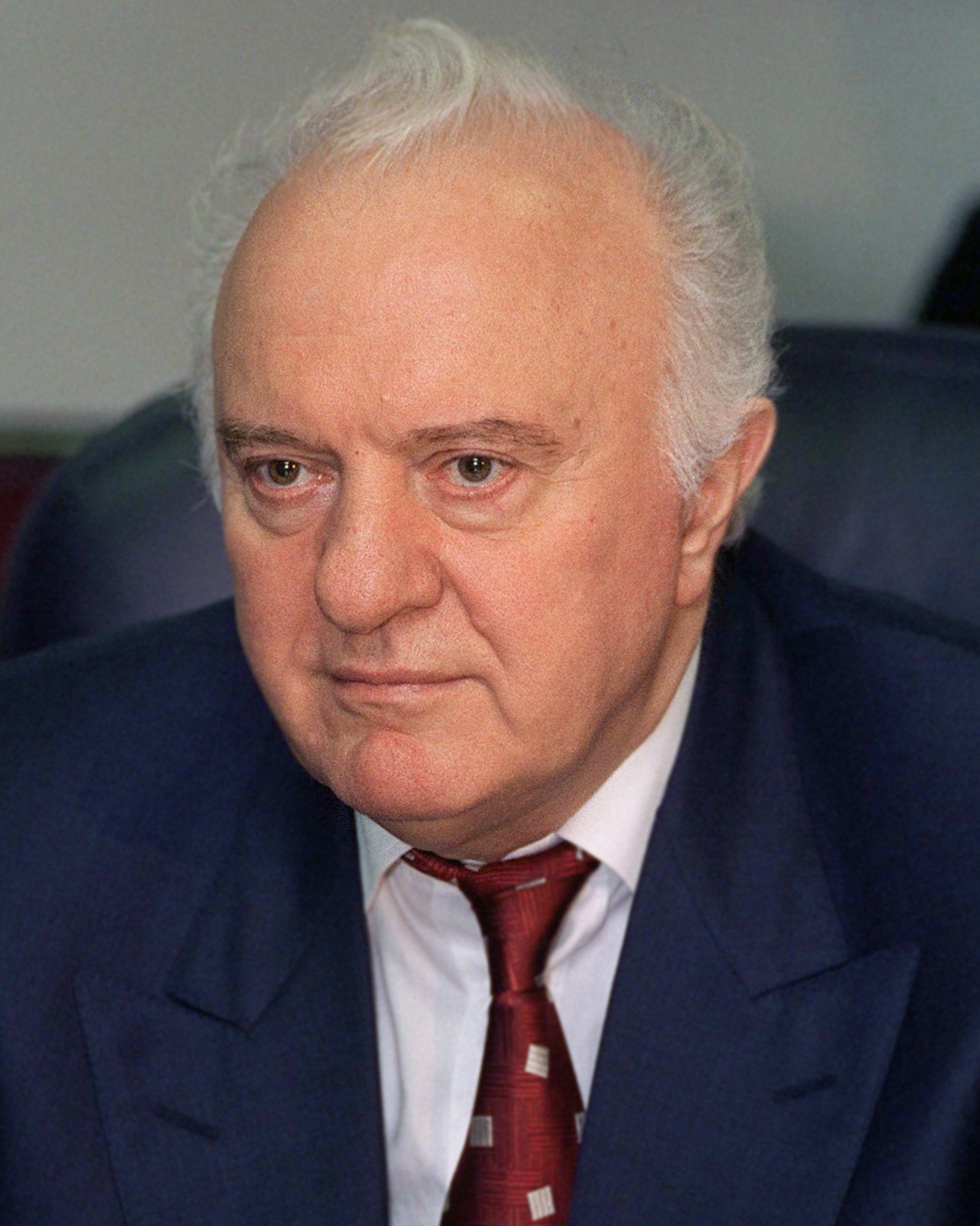
Eduard Shevardnadze, born on 25 January 1928 in Mamati and died on 7 July 2014 in Tbilisi, served as Soviet Foreign Minister and later as the second President of Georgia from 1995 to 2003. A career that spanned the late Soviet era and the post-independence Caucasus placed him at the centre of some of the most consequential diplomatic shifts of the twentieth century, including the negotiated end of the Cold War and the reunification of Germany. His public life closed with a forced resignation on 23 November 2003, following the Rose Revolution, after which he withdrew to his Krtsanisi residence in Tbilisi and published his memoirs before his death at eighty-six.
Key facts
- Born: 25 January 1928
- Birthplace: Mamati
- Died: 7 July 2014
- Place of death: Tbilisi
- Country: Soviet Union; Georgia
- Occupation: politician; diplomat
- Education: Akaki Tsereteli State University
- Awards: Hero of Socialist Labour; Order of the October Revolution; Order of the Patriotic War, 1st class; Order of the Red Banner of Labour
Early Life and Education
Shevardnadze was the fifth and final child in a rural family in Mamati, in what was then the Georgian Soviet Socialist Republic. His parents originally hoped he would become a doctor. He went on to study at Akaki Tsereteli State University, choosing a path into politics rather than medicine.
Rise in Soviet Georgia
Shevardnadze built his early career within the Georgian Communist Party, eventually rising to the position of First Secretary. In that role he pursued an aggressive anti-corruption campaign, dismissing approximately 300 members of the party’s corrupt hierarchy. By 1980 the purges had also produced measurable results in Georgia’s industrial and agricultural output.
One of the defining moments of his tenure as First Secretary came in April 1978, when mass street demonstrations broke out in Tbilisi. Moscow had attempted to downgrade the constitutional status of the Georgian language, and protesters took to the streets in large numbers. Shevardnadze negotiated directly with central authorities and secured the retention of Georgian as the sole official state language of the republic, a concession that carried significant political weight.
Soviet Foreign Minister
Appointed Soviet Foreign Minister, Shevardnadze became one of the principal architects of the diplomatic opening that brought the Cold War to a close.
His resignation on 20 December 1990 was abrupt and public. At the Congress of People’s Deputies, he stepped down and declared that ‘a dictatorship is coming,’ warning that reformers had abandoned the political stage to conservatives. The statement drew immediate attention across the Soviet Union and in Western capitals.
Return to Georgia and the Presidency
After the Soviet collapse, Shevardnadze returned to Georgia and assumed the presidency, holding office from 1995 to 2003. His time as president was marked by serious accusations from domestic opponents, including charges of electoral fraud, rampant corruption, and nepotism. Those charges accumulated over years and contributed directly to the conditions that produced the Rose Revolution.
On 22 November 2002, at the NATO summit in Prague, Shevardnadze formally requested that Georgia be invited to join NATO. The application was the first such formal request from a post-Soviet state in the Caucasus region.
The Rose Revolution, a nonviolent popular uprising triggered by widespread protests over disputed parliamentary elections, forced Shevardnadze to resign on 23 November 2003.
Assassination Attempts and Security
Shevardnadze survived at least one well-documented assassination attempt during his presidency. In February 1998, his bulletproof Mercedes-Benz S600 limousine was destroyed in an attack. Germany and Daimler-Benz subsequently gifted him a new armoured limousine valued at $350,000, citing his contribution to German reunification in 1990 as the reason for the gesture.
Later Life and Legacy
After leaving office, Shevardnadze wrote his memoirs, published under the title ‘Thoughts on the Past and the Future.’ The book appeared first in Georgia in 2006 and was later published in Germany. He spent the remaining years of his life in relative seclusion at his Krtsanisi residence in Tbilisi, where he died on 7 July 2014.
His legacy remains contested. In Soviet Georgia, his anti-corruption campaigns and the defence of the Georgian language in 1978 are credited as genuine achievements. His role in the diplomatic settlement of the Cold War brought him recognition in Western countries. Against that, domestic critics pointed to the corruption, fraud accusations, and institutional weakness that characterised his presidential years and ultimately ended his rule.
Honours and Awards
Shevardnadze received several major Soviet state honours during his career, including the title Hero of Socialist Labour, the Order of the October Revolution, the Order of the Patriotic War (1st class), and the Order of the Red Banner of Labour.
Did you know
- Although Shevardnadze spent his career inside the atheistic Soviet communist system, he was personally baptized into Eastern Orthodoxy by the Georgian Patriarch Ilia II. The Georgian Orthodox Church was an early supporter of his leadership when he returned to Georgia after the Soviet collapse. (theowp.org)
- Shevardnadze earned the nickname ‘the Silver Fox,’ known in Georgian as Tetri Melia. The name referred both to his distinctive shock of white hair and his long reputation as a shrewd and resourceful political negotiator. (hoover.org)
- After his bulletproof Mercedes-Benz S600 limousine was destroyed in the February 1998 assassination attempt, Germany and Daimler-Benz gifted Shevardnadze a replacement armoured limousine worth $350,000. The gift was made in recognition of his role in supporting German reunification in 1990. (autojosh.com)
- By 1980, Shevardnadze had dismissed approximately 300 members of the Georgian Communist Party’s corrupt hierarchy through his anti-corruption purges as First Secretary. The scale of the sweep was described as extraordinary even by Soviet standards. (countrystudies.us)
Data sources
Where it appears
Data updated: 2026-10-27