
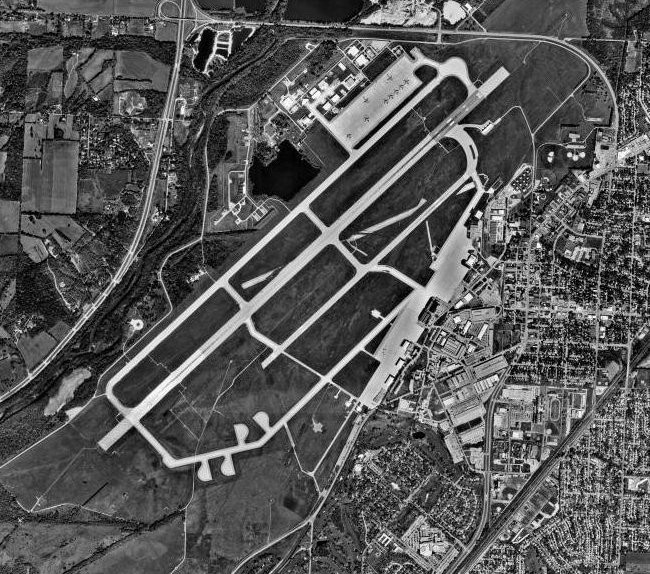
Wright-Patterson Air Force Base sits northeast of Dayton, Ohio, spanning parts of Greene and Montgomery counties across more than 8,000 acres. Founded in 1917 and formally consolidated under its present name on January 13, 1948, the installation has grown into the largest single-site employer in Ohio, with over 38,000 military, civilian, and contractor employees and an annual economic impact of $6.5 billion. Its grounds include Huffman Prairie Flying Field, where the Wright Brothers conducted the experiments that produced practical powered flight in 1904 and 1905. The base now houses major Air Force commands, intelligence centers, a graduate research university, and two parallel runways that serve the full range of military aviation operations.
Key facts
- Country: United States
- Type: airbase
- Located in: Ohio
- Coordinates: 39.8231, -84.0494
- Population: 1,567
- Area: 26 km²
- Elevation: 250.85 m
- Founded: 1917
Location and Physical Layout
The base occupies parts of both Greene and Montgomery counties, positioned northeast of the city of Dayton. Its footprint covers more than 8,000 acres, equivalent to 12.5 square miles, at an elevation of 250.85 meters above sea level. Ohio State Route 444 bisects the installation, dividing it into two main zones designated Area A and Area B.
Two parallel runways handle flight operations. Runway 05L/23R measures 12,600 feet by 300 feet and has a porous asphalt surface. Runway 05R/23L is shorter at 7,000 feet by 150 feet with a standard asphalt surface. The base provides operational support for more than 120 associate units.
History: From Flying Field to Major Command
The story of the land begins before the base existed. In 1904 and 1905, Orville and Wilbur Wright leased Huffman Prairie, an 84-acre field east of Dayton, to develop the Flyer II and the Flyer III. It was at Huffman Prairie, not at Kitty Hawk, that the brothers built on their first flight and produced a truly controllable aircraft. From 1910 to 1916 they operated a flying school there, training 119 students. Among those students were Henry ‘Hap’ Arnold, who later commanded the Army Air Forces in World War II, and Canadian pilot H. Roy Brown, credited with shooting down German ace Manfred von Richthofen in World War I.
The military airfield on this land was established in 1917. Patterson Field, one of the two predecessor installations, was named for 1st Lt. Frank Stuart Patterson, a 20-year-old test pilot killed on June 19, 1918, when his DH-4 aircraft crashed at Wilbur Wright Field during a test of a machine gun synchronizer. The two fields, Wright Field and Patterson Field, were formally merged into a single installation and redesignated Wright-Patterson Air Force Base on January 13, 1948.
During World War II the workforce at what became Wright-Patterson surged from 3,700 to 50,000 at the war’s peak, a more than thirteenfold increase. The base’s role in research, materiel management, and logistics made it central to the American war effort, and that institutional weight carried into the postwar period when Air Force Materiel Command was established there.
Commands and Tenant Organizations
The 88th Air Base Wing serves as the host unit, comprising more than 5,000 officers, enlisted personnel, Air Force civilians, and contractors. It reports to Air Force Life Cycle Management Center. Air Force Materiel Command, a major command created on July 1, 1992 and headquartered at Wright-Patterson, is responsible for research and development, life cycle management, nuclear materiel management, test and evaluation, and sustainment and logistics.
The Air Force Research Laboratory, also headquartered at Wright-Patterson, leads the discovery, development, and integration of warfighting technologies in areas including hypersonics, materials science, artificial intelligence, and directed energy.
The National Air and Space Intelligence Center, the Department of Defense’s primary source for foreign air and space threat analysis, is based at Wright-Patterson. In May 2024 it opened a new Intelligence Production Complex III, a 255,000-square-foot facility that cost $156 million. Co-located with that center is the National Space Intelligence Center, a Space Force field operating agency designated on June 28, 2024, which comprises four intelligence analysis squadrons.
The Air Force Institute of Technology, founded in 1919 and located on the base, functions as the Department of the Air Force’s graduate school of engineering and management. It has held accreditation from the Higher Learning Commission since 1960.
Huffman Prairie and Heritage
Huffman Prairie Flying Field received National Historic Landmark designation in 1990 and came under National Park Service administration in 1992. That same year it became one of four sites within the Dayton Aviation Heritage National Historical Park, which the National Park Service operates on base grounds. The field’s 84 acres are preserved within the larger installation, making the oldest flying field in the world an active part of a working military base.
Project Blue Book
Wright-Patterson was the administrative home of Project Blue Book, the Air Force’s formal program for investigating unidentified flying object reports. According to CIA historian Gerald Haines, writing in 1997, Blue Book investigators were aware that a significant number of UFO sightings during the program’s operation were caused by secret U-2 reconnaissance flights. Haines wrote that investigators did not disclose that explanation to the public and instead attributed those sightings to natural phenomena such as temperature inversions or ice crystals.
Did you know
- Huffman Prairie Flying Field, on the base, is considered the world’s oldest flying field. The Wright Brothers ‘really learned to fly’ there in 1904 and 1905. The Kill Devil Hills site at Kitty Hawk, North Carolina, is where they made their first flight, but it was never developed as an airfield. (wrightpattersonhousing.com)
- During World War II, the workforce at what became Wright-Patterson Air Force Base grew from 3,700 to 50,000 at the war’s peak, a more than thirteenfold increase. (airforce-technology.com)
- Wright-Patterson was selected as the site for the 1995 Bosnian peace talks specifically because a military base allowed participating heads of state to be sequestered, limiting their opportunities for public posturing in the media. (ebsco.com)
- The Air Force Institute of Technology, founded in 1919 at Wright-Patterson AFB, counts astronaut Guion Bluford, the first African American in space, among its distinguished alumni. The institution has awarded more than 20,600 master’s degrees and more than 1,000 doctoral degrees. (militaryschools.com)
- Project Blue Book investigators at Wright-Patterson knew that many reported UFO sightings were caused by secret U-2 reconnaissance flights. According to CIA historian Gerald Haines, writing in 1997, investigators kept that explanation from the public and attributed the sightings to natural effects such as temperature inversions or ice crystals. (uncannyatlas.com)
Data sources
- Wikidata
- wpafb.af.mil
- nps.gov
- wrightpattersonhousing.com
- themilitarystandard.com
- stripes.com
- afmc.af.mil
- af.mil
- flyawaysimulation.com
- spaceforce.mil
Data updated: 2026-10-27