
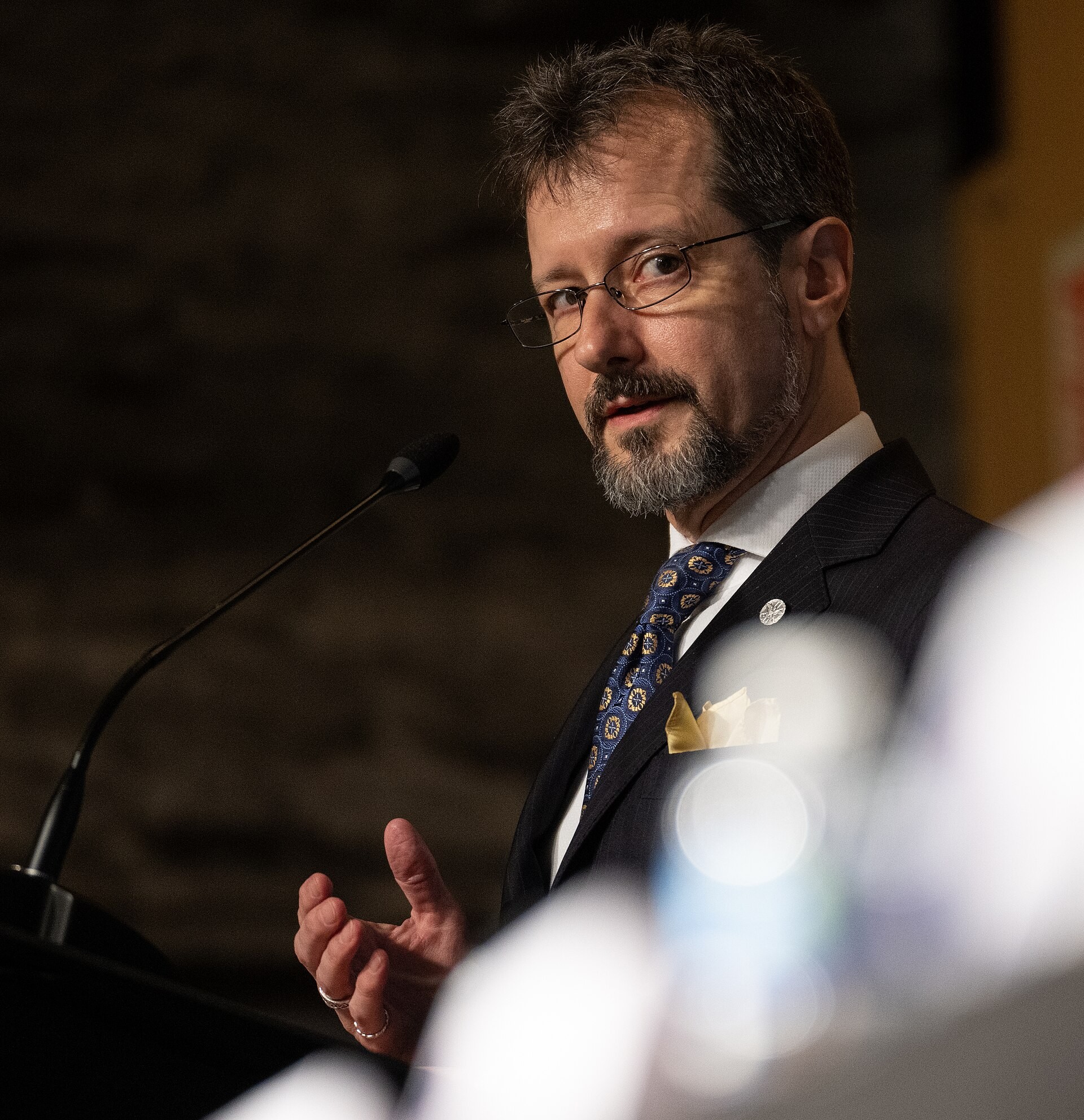
Sean M. Kirkpatrick is an American physicist who built a 27-year federal career spanning laboratory research, intelligence community leadership, and national security strategy before becoming the founding director of the Department of Defense’s All-domain Anomaly Resolution Office (AARO) in July 2022. During 18 months at AARO, his team of more than 40 DoD personnel worked through a caseload of more than 800 military-aligned UAP reports. Born in Columbus, Georgia, and raised in Duluth, Georgia, in an Army family, Kirkpatrick brought academic credentials in nonlinear physics together with senior executive experience across at least five distinct intelligence organizations, making him the government’s most prominent public face on unidentified aerial phenomena until his departure in December 2023.
Key facts
- Birthplace: Columbus
- Country: United States
- Occupation: physicist
- Employer: University of Illinois Urbana-Champaign; Air Force Office of Scientific Research; United States Naval Research Laboratory; Air Force Research Laboratory
- Education: University of Georgia; University of Georgia
Education and early academic work
Kirkpatrick received his Bachelor of Science in Physics from the University of Georgia in 1991. His doctoral dissertation, completed in 1995 under advisor William Dennis, was titled “Experimental and Theoretical Investigation of Nonequilibrium Acoustic Phonon Dynamics in Praseodymium-Doped Fluorides.” That work placed him firmly in the physics of nonequilibrium and nonlinear phenomena, a specialization he has carried through both his research output and his teaching.
Since 1995, Kirkpatrick has served as an adjunct assistant professor of physics at the University of Georgia, focusing on nonlinear and nonequilibrium physics. Across his career he has contributed to several scientific books on nonlinear phenomena and authored multiple scientific and technical intelligence strategies for the national and defense intelligence communities. He holds two open patents.
Federal career before AARO
Kirkpatrick was appointed to the Senior Executive Service in 2012. In 2017 he was appointed Director of National Security Strategy at the National Security Council, where he supported the development of the 2017 National Security Strategy.
Immediately before AARO, Kirkpatrick served as Chief Scientist at the Defense Intelligence Agency’s Missile and Space Intelligence Center in Huntsville, Alabama, from December 2021 to July 2022. His official Department of Defense biography notes that the USSPACECOM Intelligence Enterprise was the fifth separate intelligence organization for which he had served as the Intelligence Community lead for establishment, a sequence that underscores how repeatedly senior leadership turned to him when building new institutional structures from the ground up.
Establishing and leading AARO
On July 20, 2022, Under Secretary of Defense for Intelligence and Security Ronald S. Moultrie formally announced the establishment of AARO and named Kirkpatrick its first director. Kirkpatrick had reportedly postponed a planned government retirement to take the role. Over the following 18 months his team grew to more than 40 DoD personnel, reviewed more than 800 military-aligned UAP reports, and stood up the department’s first public-facing UAP website.
On April 19, 2023, Kirkpatrick testified as the sole witness before the Senate Armed Services Subcommittee on Emerging Threats and Capabilities, chaired by Senator Kirsten Gillibrand. He told the subcommittee that AARO had “found no credible evidence thus far of extraterrestrial activity, off-world technology or objects that defy the known laws of physics.” That statement captured the consistent position he maintained throughout his tenure.
Kirkpatrick stepped down as AARO director effective December 1, 2023, closing a 27-year federal career. Tim Phillips of the Office of the Director of National Intelligence served as acting director upon his departure.
The Loeb paper and physics-based UAP analysis
In March 2023, Kirkpatrick co-authored a draft paper with Harvard astronomer Avi Loeb titled “Physical Constraints on Unidentified Aerial Phenomena.” The paper derived physics-based limits on interpretations of highly maneuverable UAP. Its inclusion of a hypothetical scenario — that UAPs appearing to defy all physics could be probes from an extraterrestrial parent craft — drew attention given Kirkpatrick’s consistent public skepticism toward extraterrestrial explanations. Loeb is the head of the Galileo Project and a Harvard astronomy department chair.
Kirkpatrick’s analytical stance on UAP reports was grounded partly in his assessment of sensor and observer limitations. He estimated that nine in ten UAP cases involving pilot sightings referred to AARO were attributable to parallax, the optical effect by which an object appears to move when the observer’s position changes. That estimate, if accurate, would account for the large majority of reports without invoking exotic explanations.
Post-government positions and writing
In January 2024, Kirkpatrick joined Oak Ridge National Laboratory as Chief Technology Officer for Defense and Intelligence Programs within the National Security Sciences Directorate. Separately, following his government retirement, he became CEO of Nonlinear Solutions, LLC, a strategic consulting company providing scientific and intelligence consulting services to clients in the defense and intelligence communities.
Also in January 2024, Kirkpatrick published an op-ed in Scientific American titled “Here’s What I Learned as the U.S. Government’s UFO Hunter.” In it he concluded that allegations of a UFO cover-up derived from “circular reporting” by “a small group of interconnected believers.” The piece represented his most direct public statement on the origin of persistent cover-up claims, attributing them to a specific dynamic in how accounts were shared and amplified within a defined network rather than to suppressed evidence.
Awards and recognition
Kirkpatrick is the recipient of the Secretary of Defense Medal for Outstanding Public Service, the National Intelligence Exceptional Achievement Medal, four National Intelligence Collaboration medallions, the NRO Innovation and Achievement Award, the Cleary Award for Scientific Excellence, and the DIA Director’s Award for Excellence.
Did you know
- Among Kirkpatrick’s roughly 58 published scientific papers, at least two explored using the infrared-sensing pit organ tissue of pit vipers, including rattlesnakes, as a model for engineering non-cryogenic, high-sensitivity infrared detectors. (douglasjohnson.ghost.io)
- Kirkpatrick was known to his AARO staff simply as “Dr. K.” He reportedly postponed a planned government retirement in order to accept the role of establishing and leading AARO in 2022. (futurism.com)
- His 2023 co-authored paper with Avi Loeb, who heads the Galileo Project and is a Harvard astronomy department chair, drew notice for including the hypothetical scenario that UAPs “which appear to defy all physics, could be ‘probes’ from an extraterrestrial ‘parent craft,'” a framing that sat in tension with Kirkpatrick’s consistent public skepticism toward extraterrestrial claims. (thedebrief.org)
- Kirkpatrick estimated that nine in ten UAP cases involving pilot sightings referred to AARO were caused by parallax, the optical effect in which an object appears to move when the observer’s position changes. (uapledger.com)
- According to his official Department of Defense biography, the USSPACECOM Intelligence Enterprise was the fifth separate intelligence organization for which Kirkpatrick had served as the Intelligence Community lead for establishment during his career. (media.defense.gov)
Data sources
- Wikidata
- media.defense.gov
- fox5atlanta.com
- handwiki.org
- potomacofficersclub.com
- conandaily.com
- theblackvault.com
- uapledger.com
- lweb.cfa.harvard.edu
- defensescoop.com
- scientificamerican.com
- uaprw.com
- expeditionary.ai
Data updated: 2026-10-28