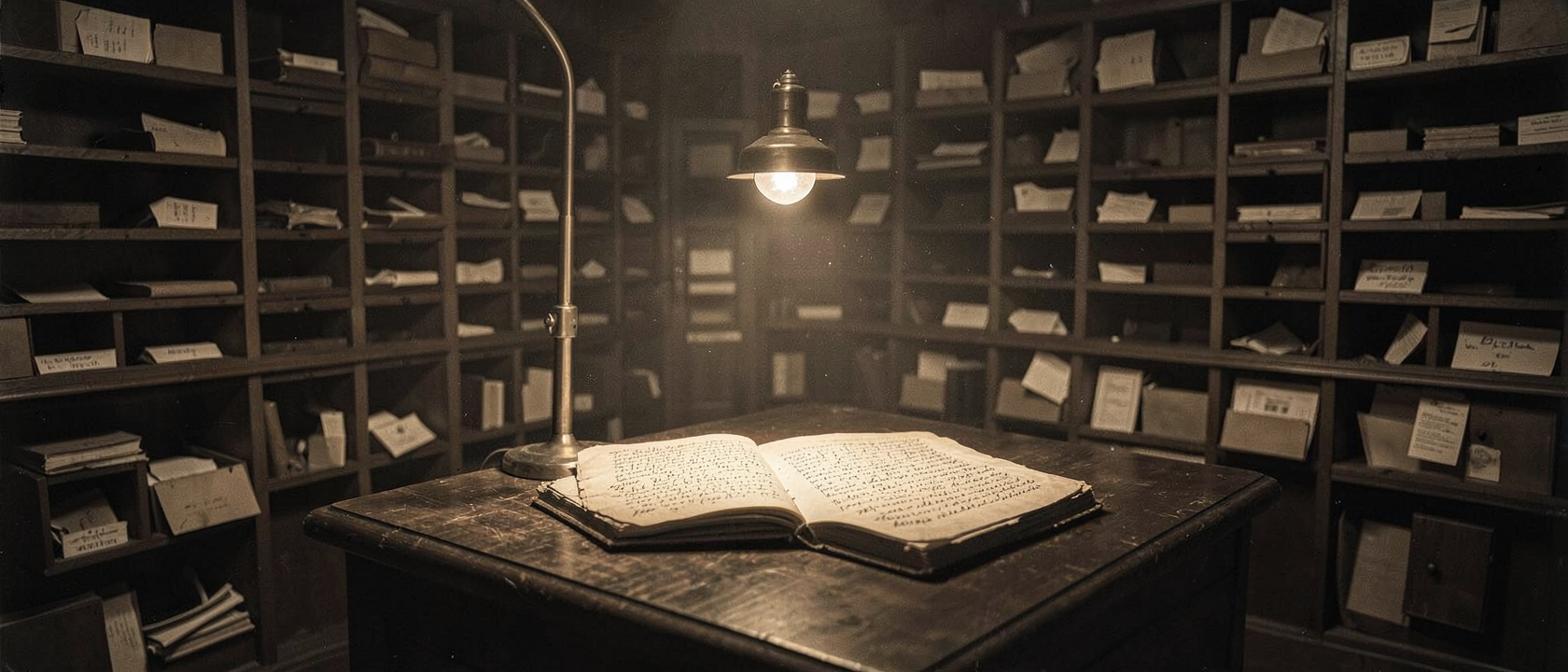
A Bound Volume With a Two-Stage Life
The document held at The National Archives under catalog reference HO 45/24665 did not begin as a bound volume. The Home Office built it as a working card index during the arrest period itself, adding entries as detentions occurred between 1906 and 1914. In 1922, the accumulated cards were compiled into the bound form that survives. The National Archives dates the document 1914 to 1935, a span of twenty-one years beyond the last arrest it records. The record does not explain why the range extends that far.
1,333 Names, Three Columns of Information Each
The index records 1,224 women and 109 men: 1,333 individuals arrested for pro-suffrage activism between 1906 and 1914. Each entry gives the person’s name, the date and location of each arrest, the number of times that individual was arrested, and a cross-reference pointing toward original arrest and conviction documents held elsewhere in The National Archives collection. Entries are organized alphabetically by surname. A dedicated tab section labeled “U” holds entries for individuals who refused to supply their names or could not otherwise be identified.
Some entries carry additional notes beyond the standard fields. The record’s entry for Frances Gordon states that replies to questions on forcible feeding have been registered. That notation sits alongside the usual data without elaboration. Annie Bell’s entry records fourteen arrests over the period, the highest individual count in the document.
Administration, Not Investigation
The Home Office did not build this record to examine its own conduct. It built it to track people, link their successive arrests to one another, and locate them when needed. The document’s use history makes that purpose plain. When many suffrage organizations suspended their campaigns at the outbreak of World War One in August 1914, the government drew on the same index to identify imprisoned campaigners and coordinate their release under an amnesty. The function did not change; the administrative direction reversed. The same structure and the same data that had tracked people into custody processed them back out of it.
The National Archives’ Own Words Are Not the Index’s Words
On August 3, 2026, The National Archives published editorial content alongside HO 45/24665 describing Emmeline Pankhurst, born July 15, 1858, as a “tireless political activist” and the Women’s Social and Political Union she founded in 1903 as the militant faction of the suffrage movement. Those characterizations belong to The National Archives’ own commentary. The index does not use them. Pankhurst’s entry in the document contains what every other entry contains: a name, arrest dates and locations, an arrest count, and cross-references to source papers. Her daughters Adela, Christabel, and Sylvia Pankhurst appear in the same “P” section under the same structure, with no annotation distinguishing their entries from any other.
Pointers to Papers That May or May Not Still Exist
Every entry in HO 45/24665 points toward original arrest and conviction documents within The National Archives. The index carries no statement of charges brought against any individual and no summary of legal outcomes. A researcher following a cross-reference may find the source paper; equally, that cross-reference may lead nowhere, because the document it points to no longer exists. The index preserves the fact of arrest. It does not preserve what happened next.
Aliases complicate that further. Lady Constance Lytton appears in the index not under her own name but as “Jane Warton,” the alias she used in January 1910 to avoid preferential treatment when arrested for throwing stones at the house of the governor of Walton Gaol in Liverpool. Where an alias was consistent enough to carry through into the record, the entry survives in recognizable form. Where individuals gave different names at different arrests, or refused to give any name at all, the “U” section holds whatever the Home Office was able to document.
The Men the Index Counts Without Explaining
One hundred and nine of the 1,333 entries belong to men. The index assigns them the same fields as every other entry and does not explain their presence or their organizational roles. George Lansbury, who held the parliamentary seat for Bow and Bromley from 1910, is listed in the record; according to parliamentary and museum sources, he was arrested in 1913 following a speech in support of suffragette militancy. Hugh Arthur Franklin is also listed, with five arrests recorded between 1910 and 1913. A National Archives blog post published August 29, 2018, identifies Franklin as the first person released under the Prisoners (Temporary Discharge for Ill Health) Act 1913, commonly called the Cat and Mouse Act, which allowed hunger-striking prisoners to be temporarily freed and re-imprisoned once their health had recovered.
Where underlying source papers have not survived, the index entry is the whole record, and the entry stops at the date and the place of arrest.