
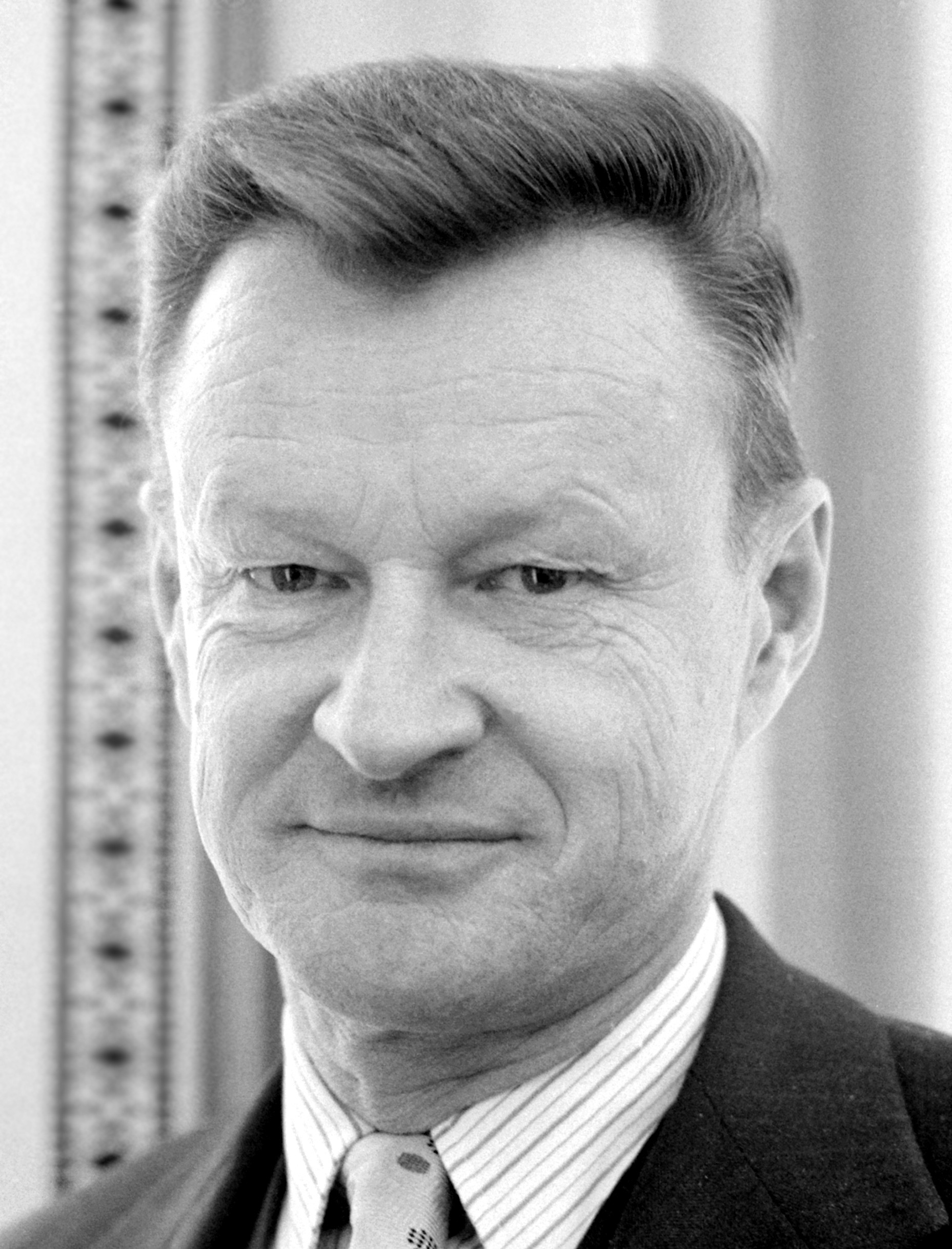
Zbigniew Brzezinski (28 March 1928 – 26 May 2017) was a Polish-American political scientist and diplomat who shaped U.S. foreign policy across five decades, most directly as National Security Advisor to President Jimmy Carter. Born in Warsaw and educated at McGill University and Harvard, he built his career at Columbia and Johns Hopkins before moving to the center of American statecraft. Among the programs he championed was Operation Cyclone, the CIA effort to arm the Afghan mujahideen, which reached a peak annual budget of $700 million in 1987, making it at that time the most expensive covert action in CIA history. He wrote more than 30 books and remained a prominent public voice on geopolitics until his death at age 89.
Key facts
- Born: 28 March 1928
- Birthplace: Warsaw
- Died: 26 May 2017
- Place of death: Falls Church
- Country: United States; Second Polish Republic
- Occupation: geopolitical analyst; political scientist; pedagogue; university teacher
- Field: international relations; national security
- Employer: Johns Hopkins University; Paul H. Nitze School of Advanced International Studies; Columbia University; Harvard University
- Education: McGill University; Harvard Law School
- Awards: Guggenheim Fellowship; Order of the White Eagle (Third Polish Republic); Order of Tomáš Garrigue Masaryk, 1st class; Presidential Medal of Freedom
Early life and education
Brzezinski was born in Warsaw on 28 March 1928, during the period of the Second Polish Republic. His family’s circumstances brought him eventually to Canada, where he studied at McGill University in Montreal. He earned a Bachelor of Arts in political science in 1949 and a Master of Arts in the same field in 1950. His master’s thesis ran to approximately 80,000 words and focused on Soviet nationalities policy, a subject that would anchor much of his subsequent scholarly work.
He completed his doctoral dissertation at Harvard in 1953, examining the Soviet Union’s evolution from the October Revolution through the Stalinist period. Harvard did not grant him tenure, and in 1959 he moved to Columbia University, where he became head of the newly established Institute on Communist Affairs.
Academic career and major works
Brzezinski’s scholarly output began while he was still at Harvard. In 1956 he co-authored Totalitarian Dictatorship and Autocracy with Harvard professor Carl Friedrich, a 346-page work published by Harvard University Press that became a foundational text in political science on the structure and nature of totalitarian states. His 1960 book The Soviet Bloc: Unity and Conflict, also published by Harvard University Press, argued that Eastern European satellite states retained national identities capable of undermining Soviet dominance over time.
His 1970 book Between Two Ages: America’s Role in the Technetronic Era examined how technology and mass communication would reshape U.S. politics and the country’s global role. That work caught the attention of David Rockefeller, who read it and then recruited Brzezinski away from Columbia University to become the founding director of the Trilateral Commission in 1973. His 1997 book The Grand Chessboard: American Primacy and Its Geostrategic Imperatives, published by Basic Books, argued that Eurasian geopolitics was the central arena where American global supremacy would be decided.
Across his career Brzezinski authored more than 30 books, many written with non-academic readers in mind. He also appeared frequently as a foreign policy analyst on the PBS program The NewsHour with Jim Lehrer.
Policy work before the Carter administration
Before reaching the National Security Council, Brzezinski served on the U.S. Department of State Policy Planning Council from 1966 to 1968, in an advisory capacity to President Lyndon B. Johnson. In July 1973 he co-founded the Trilateral Commission alongside David Rockefeller, an organization designed to foster cooperation among North America, Western Europe, and Japan. Brzezinski served as the commission’s first full-time director.
National Security Advisor under Carter
Brzezinski served as National Security Advisor in the Carter administration and became one of its most consequential figures, though not without friction. He frequently clashed with Secretary of State Cyrus Vance over the direction of U.S. foreign policy, a rivalry that created public confusion about where the administration stood on key questions.
At the Camp David summit in September 1978, Brzezinski played a central role in brokering the Camp David Accords, helping bridge the positions of Egyptian President Anwar Sadat and Israeli Prime Minister Menachem Begin.
On 3 July 1979, President Carter signed the first covert aid directive authorizing support for the Afghan mujahideen. That authorization predated the Soviet invasion of Afghanistan by six months. The CIA program that followed, Operation Cyclone, channeled more than $2 billion in weapons and support between 1979 and 1989. In a 1998 interview with the French magazine Le Nouvel Observateur, Brzezinski acknowledged that Carter had signed the directive before the invasion, and stated that the intent was to draw the Soviets into what he described as an Afghan trap.
Legacy and honors
Brzezinski received a number of significant honors over his lifetime, including a Guggenheim Fellowship, the Presidential Medal of Freedom, the Order of the White Eagle from the Third Polish Republic, and the Order of Tomáš Garrigue Masaryk, 1st class. He held appointments at Johns Hopkins University and its Paul H. Nitze School of Advanced International Studies, as well as at Columbia University and Harvard University.
In 2014, the Center for Strategic and International Studies established the Zbigniew Brzezinski Institute on Geostrategy in his honor. The institute’s stated mission is to examine the interaction of history, geography, and strategy.
Brzezinski died on 26 May 2017 at Inova Fairfax Hospital in Falls Church, Virginia, at the age of 89. The cause of death was not officially reported. His funeral Mass was celebrated on June 9, 2017, at the Cathedral of St. Matthew the Apostle in Washington, D.C., attended by more than 500 people, including former President Jimmy Carter and former Secretary of State Madeleine Albright. His inurnment was private.
Did you know
- Brzezinski’s master’s thesis at McGill University in 1950 ran to approximately 80,000 words. It has been described as a seminal early Cold War document on Soviet nationalities policy. (freebeacon.com)
- When Henry Kissinger was appointed National Security Advisor by President Nixon in 1969, Brzezinski reportedly bought a notebook to record the names of people he would hire when his own turn came. The story is frequently cited as an illustration of the intense personal rivalry between the two men. (viewfromthepeak.substack.com)
- In a 1998 interview with the French magazine Le Nouvel Observateur, Brzezinski acknowledged that President Carter had signed the first covert aid directive for the mujahideen on 3 July 1979, six months before the Soviet invasion of Afghanistan. He stated that the intent was to draw the Soviets into an Afghan trap. (soviet-union.com)
- David Rockefeller was inspired to co-found the Trilateral Commission in 1973 after reading Brzezinski’s 1970 book Between Two Ages. Rockefeller then recruited Brzezinski away from Columbia University to serve as the organization’s founding director. (beforeitsnews.com)
- Brzezinski was cremated following his death on May 26, 2017, and his inurnment was private. More than 500 dignitaries attended his public funeral Mass on June 9, 2017, at the Cathedral of St. Matthew the Apostle in Washington, D.C. (catholicphilly.com)
- Brzezinski authored more than 30 books over the course of his career, writing many with non-academic audiences in mind. He also appeared regularly as a foreign policy expert on the PBS program The NewsHour with Jim Lehrer. (goodreads.com)
- Operation Cyclone, the CIA program Brzezinski championed, reached a peak annual budget of $700 million in 1987, making it at that time the most expensive covert action in CIA history. (guinnessworldrecords.com)
- Brzezinski’s three children each built prominent public careers: his daughter Mika became co-host of MSNBC’s Morning Joe, his son Ian became a Republican foreign policy and military affairs expert, and his son Mark served as a Democratic diplomat and ambassador. (brzezinski.book.art.pl)
Data sources
- Wikidata
- u-s-history.com
- goodreads.com
- pac1944.org
- thecommongoodus.org
- influencewatch.org
- cbsnews.com
- guinnessworldrecords.com
- csis.org
- catholicphilly.com
- thebostonpilot.com
Data updated: 2026-10-29