
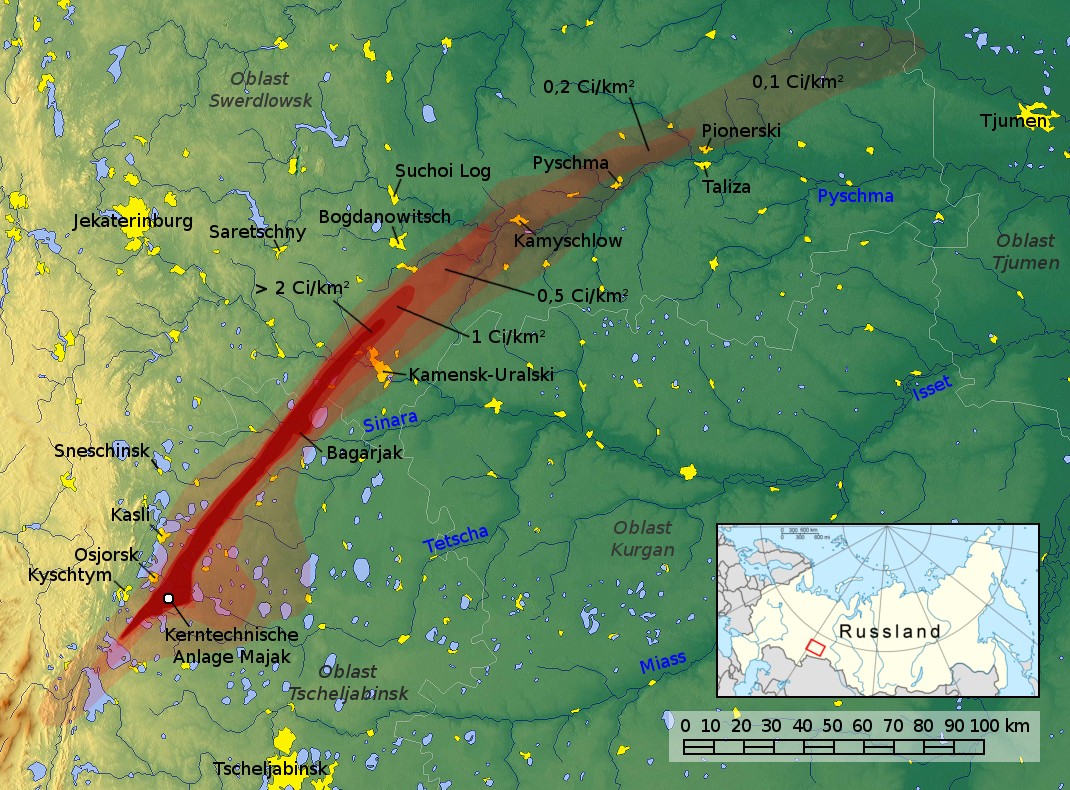
On 29 September 1957, a catastrophic explosion at the Mayak chemical combine near Ozyorsk, in the Soviet Union’s southern Urals, released approximately 740 petabecquerels of radioactivity into the surrounding landscape and atmosphere. The detonation was chemical, not nuclear, but its consequences matched the scale of a major nuclear accident: at least 22 villages were exposed, around 10,000 people were ultimately evacuated, and a contaminated plume stretched 300 kilometres to the north-northeast.
Key facts
- Country: Russia; Soviet Union
- Type: nuclear disaster
- Date: 29 September 1957
- Location: Mayak; Ozyorsk
Origins: building Mayak
The Mayak plant and the closed city that housed its workers were known by the classified postal code Chelyabinsk-40. More than 40,000 Gulag prisoners and prisoners of war provided the labour to build both the factory and the city. Chelyabinsk-40 did not appear on any public Soviet maps, a fact that would later complicate the international understanding of the 1957 explosion.
Before the explosion, Mayak had already been releasing radioactive material into the regional water system. Between 1949 and 1956, approximately 100 petabecquerels of radioactive waste containing strontium-90, cesium-137, plutonium, and uranium were discharged into the Techa River. The 1957 disaster therefore struck a landscape already carrying a significant radiological burden.
The storage system and its failure
Liquid nuclear waste at Mayak was held in steel tanks set into a concrete base 8.2 metres underground. Because radioactive decay generates heat continuously, each bank of 20 tanks was fitted with a dedicated cooling system. When the cooling system of one tank failed and was not repaired, its contents, approximately 70 to 80 tons of liquid radioactive waste, began to overheat.
The waste reached a temperature of approximately 350 degrees Celsius. Its dried chemical residue consisted mainly of ammonium nitrate and acetates. At 11:22 UTC on 29 September 1957, the accumulated heat caused the contents to evaporate and then detonate. The explosion carried an estimated force of 70 to 100 tons of TNT and blasted the 160-ton concrete lid of the tank into the air. The detonation was entirely chemical in nature; no nuclear chain reaction occurred.
Contamination and dispersal
The explosion released approximately 740 PBq (20 million curies) of radioactivity. About 90 percent of that total settled as coarse particles within 5 kilometres of the tank. The remaining 74 PBq was carried north-northeast by wind, forming a contaminated plume 30 to 50 kilometres wide and 300 kilometres long.
The primary long-lived contaminants were cesium-137 and strontium-90. Strontium-90 mimics calcium in the body and accumulates in bone tissue, raising the risk of leukemia and bone cancer. Cesium-137 spreads through soft tissue and moves readily through ecosystems. Radioactive topsoil was subsequently excavated and placed in fenced enclosures designated as ‘earth graveyards’ to limit further dispersal.
The human cost and forced silence
At least 22 villages were exposed to radiation from the explosion and its plume. The evacuation of approximately 10,000 people began within a week for some communities, but at other affected sites the process took almost two years to complete. Evacuees were not told why they were being moved. Soviet authorities banned the word ‘radiation’ from all official communications related to the event, and the cover story presented to displaced residents described environmental or chemical contamination rather than a nuclear accident.
Milk was identified as the primary route through which radioactivity entered the human diet in the affected area, accounting for up to 50 percent of ingested radioactivity.
Suppression and eventual disclosure
The first public account to reach a Western audience came in 1976, when Soviet biologist and dissident Zhores Medvedev published an article in the journal New Scientist describing the event. Medvedev followed that with a book, ‘Nuclear Disaster in the Urals’, in 1980. Researchers at Oak Ridge National Laboratory in Tennessee subsequently cross-referenced the claims against Soviet maps and found that approximately 30 villages and towns in the affected region had vanished from current editions, corroborating Medvedev’s account.
Declassified CIA documents established that the United States government had known about the Kyshtym disaster since at least 1959. The CIA did not share that knowledge publicly, a decision attributed to concern that disclosure would generate damaging questions about the safety of American nuclear facilities, including the Hanford Site. The result was that both superpowers, for different institutional reasons, actively suppressed information about the same nuclear disaster.
The name and its geography
The disaster is named after the small town of Kyshtym, which lies near the actual site but had no direct connection to it. The true location, Chelyabinsk-40, was a closed city that did not appear on any public Soviet map, so journalists and researchers reaching for a geographic label fixed on the nearest named place that could be found.
Did you know
- The disaster takes its name not from the actual explosion site but from the small nearby town of Kyshtym. The real location, the closed city of Chelyabinsk-40, did not appear on any official Soviet map, so outside observers attached the nearest findable place name to the event. (atomicphotographers.com)
- In 1967, a separate radiological incident struck the same region. Strong winds raised radioactive silt from the shallow banks of Lake Karachay, which had been used for open-air waste storage after 1957, contaminating an additional area of approximately 1,800 square kilometres. (nuclear-heritage.net)
- Approximately 90 percent of the 740 PBq of mixed fission products released by the explosion settled within 5 kilometres of the tank as coarse particles. The long-range contamination that affected communities across a 300-kilometre plume was caused by only about 10 percent of the total radioactivity released. (large.stanford.edu)
- Milk was identified as the main vehicle of radioactive contamination in the human diet following the disaster. For residents living in the affected area, milk accounted for up to 50 percent of their total ingested radioactivity. (large.stanford.edu)
- Declassified CIA documents show that the agency helped keep the Kyshtym disaster secret, suppressing information about it to protect American nuclear facilities, including the Hanford Site, from public scrutiny. In effect, the CIA and the Soviet government were working toward the same outcome on the same event, making it one of the more paradoxical intelligence decisions of the Cold War. (environmentandsociety.org)
Data sources
- Wikidata
- upscwithnikhil.com
- atomicphotographers.com
- kids.kiddle.co
- environmentandsociety.org
- large.stanford.edu
- kiddofspeed.com
- historyaffairs.com
- history.co.uk
- thecollector.com
- hibakusha-worldwide.org
Data updated: 2026-10-29