
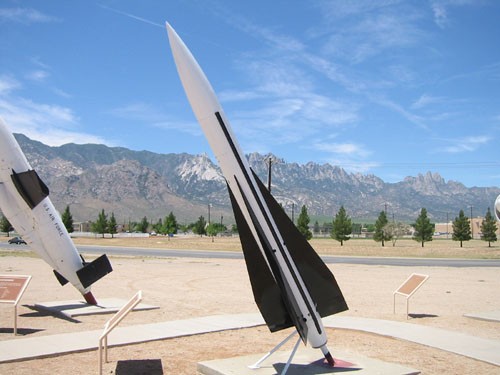
White Sands Missile Range is a military testing installation covering approximately 3,200 square miles of the Tularosa Basin in south-central New Mexico, making it the largest military installation in the United States. Spanning roughly 100 miles in length and 40 miles in width, the range accounts for about 17 percent of all U.S. Army land.
Key facts
- Country: United States
- Type: spaceport; bombing range; unincorporated community
- Located in: Doña Ana County; New Mexico; Otero County
- Coordinates: 32.5631, -106.5700
- Area: 8,288 km²
- Elevation: 1.6 km
- Founded: 1948
Geography and terrain
The range sits within the Tularosa Basin, bounded to the west by the San Andres, Organ, and Oscura Mountains and to the east by the Sacramento Mountains. Elevation across the installation rises from about 4,000 feet near Lake Lucero to 8,959 feet at Salinis Peak. The vegetation is largely representative of the Chihuahuan Desert, with additional influences from the southern Rocky Mountains, the Great Plains, and the Mogollon Rim; plant diversity reaches its greatest extent in the mountainous regions.
White Sands Missile Range lies across two counties, Doña Ana and Otero, and sits at a mean elevation of approximately 1.6 kilometers. The gypsum flats near Lake Lucero give way to scrub desert and mountain slopes, producing a landscape that varies considerably across the installation’s 8,288 square kilometers.
History and founding
The proving ground was officially established on July 9, 1945. Just seven days later, on July 16, 1945, the first atomic bomb, code-named Trinity, was detonated at 5:29:45 a.m. Mountain War Time at the northern end of the range, yielding approximately 19 kilotons. That detonation was the range’s very first major event, marking the birth of the atomic age.
In 1952, the Department of Defense integrated the Alamogordo Bombing Range into what had been called White Sands Proving Ground, and the proving ground assumed control of Trinity Site as a result. Trinity Site was designated a National Historic Landmark in 1975 by the National Park Service; the landmark covers 51,500 acres and includes ground zero, base camp, and the McDonald Ranch House.
Missile activity grew rapidly after the range’s establishment. From 1945 to 1954, annual missile launches increased from 14 to 656. On March 30, 1982, Space Shuttle Columbia landed on the gypsum surface of Northrup Strip at White Sands Missile Range to conclude mission STS-3, the only Space Shuttle landing ever made at the installation. After that landing, President Ronald Reagan signed legislation renaming Northrup Strip as White Sands Space Harbor.
Testing operations
It is the only overland range in the United States capable of supporting extended-range missile, munitions, and artillery testing.
Among its specialized facilities, the range hosts the High Energy Laser Systems Test Facility (HELSTF), described as the most comprehensive site in the United States capable of supporting directed energy technologies for the Department of Defense. The White Sands Solar Furnace is another notable installation: it produces intense thermal pulses or steady-state thermal radiation to simulate the thermal radiation from the detonation of a nuclear weapon, and at full power can penetrate a half-inch stainless steel plate in 40 seconds.
The range controls 3,421 square miles of Department of Defense-restricted airspace, managed 24 hours a day from the ground to space, and this restricted zone is expandable to 7,569 contiguous square miles, making it the largest restricted DoD airspace in the country.
Workforce and economic impact
White Sands Missile Range employs approximately 6,000 or more civilian employees alongside about 350 servicemembers from the Army, Air Force, and Navy. Approximately 950 residents live on post in 374 available housing units, giving the installation the character of a functioning community as well as a military and scientific facility.
As of the range’s official quick facts, the installation produces an estimated economic impact of $10.3 million per day and $3.7 billion annually in Las Cruces, Doña Ana County, and the surrounding borderland region. Military spending accounts for an average of 30 percent of wages in Southern New Mexico and El Paso, Texas, a share that reflects how thoroughly the range shapes the regional economy.
Museum and heritage
The range maintains a museum whose V-2 Building (Building 203) contains one of the most complete V-2 rockets currently known to exist. Sections of the rocket’s metal skin have been removed to display its internal workings, making it an unusual artifact from the earliest era of American missile testing.
Did you know
- The Trinity nuclear test took place on July 16, 1945, only seven days after the White Sands Proving Ground was officially established on July 9, 1945. The range’s very first major event was the detonation that opened the atomic age. (army.mil)
- White Sands Missile Range is one of only two places in the United States not under standard Federal Aviation Administration airspace authority. The installation controls its own airspace 24 hours a day, from the ground to space. (home.army.mil)
- The first post newspaper published at White Sands, on March 16, 1950, reported that the community already had a post office, elementary school, bank, and full utilities. Within five years of its establishment, the remote desert installation had grown into a functioning town. (army.mil)
Data sources
- Wikidata
- home.army.mil
- globalsecurity.org
- army.mil
- nasa.gov
- mveda.com
- wsmrmuseum.com
- installations.militaryonesource.mil
Data updated: 2026-10-29