
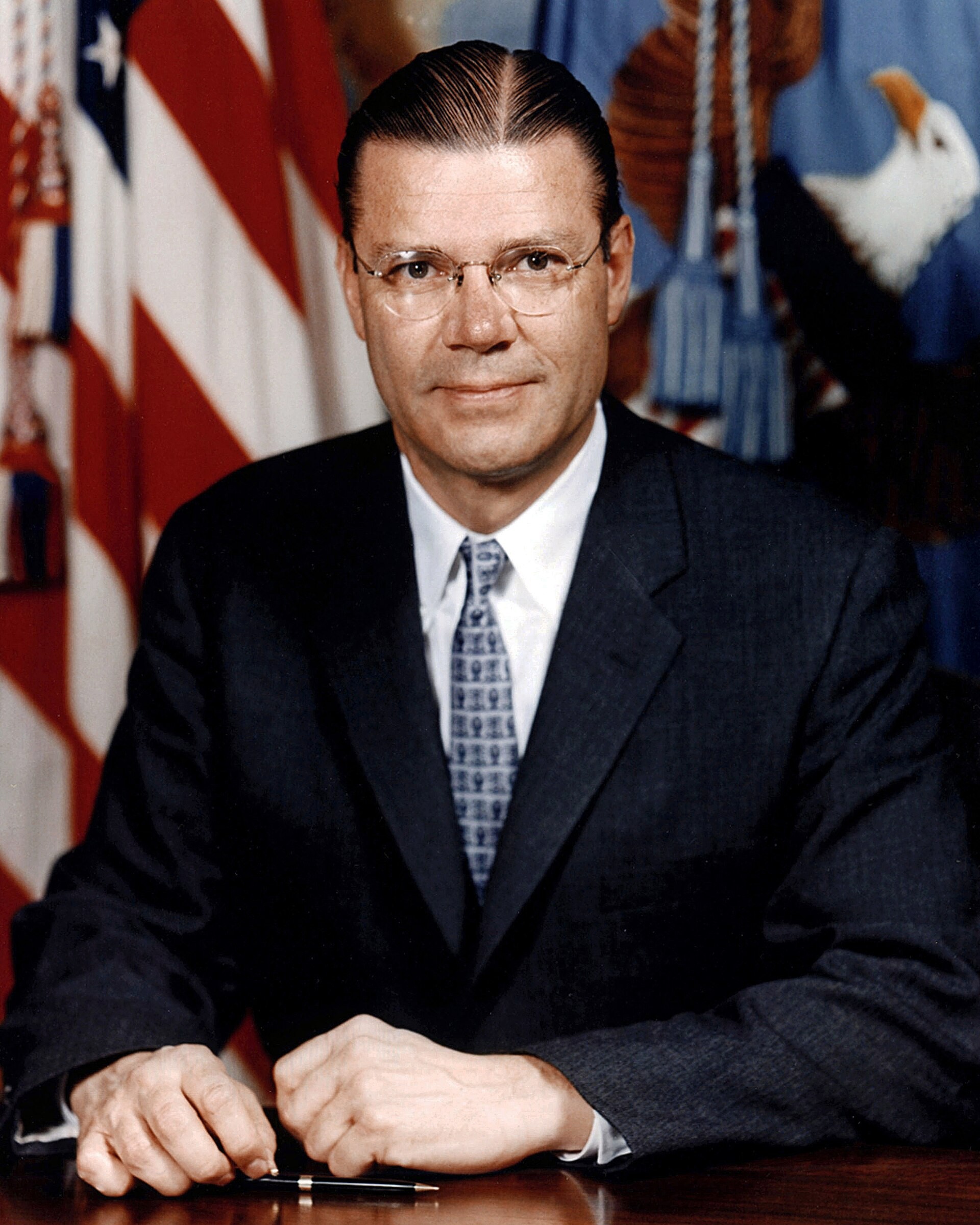
Robert McNamara (June 9, 1916 – July 6, 2009) was an American businessman, economist, and public official who served as the eighth United States Secretary of Defense from January 21, 1961, to February 29, 1968, the longest tenure anyone has held that office. Born in San Francisco, he applied statistical analysis to institutions ranging from the Army Air Forces in World War II to Ford Motor Company to the World Bank, where over 13 years he grew annual lending from around $1 billion to $13 billion. His role in escalating U.S. involvement in Vietnam, followed by his later public admission that the war had been a mistake, made him one of the most debated American officials of the twentieth century.
Key facts
- Born: 9 June 1916
- Birthplace: San Francisco
- Died: 6 July 2009
- Place of death: Washington, D.C.
- Country: United States
- Occupation: banker; politician; writer; economist
- Employer: Harvard University; Ford Motor Company
- Education: University of California, Berkeley; Harvard Business School; Piedmont High School
- Awards: Legionnaire of Legion of Merit; Presidential Medal of Freedom; Medal of honor Dag Hammarskjold; Four Freedoms Award – Freedom from Want
Early Life and Education
McNamara was born on June 9, 1916, in San Francisco. He attended Piedmont High School and went on to earn his undergraduate degree at the University of California, Berkeley, before completing his studies at Harvard Business School. As a young man he achieved the rank of Eagle Scout in the Boy Scouts, and he later said that scouting helped him establish his values and first sparked an interest in public service.
After graduating from Harvard Business School, McNamara worked for approximately one year at the accounting firm Price Waterhouse in San Francisco. He returned to Harvard in 1940 as an assistant professor of business administration. On August 13, 1940, he married Margaret Craig; they had one son, Robert Craig McNamara, and two daughters, Kathleen and Margaret Elizabeth. Margaret Craig McNamara died in 1981. McNamara married his second wife, Diana Masieri Byfield, in 2004.
World War II and the Whiz Kids
McNamara entered the United States Army Air Forces as a captain in early 1943, having relinquished his draft deferments. During the war he was assigned to the Army Air Corps Office of Statistical Control, where he applied quantitative analysis to military logistics, including optimizing bomber deployments. He left active duty in 1946 with the rank of lieutenant colonel.
In 1946, McNamara and nine other Army Air Forces statistical control veterans were hired as a unit by Henry Ford II to help revitalize the financially troubled Ford Motor Company. The group became known as the “Whiz Kids.” On November 9, 1960, McNamara became president of Ford Motor Company, the first person outside the Ford family to hold that position.
Secretary of Defense
Less than five weeks after becoming president of Ford, McNamara accepted President-elect John F. Kennedy’s invitation to join his cabinet as Secretary of Defense, despite being a registered Republican. He served in that role from January 21, 1961, to February 29, 1968, under Presidents John F. Kennedy and Lyndon B. Johnson, and remains the longest-serving secretary of defense, having held the post for over seven years.
In 1962, McNamara introduced the Planning, Programming, and Budgeting System (PPBS), a management tool designed to analyze the effectiveness of ongoing and future operations and coordinate spending across the army, navy, and air force.
During the Cuban Missile Crisis in October 1962, McNamara served as a key member of the Executive Committee (ExComm). On October 16, 1962, he was the first official to raise for consideration the option of a naval blockade of Cuba rather than an immediate military strike, helping to shift the administration’s deliberations away from direct military action.
McNamara testified before Congress in August 1964 regarding the Gulf of Tonkin incident, presenting the attacks as unprovoked. Declassified documents later showed he privately acknowledged that U.S. covert operations had probably provoked the initial North Vietnamese response. In May 1967, he sent President Lyndon Johnson a detailed memorandum arguing for a negotiated end to the Vietnam War. Johnson rejected his advice, and McNamara resigned as Secretary of Defense in early 1968.
World Bank Presidency
McNamara became president of the World Bank in May 1968. He was the first leader of that institution to set poverty reduction as its fundamental objective, directing the Bank’s attention toward poverty, underdevelopment, and sectors such as agriculture, urban poverty, education, and health.
In 1973, McNamara delivered a landmark speech at the annual meeting of the World Bank and the International Monetary Fund in Nairobi, announcing a new course focused on fighting absolute poverty. His 13-year tenure transformed the institution’s lending scale and ambitions.
His presidency was not without controversy. During his time at the World Bank, the institution provided loans to authoritarian governments on nearly every continent, including regimes in Uruguay, the Philippines, Egypt, Zaire, Bangladesh, and Romania.
Later Years and Public Reckoning
In his later years, McNamara became a prominent advocate for nuclear disarmament. He joined the board of the Arms Control Association and published the 1986 book “Blundering into Disaster: Surviving the First Century in a Nuclear Age,” a plea for nuclear reduction and arms control.
The release of “In Retrospect” in March 1995 provoked a strongly negative public reaction. The New York Times published an editorial arguing that McNamara “must not escape the lasting moral condemnation of his countrymen.”
McNamara died on July 6, 2009, at his home in Washington, D.C., from natural causes, at the age of 93. Among the awards he received during his lifetime were the Presidential Medal of Freedom, the Legion of Merit (Legionnaire), the Dag Hammarskjold Medal of Honor, and the Four Freedoms Award for Freedom from Want.
Did you know
- McNamara became World Bank president in May 1968 and over his 13-year tenure grew the Bank’s yearly lending from around $1 billion to $13 billion, an annualized growth rate of 20% that no other World Bank president has matched. (indevelopmentmag.substack.com)
- When McNamara joined the Kennedy administration in 1961, U.S. nuclear strategy called for launching nearly 3,500 nuclear weapons at the communist bloc if the Soviets made any move against Western Europe, a posture McNamara found alarming and worked to change. (npr.org)
- During the 1962 Cuban Missile Crisis, McNamara himself introduced the idea of a naval blockade on October 16, the very first day crisis deliberations began, helping to shift the administration’s debate away from an immediate air strike or invasion of Cuba. (americandiplomacy.web.unc.edu)
Data sources
- Wikidata
- millercenter.org
- sunsigns.org
- history.defense.gov
- washingtonmonthly.com
- ebsco.com
- cubanmissilecrisis.org
- csmonitor.com
- piie.com
- indevelopmentmag.substack.com
- aei.org
- thefamouspeople.com
- biography.com
- armscontrol.org
Data updated: 2026-10-31