Three Letters and a Statement
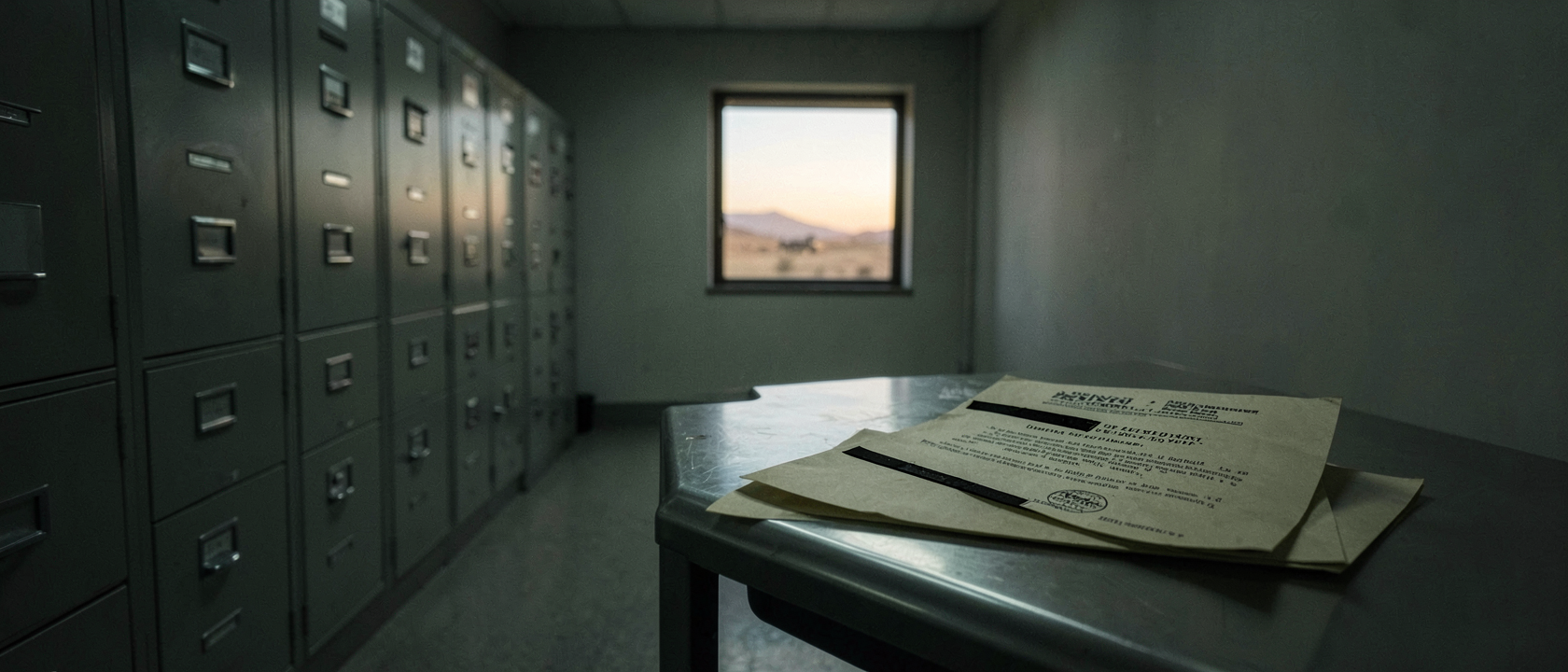
In June 2023, the Department of Defense’s Initial Denial Authority issued a response to FOIA case 23-F-0389, filed by John Greenewald of The Black Vault. The request targeted DoD records related to an image publicly known as the “Mosul Orb.” All responsive records were withheld under three statutory exemptions in 5 U.S.C. § 552: (b)(1), (b)(7)(A), and (b)(7)(E). Greenewald’s appeal was itself denied in December 2023.
Two additional denial letters arrived within sixty seconds of the case 23-F-0389 response. Each covered a different subject: one addressed correspondence between AARO (the All-domain Anomaly Resolution Office, established July 20, 2022) and an organization called UAPx; the other addressed records from AARO interviews with Dr. Robert Jacobs and Robert Salas. Both concurrent denials invoked (b)(7)(A) and (b)(7)(E). Neither invoked (b)(1).
A written statement from Air Combat Command addressed the classification of MQ-9 Reaper imagery. A Pentagon spokesperson declined in January 2023 to comment on the image’s origin, characterizing any such statements as remarks from unnamed sources alleging leaks from a classified report. Those five items constitute the official paper trail available for review.
April 16, 2016: What the Released Record Describes
According to journalists Jeremy Corbell and George Knapp, an aircraft over Mosul, Iraq recorded footage at 09:47 UTC on April 16, 2016, depicting an unidentified object. The Black Vault’s primary source identifies the platform as an MC-12, a medium-to-low-altitude twin-engine turboprop used for intelligence, surveillance, and reconnaissance. A later account from Liberation Times described the same platform as a CIA aircraft. These two characterizations have not been reconciled in any publicly available official document.
Corbell and Knapp released a still image from that footage on January 24, 2023, during Episode 1 of their podcast “Weaponized,” describing it as derived from a classified briefing last distributed on November 4, 2021, across classified government networks. On March 7, 2023, they released additional material they called the “Baghdad Phantom”: six still frames from a seven-second clip, purportedly captured by an MQ-9 Reaper drone over central Iraq.
On July 1, 2025, journalist Dustin Slaughter, operating as The UAP Register, released a four-second video clip obtained through a FOIA lawsuit filed March 26, 2024 (case 1:24-cv-00862, U.S. District Court for the District of Columbia), naming the U.S. Air Force and NASIC (the National Air and Space Intelligence Center at Wright-Patterson Air Force Base, Ohio) as defendants. The litigation confirms NASIC’s possession of the footage; which agency operated the aircraft is not established by any available document. No released DoD document confirms or denies the authenticity of either set of images, and the Pentagon’s January 2023 statement is the full extent of any official response to those releases.
The Three Exemptions: Plain Definitions
Exemption (b)(1) covers information classified under Executive Order 13526. Its presence establishes formally that the DoD considers responsive records classified in the interest of national security. It says nothing about what those records contain.
Exemptions (b)(7)(A) and (b)(7)(E) operate together. The first permits withholding of records compiled for law enforcement purposes where disclosure could reasonably interfere with ongoing or prospective enforcement proceedings; the second protects the techniques and procedures used in such investigations. Their combined invocation establishes that the DoD considers these records connected to a law enforcement proceeding, without identifying the proceeding, the agency conducting it, or the subject under investigation.
Default Secret: How MQ-9 Reaper Imagery Is Classified
Air Combat Command told The Black Vault that all imagery captured by the MQ-9 Reaper is classified by default under the platform’s Security Classification Guide, unless mission requirements call for sanitization and lower-classification release. ACC confirmed it cannot publicly disclose the specific classification level assigned under that guide.
This is a documented, non-anomalous explanation for why Reaper imagery would be withheld from a FOIA request: the classification is automatic and applies regardless of what the footage shows. Where the “Baghdad Phantom” material is concerned, this explanation accounts for the withholding fully.
The limit is specific. The MQ-9 Security Classification Guide applies to MQ-9 footage. The primary incident on April 16, 2016, is identified in The Black Vault’s source material as involving an MC-12, not a Reaper, and no released document extends ACC’s default-classification statement to that platform.
A Timing Fact Without an Explanation
The two denial letters that arrived within sixty seconds of the case 23-F-0389 response cover subjects with no direct connection to the Mosul imagery. Both share (b)(7)(A) and (b)(7)(E) with the Mosul denial, but neither carries the (b)(1) national security exemption present in the Mosul letter. DoD FOIA processing may batch responses, apply exemptions across categories of related requests, or operate through automated systems. The record does not say which of these possibilities applies. The sixty-second window is a documented fact about the paperwork; what it reflects about DoD processing or exemption policy is not established in the released material.
An Unanswered Question and a Named Guess
Pentagon spokesperson Susan Gough declined to answer approximately four dozen inquiries and follow-ups from The Black Vault over 27 months. A follow-on FOIA request seeking records explaining AARO’s internal rationale for applying the (b)(7) exemptions returned emails with more than 95 percent of the content withheld. The object in the Mosul footage has received no technical, meteorological, or prosaic identification in any public record; CENTCOM told The Black Vault it had nothing to provide on the Baghdad Phantom imagery, and ACC confirmed it could not verify the validity of that material.
Greenewald stated, explicitly flagging it as speculation, that if AARO’s UAP investigations are being treated as law enforcement proceedings, all FOIA requests touching AARO or UAP may be exempt from release in their entirety, classified or not. Marik von Rennenkampff, a former DoD and State Department official, argued in a published piece that the (b)(7) denials constitute circumstantial evidence that a law enforcement body, possibly the DoD Inspector General, is conducting a broad investigation. That is his characterization, not a finding from any released document. The record neither confirms nor refutes either hypothesis. As of the most recent update to The Black Vault’s published account, the records in case 23-F-0389 remain withheld and no official characterization of the object exists anywhere in the public record.