
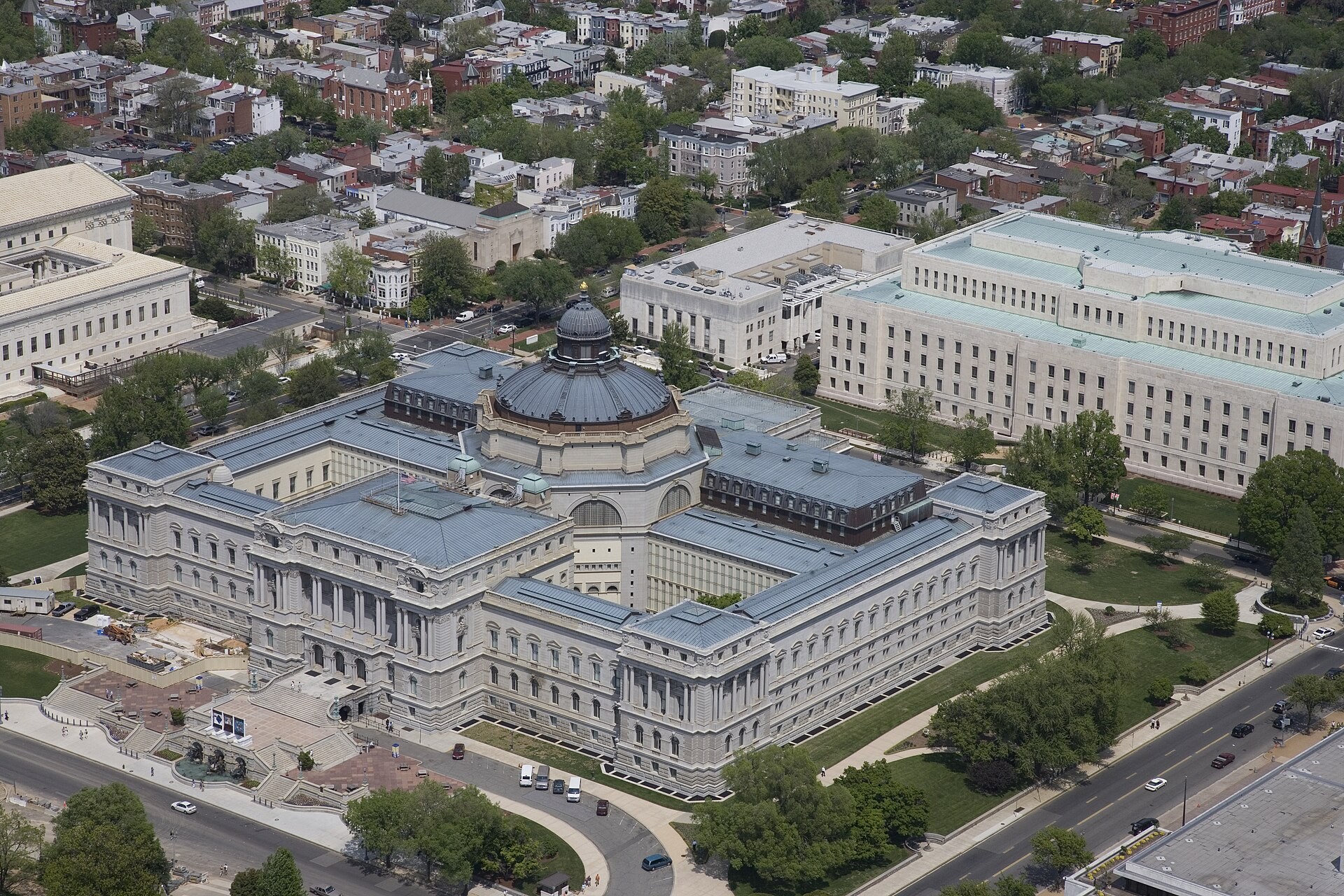
The Library of Congress is the de facto national library of the United States and, with more than 175 million items as of 2022, the largest library in the world by that measure. Founded on April 24, 1800, as a legislative reference collection, it has grown far beyond that original mandate into an institution that holds materials in approximately 470 languages, employs 3,242 people, and serves researchers, legislators, and the public from its campus in Washington, D.C. Its collections span books, maps, motion pictures, sound recordings, manuscripts, and objects ranging from medieval manuscripts to 20th-century baseball cards, all managed as a legislative branch agency of the federal government.
Key facts
- Country: United States
- Founded: 24 April 1800
- Headquarters: Washington, D.C.
- Type: national library; United Nations Depository Library; parliamentary archives; legislative branch agency
- Employees: 3,242
- Website: https://loc.gov/
Origins and Early History
Congress established the Library on April 24, 1800, primarily to serve members of the legislature. When British forces burned the Capitol, they destroyed the Library’s original collection. Congress responded on January 30, 1815, by approving the purchase of former President Thomas Jefferson’s personal library of 6,487 books for $23,950, immediately restoring the institution’s working collection and giving it an intellectual depth it had previously lacked.
Jefferson’s collection did not survive intact. On December 24, 1851, a second fire destroyed approximately 35,000 volumes, including nearly two-thirds of the books Jefferson had originally sold to Congress. The rebuilding effort that followed set the Library on a path of aggressive acquisition that has not stopped since.
The Library’s relationship with Congress was formalized in stages. The Joint Committee on the Library, established by statute on January 26, 1802, holds oversight of the Library’s operations and is the oldest continuing joint committee of the U.S. Congress. Though it has no legislative jurisdiction, it also manages the National Statuary Hall Collection and the U.S. Botanic Garden.
Growth into a National Institution
A turning point in the Library’s scope came in 1870, when Congress centralized all U.S. copyright registration and deposit activities there. Copyright deposits became a core acquisition method, particularly for maps, music, motion pictures, and photographs, and the Copyright Office continues to function as a national registry for creative works.
By the end of 1901, the Library had already become the first American library to reach one million volumes. In 1903, President Theodore Roosevelt issued an executive order transferring the records of the Continental Congress and the personal papers of six Founding Fathers to the Library, with the aim of making them more accessible to the public and to scholars.
Under Librarian Herbert Putnam, who served from 1899 to 1939, the Library established a Legislative Reference Service in 1914 to expand direct services to Congress. That service later became the Congressional Research Service. Putnam’s 40-year tenure transformed the institution: when he retired, the Library had a staff of 1,100, a book collection of six million volumes, and an annual appropriation of approximately $3 million.
The Library became a National Historic Landmark in 1975, recognized for its contributions to American history and culture through architecture, education, politics, and government.
Collections and Preservation
The Library’s collections contain materials in approximately 470 languages, with roughly half of the book and serial collections in languages other than English. Each working day the Library receives approximately 15,000 items and adds more than 10,000 to its permanent collections.
The Rare Book and Special Collections Division, whose reading room is modeled after Philadelphia’s Independence Hall, holds over 1 million items: books, broadsides, pamphlets, theater playbills, prints, posters, photographs, and medieval and Renaissance manuscripts. On March 11, 2025, the Library officially acquired through donation the 1690 ‘Tuscan-Medici’ Stradivarius viola, valued at $30 million and given by David and Amy Fulton and the Baird family’s Tuscan Corporation, making it the second Stradivari viola in the Library’s collection.
Film preservation is governed by the National Film Preservation Act of 1988, under which the Librarian of Congress selects 25 films each year deemed ‘culturally, historically, or aesthetically significant’ for the National Film Registry. As of 2025, 925 films had been selected in total. The physical preservation of audiovisual materials takes place at the Packard Campus for Audio-Visual Conservation near Culpeper, Virginia, a primarily underground facility on 45 acres that houses 6.3 million collection items and 124 nitrate film vaults, the largest concentration of such vaults in the Western Hemisphere.
The American Folklife Center, created by Congress on January 2, 1976, serves as the national repository for folklife documentation. It encompasses the Archive of Folk Culture, which was established within the Library in 1928 and contains the largest collection of American Indian music and spoken word in existence, including the earliest ethnographic field recordings made anywhere in the world.
Services to the Public
The National Library Service for the Blind and Print Disabled (NLS), administered by the Library, was established by an Act of Congress in 1931 to serve blind adults. Congress expanded it in 1952 to include children, in 1962 to provide music materials, and in 1966 to serve individuals with other physical disabilities preventing them from reading regular print. The NLS catalog contains over 300,000 records for talking books, braille books, music scores, magazines, and other accessible material, all mailed free of charge as ‘Free Matter for the Blind or Handicapped’ through a separate appropriation to the United States Postal Service. The groundwork for such a service predates the legislation by decades: Librarian of Congress John Russell Young created a reading room for the blind in 1897 containing about 500 books and music items in raised characters.
The Library presents the National Jukebox, a free online service that makes historical sound recordings available to the public, drawing from the collections of the Packard Campus for Audio-Visual Conservation. The Poet Laureate Consultant in Poetry is appointed annually by the Librarian of Congress and serves from October to May to raise national awareness of poetry.
The Veterans History Project was created by unanimous vote of both the House and Senate and signed into law on October 27, 2000 (Public Law 106-380). It collects, preserves, and makes accessible the firsthand recollections of U.S. military veterans from World War I through more recent conflicts and peacekeeping missions.
The crowdsourced transcription program ‘By the People’ launched on October 24, 2018, as a pilot of LC Labs and became a permanent program in January 2020. It covers over half a million images from the Manuscript, American Folklife Center, Law Library of Congress, and Rare Book and Special Collections divisions. In a 2026 digital update, the Library made available two searchable, full-text transcription datasets for the Manuscript Division’s Abraham Lincoln papers: one produced through ‘By the People’ and one from a collaboration with the Lincoln Studies Center at Knox College.
Digital Preservation and Web Archiving
The Library debuted its website on June 22, 1994, at the American Library Association annual conference in Miami, Florida, and launched its National Digital Library program on October 13, 1994, aimed at digitizing primary sources related to American history.
The Library was a founding member of the International Internet Preservation Consortium (IIPC) in 2003. By the end of 2025, its web archive program had completed 25 years of operation, accumulating over 5.7 petabytes of archived data representing online content published in 137 languages across 218 countries, organized into 203 web archive collections.
Did you know
- The Library’s Gutenberg Bible, purchased in 1930 as part of a $1.5 million congressional acquisition, is one of only three perfect, complete copies of the Bible printed on vellum known to survive in the world; the other two are held by the Bibliothèque Nationale de France and the British Library. (thehistoryblog.com)
- Each working day the Library receives approximately 15,000 items and adds more than 10,000 of them to its permanent collections, making it one of the fastest-growing library collections in the world. (loc.gov)
- The Library holds a lock of President Abraham Lincoln’s hair collected after his assassination in 1865, a lock of President Ulysses S. Grant’s hair that Grant sent his wife as a gift in 1864, and a coil of hair from composer Ludwig van Beethoven collected by a fan after his death in 1827. (cbsnews.com)
- The Library’s Archive of Folk Culture contains the largest collection of American Indian music and spoken word in existence, including the earliest ethnographic field recordings made anywhere in the world. (loc.gov)
- By the end of 1901, the Library of Congress became the first American library to reach one million volumes, marking a milestone in the history of public access to knowledge in the United States. (cool.culturalheritage.org)
- The Library holds a collection of more than 2,000 baseball cards from the turn of the 20th century, illustrating the remarkable breadth of its collecting mandate beyond books and manuscripts. (cbsnews.com)
- Jefferson’s 6,487-volume library, purchased in 1815, was organized using a subject arrangement he derived from Sir Francis Bacon’s division of knowledge, a classification system the Library of Congress used to organize its book collection for nearly a century. (guides.loc.gov)
- The Thomas Jefferson Building’s Great Hall contains metallic ceiling ornamentation that restorers discovered during renovations in the 1980s is actually aluminum leaf, not the silver leaf it had long been assumed to be. (loc.gov)
- In 1969, the National Press Club donated audiotapes of nearly 2,000 talks recorded since 1952 to the Library of Congress; by September 2026, 62 of these talks had been made available online, including one featuring Librarian of Congress James Billington from 1989 announcing the American Memory digital project. (blogs.loc.gov)
- Herbert Putnam served as Librarian of Congress from 1899 to 1939, a span of 40 years, making him by far the longest-serving person in the role; when he retired, the Library had a staff of 1,100, a book collection of six million volumes, and an annual appropriation of approximately $3 million. (blogs.loc.gov)
- The Dayton C. Miller Collection, donated to the Library of Congress in 1941, includes approximately 1,600 flutes and other wind instruments from around the world dating as far back as 1100 BCE, along with around 10,000 pieces of sheet music and 3,000 books, making the Library home to the world’s largest collection of flutes. (grunge.com)
- The idea for a national library service for the blind was first developed in 1897 by Librarian of Congress John Russell Young, who created a reading room for the blind in the Library containing about 500 books and music items in raised characters, more than three decades before Congress formally established the National Library Service for the Blind in 1931. (loc.gov)
Data sources
- Wikidata
- loc.gov
- filmsite.org
- aoc.gov
- blogs.loc.gov
- citizen-dj.labs.loc.gov
- govinfo.gov
- nps.gov
- nlscatalog.loc.gov
- casar.house.gov
- openhumanitiesdata.metajnl.com
- guides.loc.gov
Data updated: 2026-10-31