
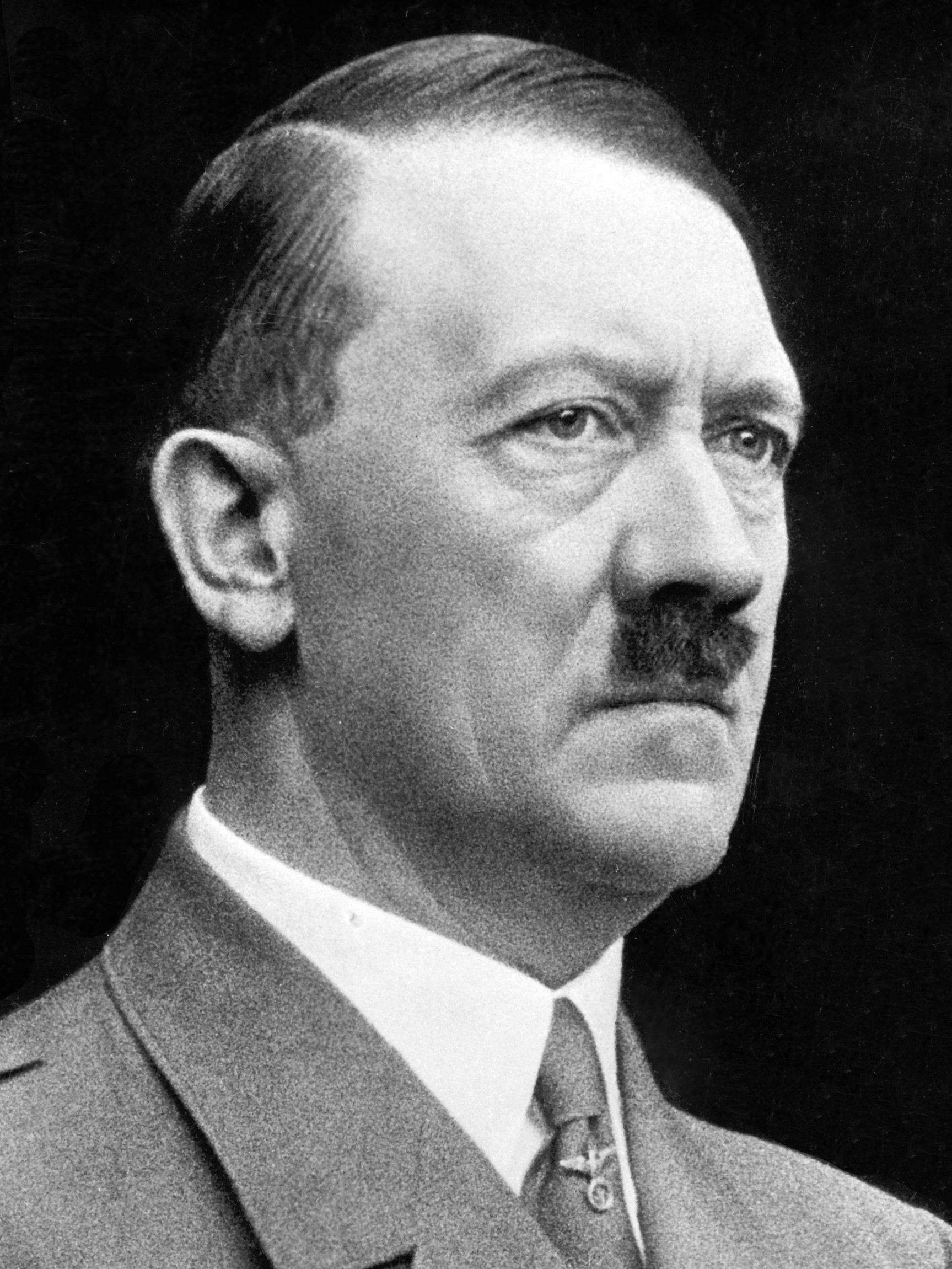
Adolf Hitler was an Austrian-born politician who ruled Germany as an absolute dictator from 1933 until his death on April 30, 1945, directing a regime responsible for the systematic murder of approximately six million European Jews and millions of others in the Holocaust. Born on April 20, 1889, in Braunau am Inn, he rose from obscurity in post-World War I Bavaria to lead the Nazi Party, seize control of the German state, and launch a war of conquest that became the deadliest conflict in human history. His aggressive, expansionist foreign policy is considered by historians the primary cause of World War II in Europe. Historian Ian Kershaw described him as “the embodiment of modern political evil.”
Key facts
- Born: 20 April 1889
- Birthplace: Braunau am Inn
- Died: 30 April 1945
- Place of death: Führerbunker
- Country: Cisleithania; Austria; German Reich; Nazi Germany
- Occupation: politician; Holocaust perpetrator
- Field: Nazism; propaganda in Nazi Germany; military dictatorship; politics
- Education: Lambach Abbey; Bundesrealgymnasium Linz Fadingerstraße
- Awards: Iron Cross (1914), 2nd class; Wound Badge (1918) in Black; honorary citizen of Sankt Andreasberg; honorary citizen of Goslar
Early Life and Education
Hitler was born on April 20, 1889, in Braunau am Inn, and was baptized in the Roman Catholic Church shortly afterward. His mother, Klara Polzl, was Alois Hitler’s third wife and was twenty-four years younger than him. She died of cancer in December 1907.
His formal schooling took place at Lambach Abbey and at the Bundesrealgymnasium Linz Fadingerstraße, but he never pursued higher education successfully. He applied to the Academy of Fine Arts Vienna in 1907 and was rejected; he applied again in 1908 and was rejected a second time. The examiners noted that his test drawing showed ‘too few heads.’ Following those rejections and his mother’s death, Hitler spent approximately five years in Vienna earning a meager living painting posters and postcards.
World War I Service
In August 1914, Hitler volunteered for service in the Sixteenth Bavarian Infantry Regiment and served throughout World War I as a dispatch runner, rising no higher than the rank of Lance Corporal. He was wounded twice during the conflict and was badly gassed four weeks before the war’s end, spending three months recuperating in a hospital in Pomerania.
For his service, he received the Iron Cross, 2nd class, in 1914, and the Wound Badge in Black in 1918.
Rise to Political Power
Hitler joined the Deutsche Arbeiterpartei (German Workers’ Party) in September 1919 and became its leader in 1921, reshaping it into what would become the Nazi Party. An early attempt to seize power by force, the Beer Hall Putsch, ended in failure. Hitler was convicted of treason and sentenced to five years in prison, but served only approximately nine months at Landsberg Prison.
During his imprisonment he dictated Mein Kampf, the book that outlined his ideology and ambitions. From 1925 to 1945, the book sold over 12 million copies and was translated into more than a dozen languages, including a braille edition for blind Germans. Hitler had originally wanted to title it ‘Four and a Half Years of Struggle Against Lies, Stupidity, and Cowardice,’ but his publisher Max Amann insisted on the shorter title.
The Nazi Party’s electoral performance gave Hitler his path to legal power. In the July 1932 parliamentary elections, the party won 37 percent of the vote, more than any other party. German President Paul von Hindenburg appointed Hitler as Chancellor of Germany on January 30, 1933. The Enabling Act, passed by the German parliament on March 23, 1933, then gave Hitler the power to make laws without the approval of parliament or the president, effectively transforming Germany into a dictatorship. Following the death of President von Hindenburg on August 2, 1934, a new law combined the offices of president and chancellor, making Hitler the absolute dictator of Germany under the title of Fuhrer.
World War II and the Holocaust
Under Hitler’s leadership, Germany invaded Poland on September 1, 1939, triggering World War II. Britain and France declared war on Germany two days later, on September 3, 1939.
The Holocaust, the state-sponsored genocide directed by Hitler and the Nazi regime, resulted in the systematic murder of approximately six million European Jews between 1941 and 1945, representing around two-thirds of Europe’s Jewish population. The Nazis also murdered more than 250,000 Roma people, over three million Soviet prisoners of war, and nearly two million Poles during the same period.
Hitler died by suicide on April 30, 1945, in the Führerbunker as Allied forces closed in on Berlin. Because he died before the Nuremberg Trials began in November 1945, he was never indicted, tried, or convicted. The tribunal refused to conduct trials in absentia or issue posthumous judgments.
Statelessness and German Citizenship
For a period of seven years, from 1925 to 1932, Hitler was stateless. He had renounced his Austrian citizenship and did not hold German citizenship for most of his rise to political prominence. He eventually obtained German citizenship through an administrative appointment as a government official in Braunschweig, which was otherwise an obscure civil service post arranged to resolve his legal status.
Did you know
- Hitler was stateless for seven years, from 1925 to 1932, after renouncing his Austrian citizenship and before obtaining German citizenship through an obscure administrative appointment as a government official in Braunschweig. (theconversation.com)
- Hitler’s regiment, the 16th Bavarian Reserve Infantry Regiment, suffered 3,754 casualties over 45 months and 36 major battles in World War I, during which Hitler served primarily as a headquarters dispatch runner behind the front lines. (warfarehistorynetwork.com)
- Hitler originally wanted to title Mein Kampf ‘Four and a Half Years of Struggle Against Lies, Stupidity, and Cowardice,’ but his publisher Max Amann insisted on the shorter title. (ebsco.com)
Data sources
- Wikidata
- encyclopedia.ushmm.org
- historyskills.com
- worldhistory.org
- jewishvirtuallibrary.org
- history.com
- historycrunch.com
- nationalww2museum.org
Where it appears
Data updated: 2026-10-31