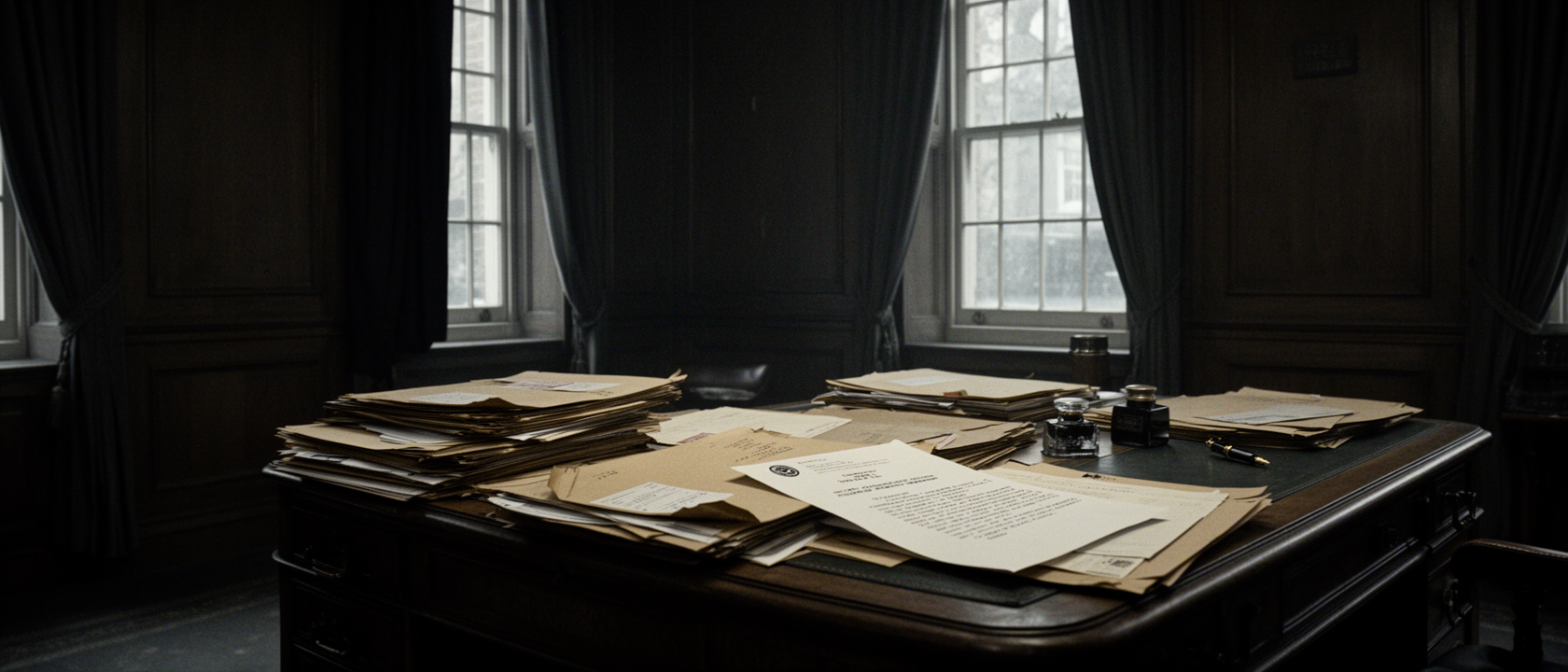
File KV 4/16
Six weeks after Neville Chamberlain returned from Munich declaring “peace for our time,” MI5 produced an intelligence assessment that took a rather different view of how the meeting had gone.
The document carries catalogue reference KV 4/16 and is dated November 7, 1938. It belongs to the KV 4 series, which covers MI5 policy matters and liaison with other agencies. The assessment concerns how the Nazi regime read the leadership of the United Kingdom in the aftermath of the Munich Agreement, signed September 30, 1938, under which Britain, France, Germany, and Italy permitted Germany to annex the Sudetenland region of Czechoslovakia. On the same day, Chamberlain separately signed an Anglo-German declaration of cooperation with Hitler and, outside 10 Downing Street, made the “peace for our time” statement, a phrase frequently but incorrectly rendered as “peace in our time.”
The National Archives describes KV 4/16 as one of several MI5 assessments from late 1938 that openly criticized government foreign policy toward Nazi Germany. The original classification assigned to the file at the time of its creation is not recorded in the available primary source, nor is the date on which it was released to the public.
The Brückner Testimony
The report’s principal source is identified only by surname, rendered in capital letters: BRÜCKNER. The full identity behind that name, based on what is recorded, is Wilhelm Friedrich Brückner (December 11, 1884, August 18, 1954), who held the rank of SA-Obergruppenführer and served as Adolf Hitler’s Chief Adjutant from February 20, 1934, until his dismissal on October 18, 1940. In November 1938, that relationship was still current.
The report attributes several statements to Hitler as relayed through Brückner. According to the document, Hitler described Prime Minister Chamberlain using the German word “Arschloch,” rendered in the National Archives commentary as “arsehole.” The same reporting mocked the British Empire’s “umbrella-pacifism,” a phrase that played on Chamberlain’s trademark umbrella. On the question of democratic governance, Brückner’s account recorded Hitler as saying that England and France would “jog-trot themselves to death with their democracy,” and separately that “it is astounding how easy the democracies make it for us to reach our goal.”
On British rearmament, the report attributed to Hitler a specific forecast: if Chamberlain did not move immediately toward “total” war preparations and institute universal conscription by the spring of 1939, Britain might consider its World Empire as lost. On colonial policy, it recorded his stated intention to apply to any future colonial demands the same escalating tactics used in Czechoslovakia, pressing harder the more concessions were offered.
The Institutional Conclusion
MI5’s reading of the Munich Agreement diverged sharply from Chamberlain’s public interpretation of it. Where Chamberlain presented the settlement as a stabilizing outcome, the report concluded it had produced the opposite effect on Hitler. Rather than satisfying him, the British conduct had persuaded him that the government in London was weak and susceptible to further pressure. In MI5’s assessment, appeasement had not reduced the risk of confrontation; it had encouraged it.
The report was, according to the National Archives, part of a pattern of internal dissent from the government’s position, not an isolated judgment.
As for whether Chamberlain actually read any of this: the fact that Lord Halifax, the Foreign Secretary, underlined Hitler’s description of Chamberlain in the report is recorded. The National Archives notes that it is thought Halifax subsequently showed the document to the Prime Minister. That remains an inference drawn from available evidence, not a fact confirmed by the primary record.
Subsequent events gave the MI5 position some weight. On March 15, 1939, Hitler violated the Munich Agreement by occupying Bohemia and Moravia. On March 31, 1939, Chamberlain announced in the House of Commons a British guarantee to defend Polish independence. Germany invaded Poland on September 1, 1939, and Britain declared war on Germany on September 3, 1939.
The Provenance Gap
The report’s picture of Hitler rests, in significant part, on testimony from a single named source. What the record does not settle is whether the statements attributed to Hitler were actually spoken by him.
The National Archives raises a specific alternative: that the account Brückner provided, or whoever transmitted it, may have been shaped or fabricated by German sources hostile to the existing Nazi leadership. The motive identified for such a fabrication is not vague. The record names it as a possible effort to push Britain toward a harder military posture. A German source who wanted to see Britain rearm aggressively might have found that placing blunt insults in Hitler’s mouth was a practical way to make that case.
The report also does not explain how MI5 obtained intelligence attributed to Brückner, or through what intermediary it passed. Whether the information came directly, through a second party, or through a chain that introduced additional distortion is not recorded in the available primary source.
The specific quotes may be accurate. But KV 4/16 cannot verify them; it can only record that they were reported. Whether the insults were uttered, invented, or somewhere in between is a question the file opens and does not close.