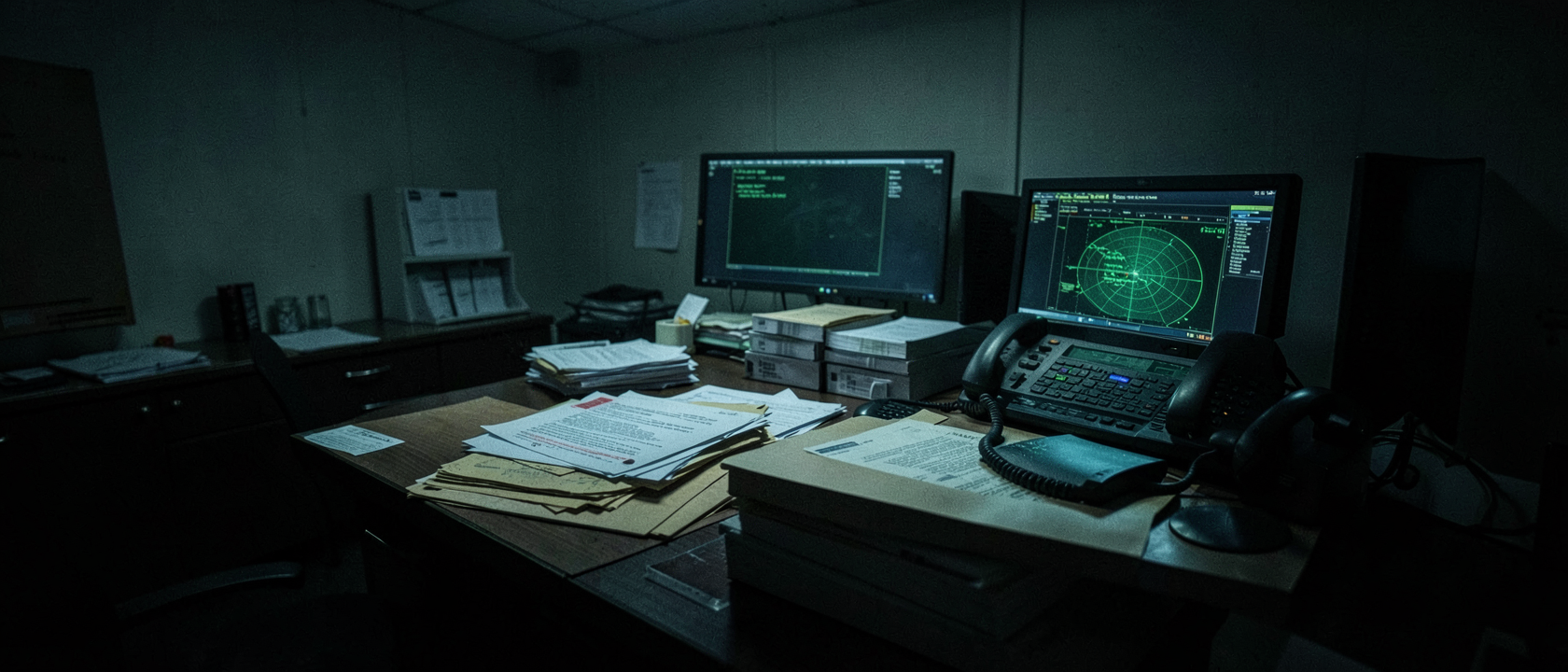
The Black Vault filed a Freedom of Information Act request in January 2022 seeking the email traffic of Navy program manager Yasir Qureshi, whose name runs through records of the Unidentified Aerial Phenomena Task Force (UAPTF) under directors Jay Stratton and later Brennan McKernan. The task force had existed since August 4, 2020, set up by the Department of Defense to look into whether unexplained aerial sightings posed a security risk. The Navy’s answer came as a twenty-page release package, case number DON-NAVY-2022-003198, roughly one megabyte, published by The Black Vault on June 3, 2025. It covers email threads from October through December 2021, months when the task force was being folded into a new office while officials tried to arrange briefings with allied intelligence services. The Navy applied FOIA Exemption (b)(6), which lets an agency withhold personal information where release would be an unwarranted invasion of privacy, but applied it unevenly: names, addresses, and phone numbers, including Qureshi’s, surfaced anyway before The Black Vault reapplied the intended redactions. Qureshi’s name still appears because it was already in the Navy’s official FOIA response letter, itself a public record.
A complaint about three Christmases
One thread opens with a Federal Aviation Administration employee describing three separate sightings, all observed from the ground, all on Christmas night, in 1991, 1992, and 1993. The employee wrote that they were weighing whether to send the account to the task force, adding they would feel more comfortable elaborating if historical radar data confirmed anything unusual on those dates. ODNI Public Affairs routed the message to Navy officials and eventually the UAPTF, and one task force official’s reply shows direct contact with the observer, treating the account as worth logging rather than dismissing. Beyond that, the released pages give no location, no altitude, nothing but the word “unexplained.” The entry resembles a routine report log, with no indication further investigation followed.
A meeting on the calendar
A separate exchange fixes a classified briefing for December 8, 2021, between U.S. officials and their Five Eyes counterparts, Australia, Canada, New Zealand, the United Kingdom, and the United States. The session was postponed over what the emails call only a calendar conflict, with no further detail. One official wrote that the task force did not want to seem dismissive of its allies’ time and now had “an obligation” to keep the conversation going. Documents obtained separately by Australian researcher Grant Lavac describe a body called the FVEY Inaugural UAP Caucus Working Group, meant to build shared awareness of each ally’s UAP detection and reporting efforts. Nothing in the Navy release names which countries were slated for December 8, and nothing confirms the meeting took place once rescheduled.
An office in the middle of moving
On November 23, 2021, Deputy Secretary of Defense Kathleen Hicks signed a memo directing the Office of the Under Secretary of Defense for Intelligence and Security, OUSD(I&S), to absorb the task force’s duties and build a lasting structure for UAP data, including work with foreign partners. The messages that follow show staff, Qureshi among them, unsure whether to proceed with hiring a contractor for knowledge management, given both the reorganization and an active Continuing Resolution, the stopgap funding measure that can freeze new spending until Congress passes a full budget. One thread weighs the risk of hiring for a job that might be “overcome by events” once OUSD(I&S) finishes the takeover. The record suggests bureaucratic uncertainty rather than concealment, as the office had not yet settled into its new form. In July 2022 that structure was renamed again as the All-domain Anomaly Resolution Office (AARO), with a broader mandate.
What the paperwork does not settle
The release contains no analytic finding on the FAA employee’s account: no conclusion, no cause, no note that anyone pulled radar data for the Decembers of 1991, 1992, or 1993. There is no assessment of what, if anything, came out of the caucus working group. What survives are forwards, scheduling notes, and hiring questions, the paperwork of a program being run rather than a phenomenon being examined. Qureshi’s LinkedIn profile, as of December 2024, lists him at OUSD(I&S) under the title “Deputy Director H&SA”; the release does not gloss those initials, and neither do public organizational charts.
Canberra says no such briefing happened
The Canberra Times, in reporting by Jamieson Murphy, set that gap against testimony from Australia’s own Parliament. In November 2022, Air Marshal Robert Chipman, then Chief of Air Force and now Vice Chief of Defence, told a Senate estimates hearing that he was “not aware of any formal discussions that we’ve held with the US,” responding to a question from Greens Senator Peter Whish-Wilson about whether Washington had raised UAP with Australian intelligence or the Air Force. He repeated the denial the following year. Separate briefing notes, prepared in May 2022 for an earlier estimates hearing, stated that neither the United States nor any other nation had requested or offered collaboration on UAP, and that Defence had no interest in pursuing it. Set against the Navy emails, which describe a briefing scheduled for December 8, 2021 and a working group premised on Five Eyes participation, the two accounts do not meet. The American paperwork never names Australia as a confirmed attendee at anything, and Chipman’s testimony never mentions a caucus working group at all. Asked directly whether Australia attended the rescheduled session, the Department of Defence did not answer.
Three explanations, unchosen
Grant Lavac, whose own FOIA requests turned up the caucus working group, called the gap “quite concerning” and argued that Chipman, as the officer who leads Australia’s internal UAP discussions, should have known of any exchanges with Washington. He offered three possible explanations: a plain failure of intelligence sharing between allies, incompetence somewhere in the chain, or what he called plausible deniability. He did not say which he thought most likely, and the three are not mutually exclusive. None of them is supported by anything in the FOIA release itself; they are Lavac’s reading of a gap the documents do not explain.
What remains is two paper trails, compiled for different purposes in different countries, that were never reconciled with each other. The American record shows a task force in transition, coordinating with allies and logging whatever the public sends it, including one FAA employee’s memory of three Christmas nights three decades gone. The Australian record shows an officer, under questioning, saying none of that reached him. Both statements are on file. The two accounts cannot both be complete.