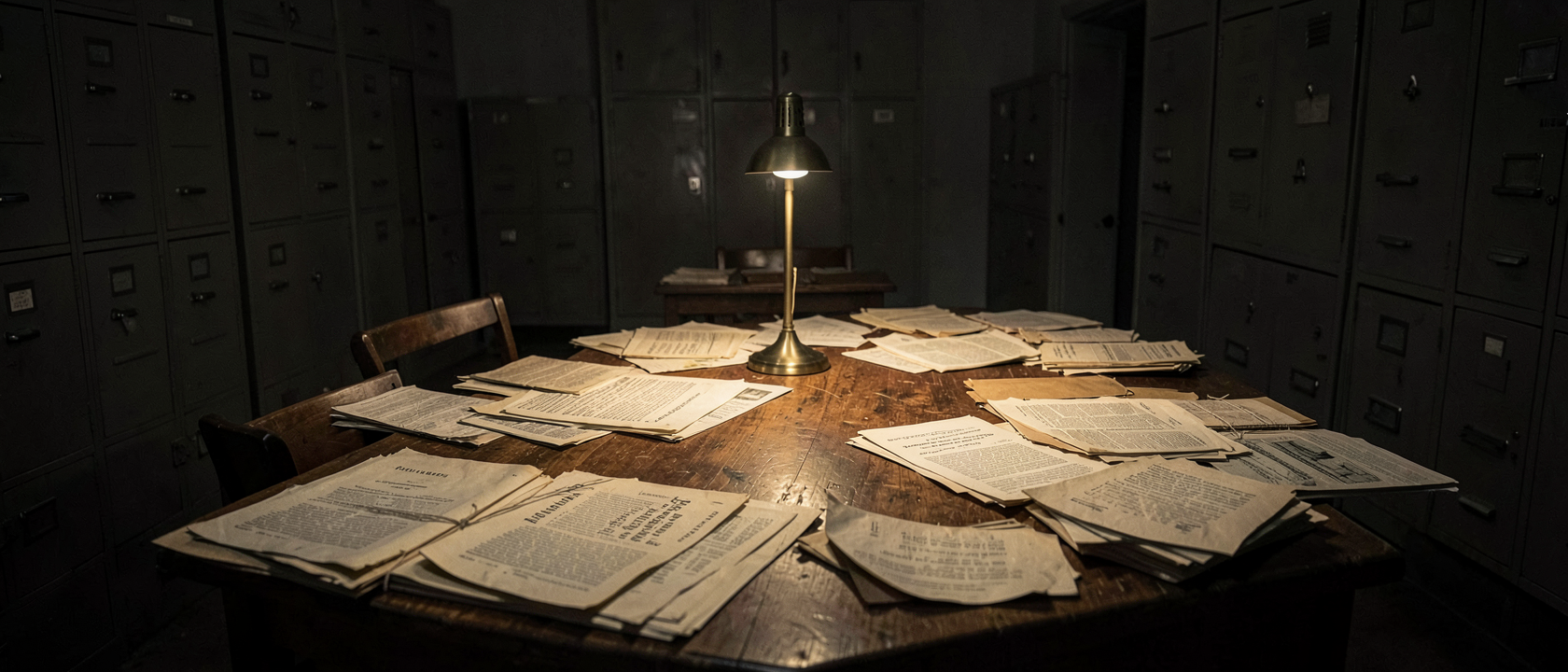
Filed as Threat: The Accidental Archive of Black Publishing in Britain
Archives usually know what they are for. This one does not, not entirely. The National Archives in London holds a scattered set of files documenting Black-led radical and community publishing in Britain between 1817 and 1975, and almost none of it was kept because anyone thought it mattered as literature or as the record of a movement. It was kept because someone in government wanted to watch, ban, or prosecute the people producing it. The paper trail runs wherever official attention happened to land, and it stops the moment that attention moved on.
Five series, two dates
The material sits across five archival series, named for the office that generated the paperwork: TS, the Treasury Solicitor, which handled Crown prosecutions; CO, the Colonial Office; MEPO, the Metropolitan Police; HO, the Home Office; and CRIM, trial records from the Old Bailey. The earliest item is Robert Wedderburn’s pamphlet series, “The Axe Laid to the Root,” accessioned in 1817 as TS 11/45/167, part of the paperwork built around his trial. The latest is HO 376/222, a Home Office file opened in 1975 on “Black Voice,” the paper of the Black Unity and Freedom Party. Nothing between those two dates is filed as literature, journalism, or political history. Every item entered the record as evidence, as a complaint to be adjudicated, or as a threat to be assessed.
How four publications reached government hands
Each item arrived through a specific, attributable act, not a general policy of watching Black writers. In 1919, colonial officials judged that “The Negro World,” the Universal Negro Improvement Association’s paper, was likely to incite Black populations against white people, and a colonial governor ordered copies seized on arrival; one sits in CO 23/285. In 1937, Colonial Secretary William Ormsby-Gore signed an order banning the import of “The Negro Worker” into what is now Ghana, and five copies were filed alongside that order in CO 323/1518/9. The Metropolitan Police kept copies of “International African Opinion” after monitoring the International African Service Bureau through the late 1930s, filed as MEPO 38/91, and copies of “Black Power Speaks” after raiding the British Black Panther Movement’s Portobello Road headquarters in July 1968, filed as MEPO 2/11409. Rhodan Gordon’s “Black People’s News Service” was seized from his house at his arrest and entered as evidence at the Mangrove Nine trial, filed as MEPO 31/21.
What the state decided, case by case
Kept apart from the seizures are the actual outcomes. Wedderburn was tried for seditious blasphemy and sentenced to two years at Dorchester Jail; the National Archives’ own record names Dorchester, though at least one later account places the sentence at Carlisle. Roy Sawh was tried under the Race Relations Act in 1967 on a charge of inciting racial hatred, a case filed as CRIM 1/4777. Obi Egbuna, who had left the Universal Coloured People’s Association to found the British Black Panther Movement, was arrested in July 1968 after police seized Movement material, having encouraged Black people to resist police violence. In 1973, the Race Relations Board considered a National Front complaint that “Grass Roots,” the Black Liberation Front’s paper, discriminated by restricting an art competition to Black entrants. The Board’s file, CK 2/1212, records that officials privately agreed the paper had technically breached the Race Relations Act, then chose not to prosecute, reasoning that nobody except the National Front would come out of a court case looking like a winner. Of everything in these files, that is the one place where the state writes down its own thinking rather than simply acting on it.
Preserved by the people watching, not the people meaning it
The clearest sign of how this record was built sits inside two of the files already named. The International Trade Union Committee of Negro Workers stated its purpose as solidarity among workers of every race, and its paper tied colonial rule to the rise of fascism; that statement survives only because a Colonial Office official copied it into the same file used to justify banning the paper it appeared in. The International African Service Bureau’s founding editorial announced itself as speaking for oppressed Black people and workers everywhere; it survives only because the Metropolitan Police kept a copy while watching the group. Neither text was preserved because an official agreed with it or valued it as writing. Both were preserved as things that needed watching.
Where the paper trail stops
Three gaps sit at the edge of this record, and each is a fact about the paperwork, not a hint about what is missing. The Home Office file on “Black Voice” was compiled amid a dispute over grant funding for projects linked to the Black Unity and Freedom Party, and amid concern about member Anthony “Bonsu” Munroe; the file does not record how that funding review ended. The Race Relations Board’s file on “Grass Roots” ends with the 1973 decision not to prosecute; it does not say whether the Board took any further action afterward. And MEPO 38/91, cataloged to run from 1937 to 1965, actually holds copies only from 1938 and 1939. What, if anything, was collected on the International African Service Bureau in the years after that is not stated in the file.
What the Black Liberation Front said afterward
A later issue of “Grass Roots,” still within CK 2/1212, carries the Black Liberation Front’s own account of the Board that had just declined to prosecute it. The group wrote that the Board existed, in its words, “to oppress Black people and not to prevent discrimination.” That is the Black Liberation Front’s claim about the Board, made after the fact. It is not a finding from any inquiry, tribunal, or official review, and the file does not record any response to it.
The joke the file wasn’t looking for
One detail in this record has nothing to do with a document and survives only by report. The Metropolitan Police file on the Racial Action Adjustment Society, filed as MEPO 28/4 in 1970, identifies the group and its founder, Michael X (born Michael de Freitas in Port of Spain, Trinidad, in 1933), and gives no reason for the choice of acronym: RAAS. Accounts of the group describe it as a private joke, since the letters spell a Jamaican Patois swear word that unwitting white broadcasters would repeat on air without knowing what they were saying. That story comes down to us through what people said about Michael X afterward, not through anything a police officer wrote down. It survived anyway, filed next to material the state took to be genuinely dangerous.