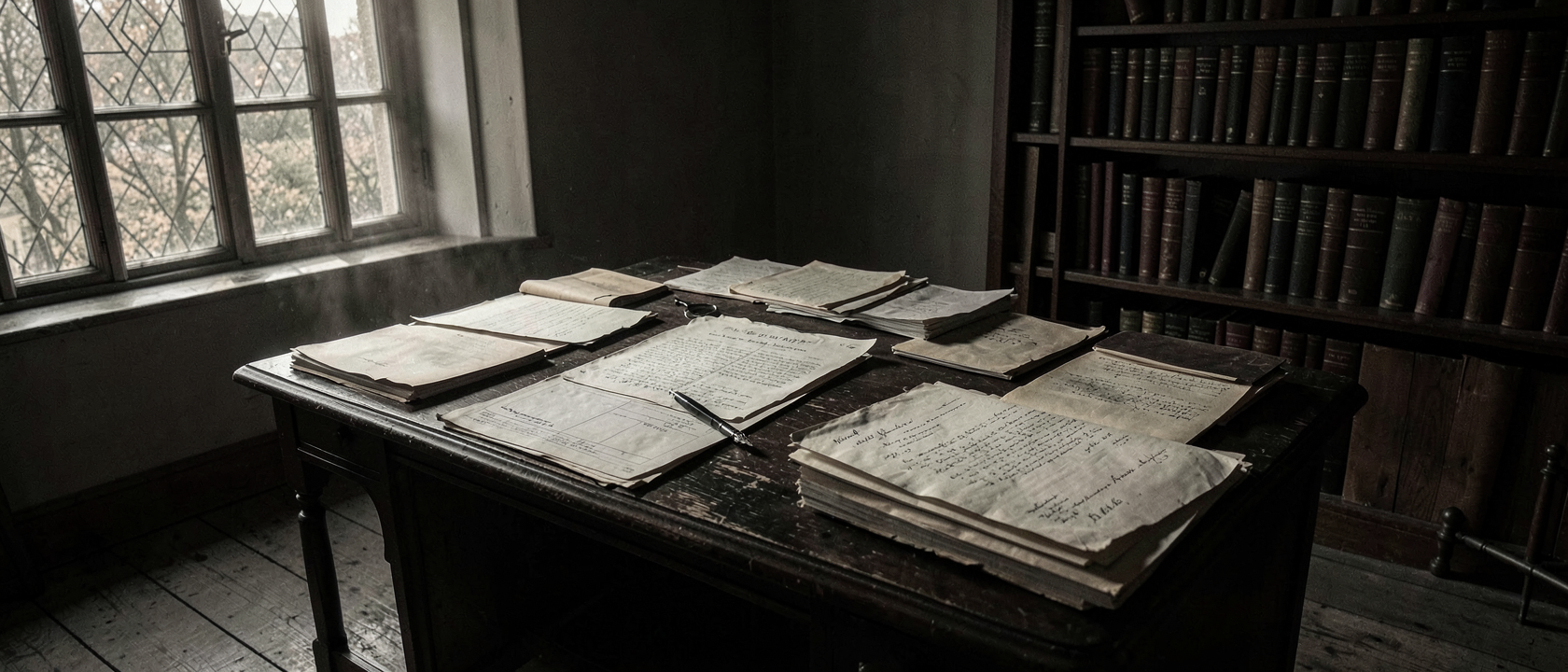
Most estate duty files are exactly as dull as their name promises: a ledger of who inherited what, and how much the Crown collected for the privilege. IR 59/805, the death duty account for the writer Virginia Woolf, follows that form to the letter. It also contains one line the form was never built to hold.
The File Itself
IR 59/805 is held at The National Archives in the United Kingdom and was published online as a featured record on August 2, 2026. It is not a biography or a narrative account of Woolf’s life. It is an Inland Revenue estate duty file, the tax paperwork generated when an estate passes to its heirs. The file gathers a sworn probate affidavit from Leonard Woolf, a valuer’s letter assessing the contents of Monks House and a storage annex at Place Farm, a beneficiary schedule, and a probate death-duty summary sheet stamped “REVIEWED.” The solicitors handling the estate, named throughout the correspondence, were Dollman & Pritchard of 37 Mecklenburgh Square, London.
The Estate, As Recorded
Virginia Woolf died at Rodmell, Sussex, on March 28, 1941. Probate was granted to her husband, Leonard Woolf, on August 19, 1941, under a will originally made on July 27, 1930. The valuer’s report set the household furniture, effects and books at £497 in total, of which Virginia’s half share came to £249. To that the valuer added jewelry valued at £7.15s and the manuscript of Mrs Dalloway at £50, for a combined value of £306.15s. The bequest schedule lists Clive Bell receiving £100 and jewelry, Adrian Stephen £50, Duncan Grant £50, and former domestic servant Nellie Boxall £10. The residue of the estate, real and personal, went to Leonard.
The Sackville-West Entry
One line in the schedule names Vita Sackville-West, recorded formally as “Hon. Mrs. Harold Nicholson” and described in the relationship column as “Stranger in blood,” meaning she was not a blood relative. Her bequest was the manuscript of Mrs Dalloway, valued at £50, with £5 charged in duty at a rate of 10 percent. Beside it, the file carries a note: “MS of book to be selected by husb.” Every other bequest in the schedule is a name, an item, a value. This is the only one that explains itself at all.
What the Duty Office Concluded
Nothing in the file suggests the Inland Revenue looked past the number. Duty officers were assessing value and collecting tax, not investigating intention. The valuation was set, the duty was charged, the file was reviewed and closed in the ordinary course. That the note “selected by husb.” goes unexplained is not evidence of anything held back. A duty officer’s job ended at the £50 figure and the £5 owed on it. The document was built to answer a tax question, and it answers only that one.
Where the Paper Runs Out
Some details cannot be pinned down from the surviving transcript. The valuer’s letter refers to instructions received “on the 17th ulto” and states the inspection took place “on the 22nd ulto,” using the old shorthand for “of last month,” but gives no month or year for either date. The review stamp on the summary sheet reads “17 APR 142,” almost certainly a rendering of 1942, though the file does not state the year outright. The 1930 will itself is not reproduced; only the bequest summary survives here. And nowhere does the record say why Leonard chose Mrs Dalloway, specifically, as the manuscript for Sackville-West. These are gaps in what the paperwork preserved, not signs that more once existed and was taken out.
What Was Said Afterward
The National Archives’ own commentary, published alongside the file, draws a connection the file itself does not make. It notes that Woolf had earlier given Sackville-West the manuscript of her 1928 novel Orlando (written with Vita in mind), and reads the later gift of the Mrs Dalloway manuscript as a sign of how much the relationship still mattered to Woolf near the end of her life. The same commentary observes that Orlando has since been described as “the longest and most charming love letter in literature,” without saying who first used the phrase. Both observations belong to the Archives’ account, written and published in 2026. Neither appears in Leonard Woolf’s affidavit, the valuer’s letter, or the duty schedule itself.
What the File Leaves You With
Set the later commentary aside and what remains is a single phrase inside an otherwise indifferent tax record: a manuscript, chosen by a husband, for a woman the form itself records as no relation at all. The file was never built to say what that choice meant, and it doesn’t try. It states the item, states the value, states the tax owed, and stops there. Whatever passed between Leonard Woolf and Vita Sackville-West in that decision is not in IR 59/805, and nothing in the surviving paperwork says it ever was written down anywhere else.