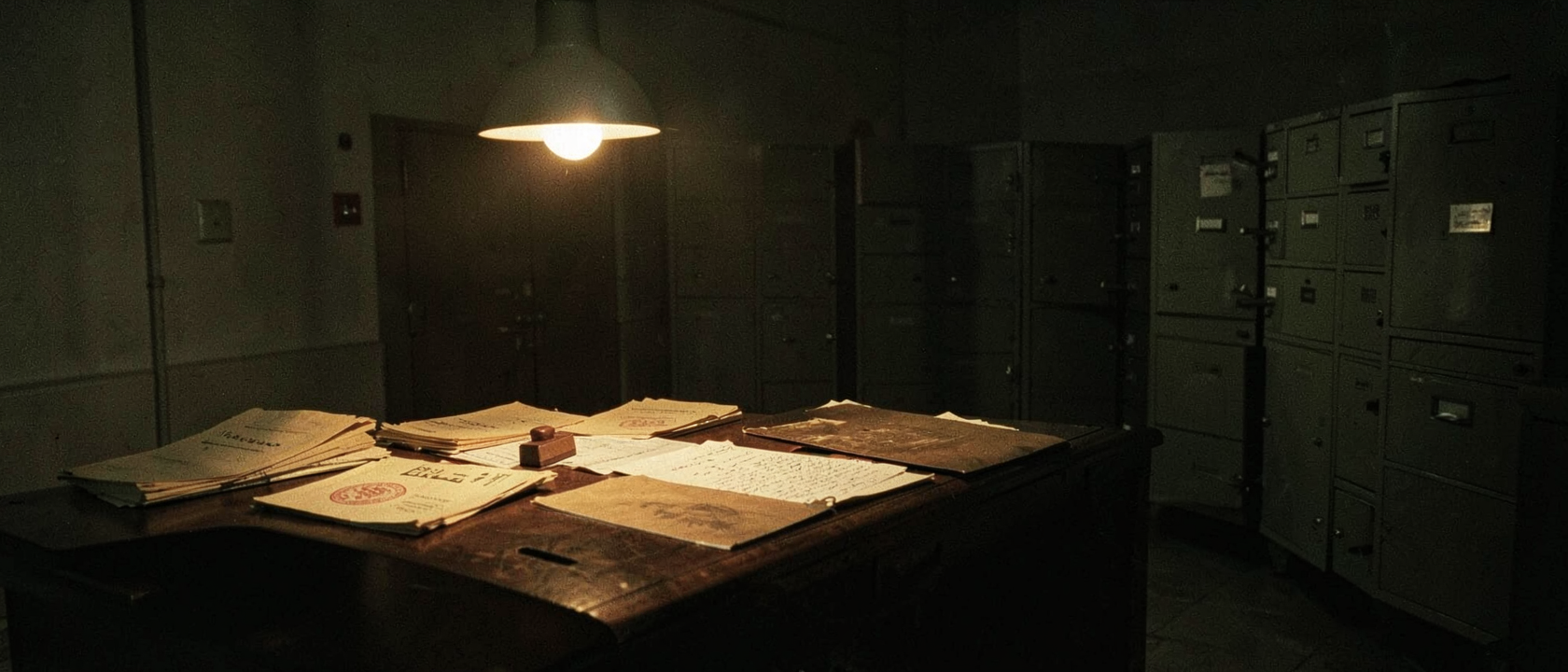
A government registry entry from June 1974 looks, on its face, like nothing worth keeping secret. It creates an intelligence coordination office. What actually matters is what was left out of the registry.
Two decrees, one number
Decree Law 521 was signed by General Augusto Pinochet and Chile’s military junta on June 14, 1974, and published in the Diario Oficial four days later, on June 18. The published text created the Dirección de Inteligencia Nacional, DINA, as an ordinary intelligence body: coordination, information gathering, nothing that would draw a second look.
Articles 9, 10 and 11 did not appear in that published version. They authorized DINA to detain, interrogate and, per the source record, eliminate people. Those three articles stayed outside the public record for thirty-six years, until journalist Jorge Escalante retrieved the original text through the Archivos Chile “Secret Decrees” project and published it in 2010. The existence of secret provisions had surfaced earlier, in 1975, when attorney Jose “Pepe” Zalaquett described them off the record to journalists including John Dinges, but the clauses themselves were not public until Escalante’s find. DINA had been operating since Pinochet secretly created it in mid-November 1973; the June 1974 decree gave it, in the words of a U.S. Defense attaché cable transmitting the censored text, “legal/official blessing” for an organization that was “already fully active.”
What the cables describe
Declassified U.S. material, from the Defense Intelligence Agency, the State Department, the U.S. Embassy in Santiago and a Senate committee, describes DINA director Manuel Contreras reporting exclusively to Pinochet, outside the normal military chain of command. A Senate report built on still-classified CIA documents put DINA’s staff at 3,800 officers and support personnel with an annual budget of $27 million; the same report elsewhere renders the figure as 38,000, a mistyped digit the document never corrects.
The cables and later Chilean court testimony, including statements from Capt. Ricardo Lawrence, describe a network of detention centers: Villa Grimaldi, Londres No. 38, Venecia, Malloco, Jose Domingo Cañas and Cuatro Álamos. Other records describe Michael Townley operating a nerve-gas laboratory in his own basement under a program later called Project Andrea, and Townley’s own handwritten account states the gas was used to kill at least two people in Santiago. The files also describe the 1975 disinformation campaign known as Operation Colombo, in which false accounts placed in Argentine and Brazilian outlets blamed disappearances on infighting among Chilean leftists; DINA’s founding role in Operation Condor, the intelligence-sharing arrangement agreed at a Santiago meeting between November 25 and December 1, 1975; a Condor-linked death-squad program called Plan Teseo, created at a second Santiago meeting in June 1976; and the September 21, 1976 car bombing on Sheridan Circle in Washington, D.C. that killed Orlando Letelier and Ronni Moffitt.
What was concluded, and by whom
The U.S. Embassy in Santiago assessed the Colombo stories, at the time, as “probably untrue,” attributing the disappearances to Chilean security forces rather than rival leftist factions, a formal judgment on file, not a later inference. In January 1978, the U.S. Justice Department indicted Contreras and his deputy, Pedro Espinoza, for the Letelier-Moffitt bombing and sought their extradition; Chile’s Supreme Court blocked it. After Chile returned to civilian rule, a Chilean court convicted both men for the assassination on November 12, 1993, sentencing Contreras to seven years and Espinoza to six. Contreras was later convicted in additional cases and, at his death in 2015, was serving 59 sentences totaling 529 years for kidnapping, forced disappearance and assassination. Pinochet himself was indicted on other charges but died on December 10, 2006, without a conviction.
The cosmetic fix
Roughly eleven months after the Letelier bombing, in August 1977, the Pinochet government announced DINA’s dissolution. Decree 521 was rescinded and a new decree created the Centro Nacional de Informaciones, CNI, to take its place. Personnel moved across largely intact, and the new agency, like DINA before it, answered only to Pinochet. Contemporary U.S. intelligence and embassy assessments treated the change as largely cosmetic rather than structural, a reading made at the time, not a later reassessment. Human rights abuses continued under CNI through the rest of Pinochet’s rule, which ended in 1990.
Left unresolved on the page
Three items in the file stay open. The Senate report on DINA’s size and budget draws on CIA documents that remain classified beyond what the report itself cites; the full material behind the 3,800/38,000 figures has not surfaced, and the discrepancy is never explained in the source document. And Contreras is recorded as having claimed, in his own defense, that he held documents proving Pinochet personally ordered the Letelier killing. That claim appears in the record as Contreras’s assertion; it is not corroborated anywhere else in the material reviewed here, and separate declassified reporting describes the operation as a largely unilateral DINA mission that drew on Paraguayan help, through the Condor network, only for false travel documents. The two characterizations of who gave the order are not reconciled in the available record.
What people have said since
Decades after the events, Townley gave later interviews describing an order to kill Letelier “by whatever method,” alongside further accounts of the sarin work, his own statements, made long after the fact, and nothing in the file independently confirms them. When the National Security Archive released this document collection on June 18, 2024, marking fifty years since the decree’s publication, historians John Dinges and Peter Kornbluh commented on the material’s relevance to present-day authoritarian movements, calling it a history that “must not be forgotten”, commentary offered at a public release, separate from anything the decree or the cables themselves establish.
What the paper trail settles is the shape of the deception: a public decree for an intelligence office, a private one for something with the power to kill. What it does not settle is who, on paper, gave the order for Letelier. The indictment names Contreras and Espinoza. The claim about Pinochet’s personal, documented instruction rests on one man’s word, made from a prison cell, and stops there.