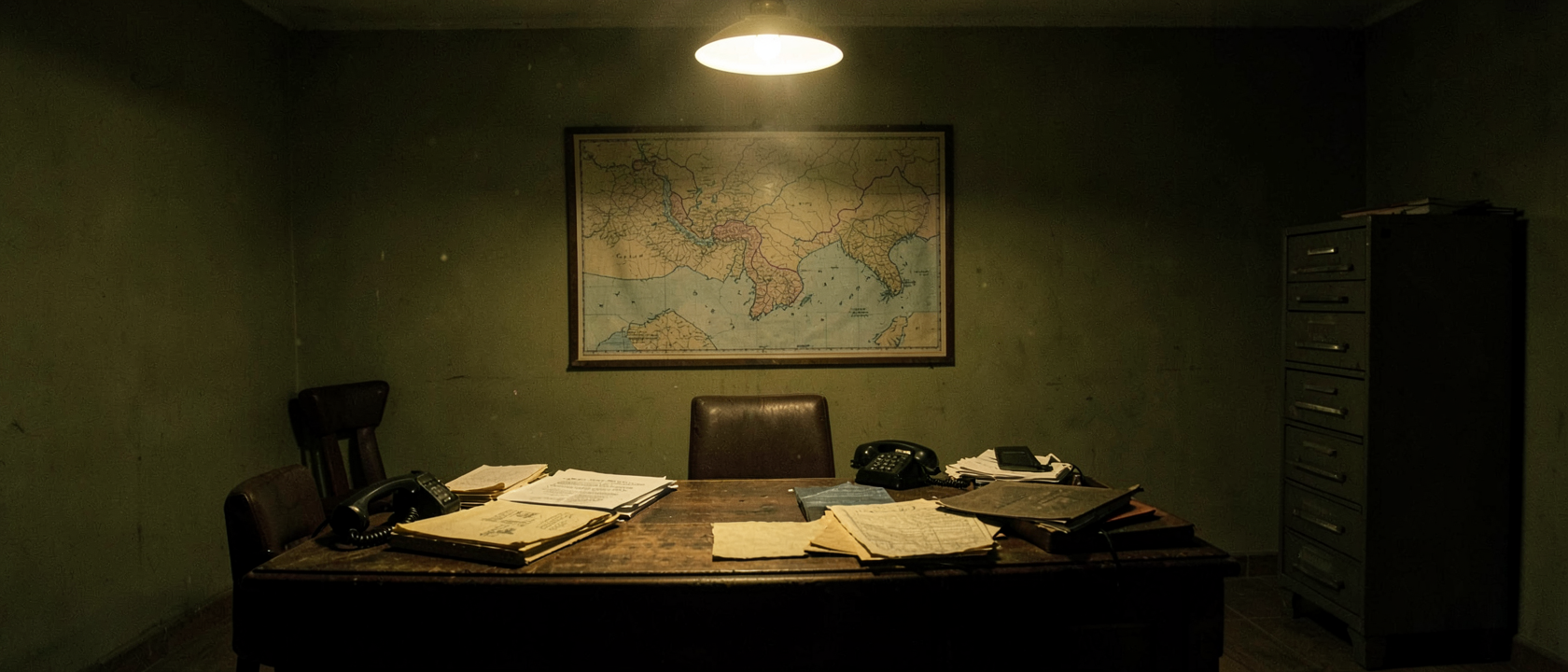
Some documents about a military failure are dense with testimony, cross-examination, dissenting opinions. This one is a single page, typed, ending in a list of fixes and nothing else.
One Page, One Reference Number
The document is titled “Summary of Recommendations.” It was produced by M.O.12, a military operations branch of the War Office, and dated at the foot: “M.O.12. 11 Oct 43,” October 11, 1943. It is held today by The National Archives in London under the catalogue reference WO 106/3782. There is no introduction, no account of who compiled it or how, and no narrative of the events behind it. It reads as a list of prescriptions, not a report.
Arakan, Spring 1943
The document exists to answer for a specific defeat. In the spring of 1943, the Eastern Army, a combined British and Indian force, was beaten by Japanese troops at the first battle of Arakan, in Burma. The army that fought there was not the army that had entered the war. It had gone in as roughly 240,000 volunteers, advised by the British government that it was unlikely to see frontline combat. By 1940 it was fighting in North and East Africa, and six divisions were added that year to help defend Malaya and Iraq. It grew again in 1941 as the Japanese threat in Southeast Asia increased. That expansion diluted experience at every level. Most officers understood the North-West Frontier; few knew jungle terrain, and the National Archives records that this gap “had cost them in Arakan.”
The Committee, and What Survives of It
After the defeat, a British Infantry Committee was set up to examine what had gone wrong. Its work is the source behind the M.O.12 summary, but the summary is what survives in this file, not the inquiry. The committee’s full report, its membership, and its working papers are not part of WO 106/3782. Even the surviving page has a gap of its own kind: the numbered list of recommendations runs from item 4, on officers, straight to item 6, on organization. Item 5 is simply absent from the released transcript, with no explanation given.
Eleven Months
What the summary does contain is specific. Infantry service needed better pay and a stronger claim on officer cadets and educated recruits, with an end to pulling men out of infantry battalions for other duties. British drafts arriving in India needed acclimatization, toughening, and elementary jungle training before anything else. Indian infantry basic training was to run to 11 months, including two months at a training division learning jungle warfare. Units needed collective training with other arms and the Royal Air Force before active operations. On officers: command tenures of one to two years, at least three experienced “Middle Piece” officers returned to each battalion, a simplified basic Urdu, and the removal of unsuitable officers. The summary also called for an end to ad hoc experimental units in favor of a standard division structure, and, according to the National Archives’ account of the file, for brigades built from one British, one Indian, and one Gurkha battalion. A final section addressed morale: regimental pride, stricter discipline, protection of troops from subversive propaganda while on leave, coordinated welfare, equal demobilization treatment for troops in Europe and the Far East, and a review of pensions and widows’ allowances.
“The Jungle Book,” September 1943
A month before the summary was written, the War Office had already published a training manual titled “The Jungle Book,” covering jungle craft, physical fitness, marksmanship, and decentralized control for commanding officers. It also stressed anti-malaria medication, which senior commanders began enforcing rigorously by late 1943. The manual is not part of WO 106/3782; it is a separate publication. But its existence shows the reforms named in the October summary were already circulating before the summary put them on paper.
What the Document Declines to Say
The summary is explicit about one thing it leaves out. Recommendations on the reinforcement system, it states, “have not been summarised” in this document, because the training divisions behind them were already a “fait accompli,” a decision already made rather than something still open to recommendation. The file carries no release date, and it records no mechanism by which any of these recommendations were formally adopted. What happened to them after October 11, 1943, is not addressed in the document itself.
Auchinleck’s Prediction
In September 1943, weeks before the summary was drafted, Field Marshal Claude Auchinleck, head of India Command, is reported to have told his chiefs that the new training divisions, built around units like the 14th and 39th Divisions, would “go far to improve the individual efficiency of reinforcements, particularly in jungle warfare, both of junior officers and other ranks.” That is a commander’s own assessment, recorded around the time. It does not appear in WO 106/3782 and predates the summary by weeks.
After Arakan
The second battle of Arakan, in February 1944, was a British victory. The battles of Kohima and Imphal followed between March and July 1944. By 1945, more than two million Indians had served in the Indian Army across Europe, Africa, and Asia. The National Archives states that the 1943 changes to organization, equipment, and training “rebuilt the overall combat effectiveness” of Indian units and helped restore confidence and morale. What the record does not do is draw a straight line from one typed page in October 1943 to a battlefield outcome eight months later. The committee that made the diagnosis, and the paperwork showing how its recommendations became army policy, remain outside the file.