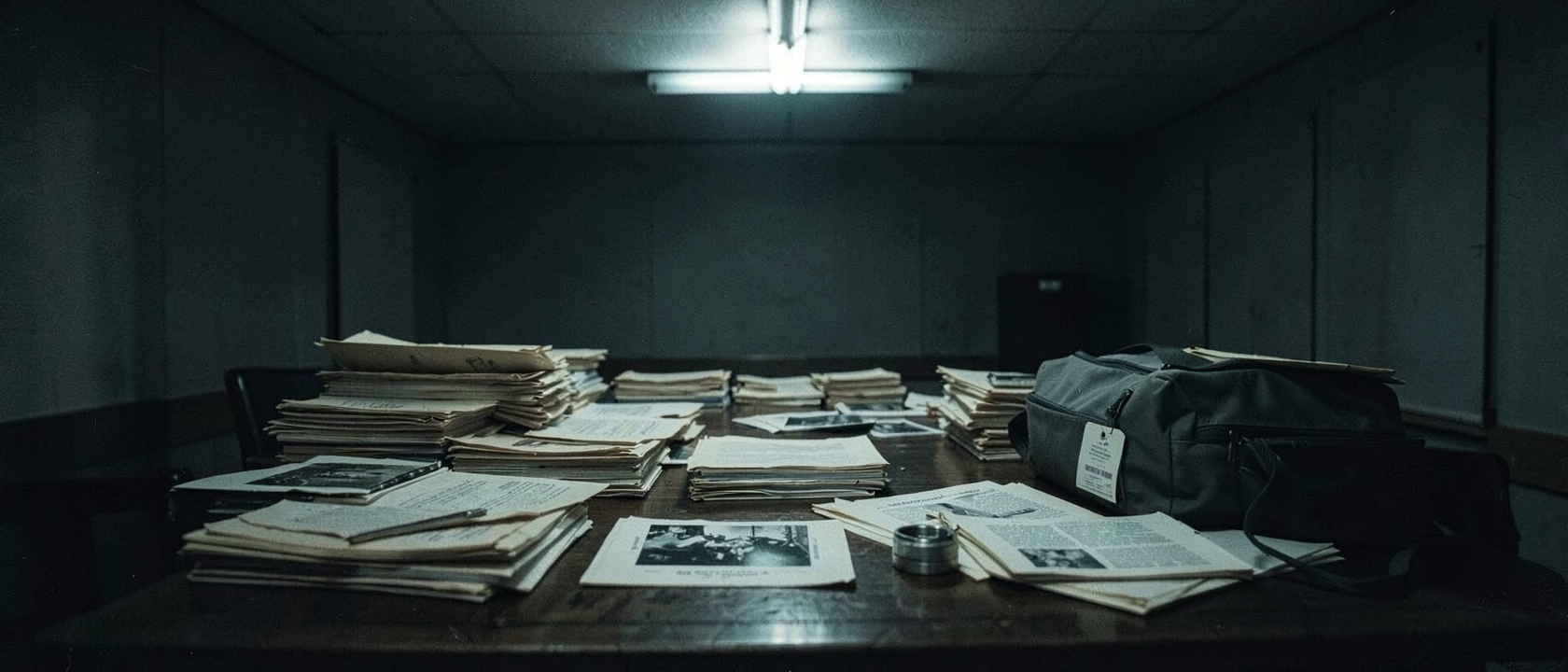
Among the objects photographed for the National Archives’ 2022 digitization project is a ChapStick container modified to conceal a microphone. It was entered into evidence before Chief Judge John J. Sirica of the U.S. District Court for the District of Columbia during the trial of United States v. G. Gordon Liddy, and it now sits in a digital folder alongside floor plans, a gym bag, and several hundred pages of court filings, available for inspection by anyone with an internet connection.
That collection is what this piece is about, not books, congressional testimony, or memoirs: the physical trial record and court filings, digitized and published by the National Archives and Records Administration (NARA) on June 17, 2022, fifty years after the break-in that generated them.
What NARA Published, and When
The originals are held at the National Archives at College Park, 8601 Adelphi Road, College Park, Maryland. Before June 2022, they were open in full but available only in person. NARA’s digitization project changed that. Digital Imaging Specialist Jennifer Seitz photographed the artifacts using a high-resolution studio setup, capturing multiple views where condition allowed. Some objects presented handling constraints, string bindings, plastic coverings, and attached exhibit tags limited image clarity in places.
The collection comprises three kinds of material: court filings, transcripts of testimony, and Government Exhibits, the physical artifacts and photographs formally entered into evidence. Government Exhibit 1 is a panoramic view with elevations and floor plans of the Watergate complex and the Howard Johnson’s Motor Lodge across the street. Government Exhibit 8 is a gym bag. Questions about the collection can be directed to NARA’s Special Access and FOIA Program at 8601 Adelphi Road, Room 5500, College Park, MD 20740-6001.
Everything that follows is drawn from this collection and NARA’s own documentation. Secondary sources, congressional testimony, and published accounts are set aside.
June 17, 1972: What the Record Says Happened
At approximately 2:30 a.m. on June 17, 1972, Washington Metropolitan Police officers arrested five individuals inside the sixth-floor offices of the Democratic National Committee at the Watergate Office Building. The charging documents identify them as agents of the Committee to Re-Elect the President, carrying wiretapping equipment, cameras, lock-picks, surgical gloves, door jimmies, a short-wave radio receiver, 40 rolls of unexposed film, three pen-sized tear gas guns, and approximately $2,300 in cash, predominantly $100 bills with sequential serial numbers.
The trial record also establishes that June 17 was the second entry into those offices. The first, on May 28, 1972, had produced the installation of listening devices and the photographing of documents. The June 17 break-in, according to the court’s record, was an attempt to repair surveillance equipment already in place.
The Named Men: Who the Court Charged
A federal grand jury returned an eight-count indictment on September 15, 1972. The seven named defendants were G. Gordon Liddy, E. Howard Hunt, James W. McCord Jr. Bernard L. Barker, Virgilio Gonzalez, Eugenio Martinez, and Frank Sturgis. The archival record groups them as co-defendants on shared charges and does not assign a hierarchy among them or distinguish their individual roles.
What the Court Concluded in January 1973
Jury selection began January 8, 1973. Five defendants entered guilty pleas before the trial concluded: Hunt on January 11, and Barker, Sturgis, Martinez, and Gonzalez on January 15. On January 30, 1973, a jury found Liddy and McCord guilty on all counts. The charges on which all seven were convicted covered three categories: conspiracy, burglary, and wiretapping. There is no partial verdict in the record.
Three Things the Trial Record Does Not Address
The record has three specific silences worth naming precisely.
First: the trial record does not address whether the operation was authorized, directed, or known by anyone above the Committee to Re-Elect the President. The question was not put to the jury, and the verdict does not reach it.
Second: the digitized collection, as described by NARA, does not contain sentencing information, individual penalties, or any post-conviction proceedings for the seven defendants.
Third: NARA’s documentation identifies certain items as highlights of the Government Exhibits without describing their specific contents in detail. The precise evidentiary content and relative prominence of those highlighted items within the evidence set remains unstated in the source.
Jurisdiction Drawn, Questions Left Standing
A criminal trial is constituted to determine whether named defendants committed named acts. United States v. G. Gordon Liddy did exactly that. The question of authority above the Committee to Re-Elect the President was outside the trial’s jurisdictional scope.
Chief Judge Sirica was not satisfied that the trial had produced the full picture. After sentencing, he stated on the record that he was “still not satisfied that all pertinent facts that might be pertinent to this matter have been produced before an American jury.” That statement belongs in the register of what the court itself concluded. What it led to, structurally, was the necessity of separate proceedings: the Senate Watergate Committee, the House Judiciary Committee, the office of the Special Prosecutor, distinct records, reached by different processes and held separately.
On March 19, 1973, James McCord wrote a letter to Judge Sirica claiming that defendants had been pressured to plead guilty and remain silent, that perjury had occurred during the trial, that the CIA was not involved despite the number of former CIA personnel among the defendants, and that others involved in the operation had not been identified during the proceedings. That letter was read in open court on March 23, 1973. McCord’s assertions are in the record as assertions. Whether those claims were accurate is a question the trial record itself does not settle.
Additional material has been released in stages since the trial. On November 2, 2012, Chief Judge Royce C. Lamberth ordered most remaining sealed material unsealed, citing the passage of time and the completion of criminal proceedings. NARA released 36 folders totaling approximately 950 pages on November 30, 2012. A second release, on July 15, 2013, added pre-sentence reports for the four Cuban defendants and the names of individuals overheard by the listening devices installed in the DNC offices. Fourteen pages from a folder of Liddy’s insurance papers remain withheld on personal privacy grounds. Grand jury records remained sealed beyond the 2013 releases; as of November 2013, the American Historical Association had petitioned for their release. Their current status is not stated in the available sources.
The trial record answers the question it was constituted to answer. Seven men were convicted on charges of conspiracy, burglary, and wiretapping. On the question of how far the operation’s authorization extended, United States v. G. Gordon Liddy is silent, and the cause of that silence is documented and ordinary: the question was never within its scope.