
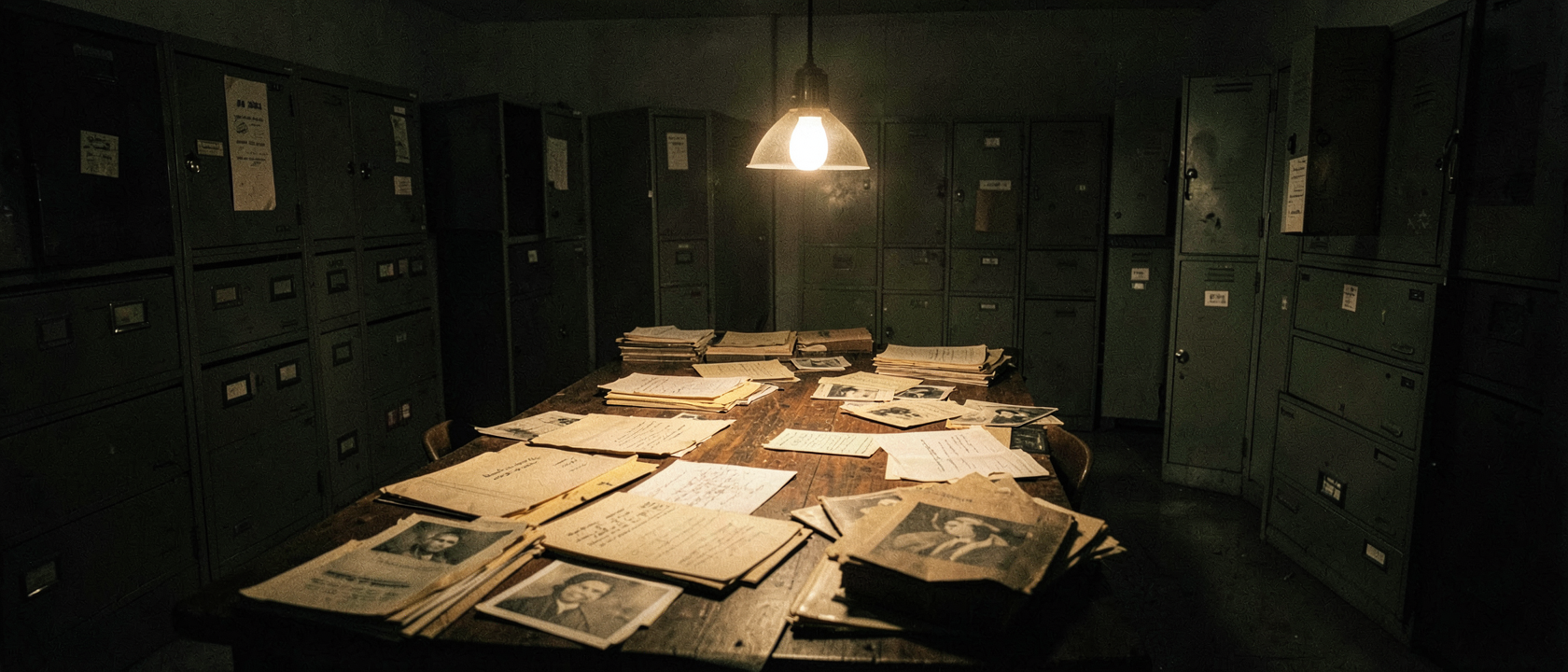
The Briefing Book
Fifteen declassified U.S. government documents, drawn from CIA analytical briefs, State Department reporting, embassy cables and military attaché dispatches, span the years 1972 to 1998. Most were obtained under the Freedom of Information Act, the U.S. law that lets the public request the declassification of government records. The National Security Archive, a research institute that compiles and publishes such material, released the set on June 21, 2024, two days after a Colombian court issued the verdict that gives the collection its occasion. One CIA document in the set carries an internal title that reads, in full, “Portrait of a Corrupt General.” The posting states what the collection contains and when it was released. It settles nothing on its own about the man it describes.
November 1985: Irma Franco
On November 6 and 7, 1985, M-19 guerrillas seized Bogotá’s Palace of Justice, holding more than 300 hostages, among them eleven Supreme Court justices. Irma Franco, one of roughly thirty M-19 members inside the building, escaped the following day with a group of released hostages. Army intelligence officers recognized and detained her. She was last reported being taken to the building of the Intelligence and Counterintelligence Operational Command (COICI), the unit Gen. Iván Ramírez Quintero commanded at the time. U.S. reporting compiled afterward places her death in that unit’s hands. Later cables, through the late 1980s, link intelligence units under Ramírez’s subsequent commands, including a B-2 unit, to the 1987 killing of twenty banana workers in the Urabá region and to further violence around Medellín. This is what the documents describe happening. What a court eventually found is a narrower matter, taken up below.
The Conviction
On June 19, 2024, the Criminal Chamber of the Bogotá Superior Tribunal, ruling on a second-instance appeal, convicted Ramírez as a co-perpetrator in Franco’s aggravated forced disappearance. It sentenced him to 31 years, 10 months and 15 days in prison, a fine equal to 2,562 times Colombia’s monthly minimum wage (about 3.33 billion pesos), and 191 months’ disqualification from public office. Retired Lieutenant Colonel Fernando Blanco Gómez, described in the 413-page ruling as the officer who coordinated the handling of detainees, was convicted on the same charge. The 413-page judgment credits Ramírez with having ordered personnel under his command to the Casa del Florero museum next to the Palace, where detainees were taken for identification under a separate officer’s coordination. The ruling overturned a 2011 acquittal by a lower court, and it directed Colombia’s Attorney General’s Office to open separate investigations into two other disappearances from the same siege. Under Colombian procedure, the prison term takes effect only once the ruling becomes final, so neither man has yet entered custody. This is the one point in twenty-six years of American reporting and Colombian litigation where a court, rather than a cable writer, reached a conclusion about what happened to Irma Franco.
The JEP Questioning
In May 2023, magistrates from Colombia’s Special Jurisdiction for Peace, a tribunal set up to examine crimes from the armed conflict, questioned Ramírez using some of the same cables later included in the 2024 release. Among the material cited was CIA reporting describing links between Ramírez and Carlos Castaño, a commander of the United Self-Defense Forces of Colombia (AUC), the country’s main paramilitary umbrella group, and a cable in which U.S. Ambassador Myles Frechette told Colombia’s defense minister there was “evidence suggesting” Ramírez had passed military intelligence to paramilitary forces used against guerrillas. The questioning was an inquiry, not a trial. No ruling from that proceeding has been issued as part of the record described here, and it remains separate from the closed Franco case.
A Document That Disagrees With Itself
One document in the set, built on a U.S. military source’s account, explicitly doubted Ramírez’s involvement in the 1994 assassination of Gen. Carlos Gil Colorado. No other document directly contradicts that account, but none confirms it either. Elsewhere in the same fifteen documents, Ramírez appears as a suspect in a broader pattern of paramilitary collusion. The source doubting him in the Gil Colorado case speaks from inside that same body of reporting, not against it. The record does not explain why this one case produced a doubt that the others did not.
What the Files Don’t Say
The declassified record never states whether Ramírez personally ordered Franco’s killing or tolerated it once other officers carried it out. Several of the CIA documents are redacted heavily enough that the full extent of his paramilitary dealings cannot be reconstructed from what survives. The fifteen-document set says nothing about whether other officers who served under him in COICI, the B-2 units, or the Twentieth Intelligence Brigade, which an Embassy report described as “suspected of narco, paramilitary, and death squad ties,” were ever investigated or disciplined. The tribunal’s own ruling notes separately that Franco’s remains have never been found or registered with Colombia’s national forensic institute, a gap the court cited in reaching its forced-disappearance finding, not a conclusion about where the remains are. These are gaps in the paperwork. They are not evidence of what the missing material would have shown.
What People Said Afterward
On August 11, 1998, the Washington Post reported allegations that Ramírez had worked as a paid CIA informant. An unnamed retired Army colonel, quoted in a military attaché report, told U.S. officials that Ramírez had gone “far beyond” simply tolerating paramilitary groups. The head of an International Committee of the Red Cross delegation separately told the U.S. Embassy that he believed Ramírez’s generation of Army commanders had, at minimum, tolerated paramilitary violence. None of these three statements appears in any court record. They sit in the files as things people said about a general, not things any tribunal has found true. The full briefing book of fifteen documents remains posted by the National Security Archive alongside the record of the June 2024 ruling.