
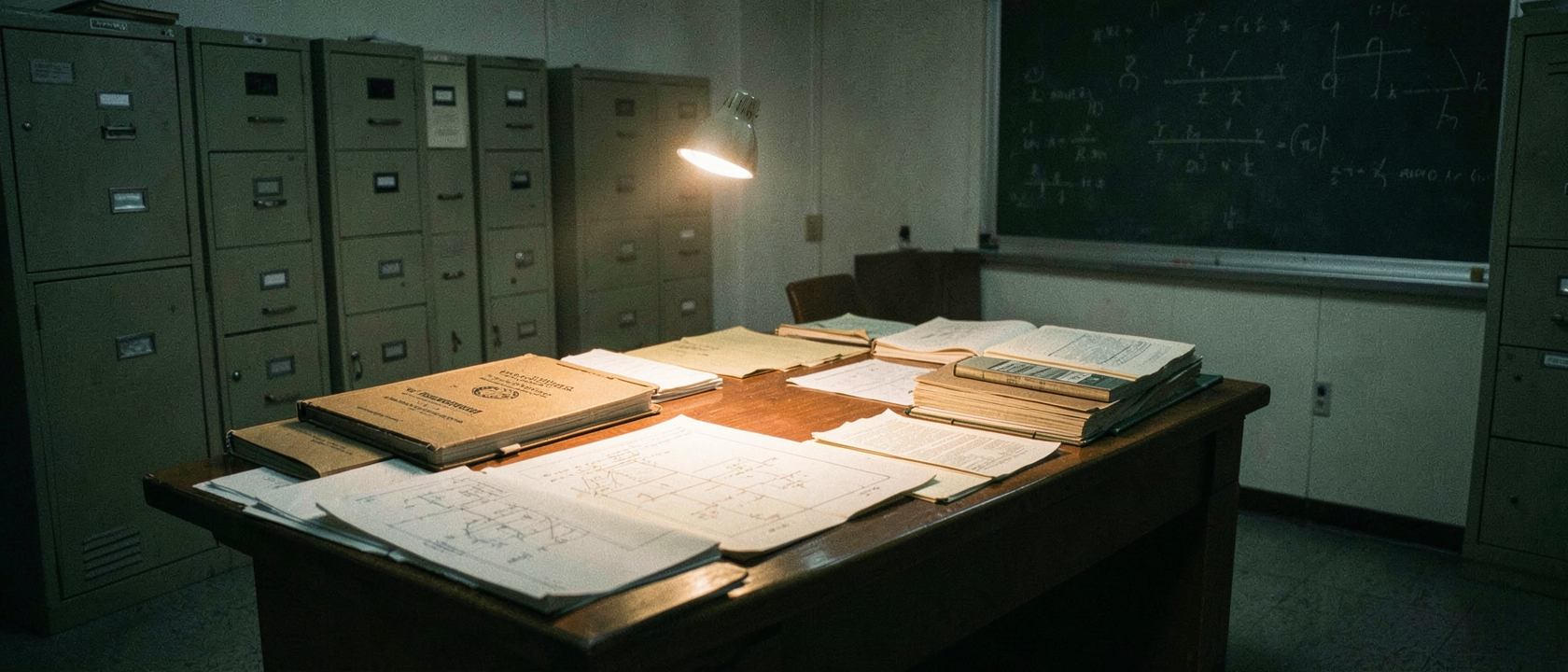
No classified material, under any circumstance, for as long as the project ran. That was the condition before anything else, at the Lawrence Radiation Laboratory in Livermore, California, now Lawrence Livermore National Laboratory. The National Security Archive’s January 23, 2025 posting lays out what happened when two, then three, young physicists were held to that rule for three years and told to design a nuclear weapon anyway.
Three physicists, three years, no clearance
In May 1964, Livermore hired two recent physics PhDs, David A. Dobson (UC Berkeley) and David N. Pipkorn (University of Illinois), on one-year appointments. Their assignment, later known as the Nth Country Experiment, was to find out whether a few capable people with no background in nuclear weapons work, and no access to classified material, could still produce a design with a militarily significant yield. The appointment ran into a second year, and in March 1965 Robert W. Selden, an Army Research Associate at the lab, joined full time. Correspondence with the project’s oversight committee went by letter only, meant to rule out any unrecorded hint from someone who already knew the answers. The team was, however, allowed ordinary unclassified computer time and technical support, a detail the record states directly. They settled on a plutonium implosion design over a uranium gun-type device. By the end of 1965 they had a complete early version; Pipkorn left in 1966 for regular staff work at the lab, and Dobson and Selden finished the final draft report on December 14, 1966. In April 1967 they staged a hypothetical, paper-only test. The finished design, per the record, was too large to fit on a missile but could be delivered by aircraft or truck.
The paperwork itself
Five documents make up the release. The centerpiece is the 1967 Summary Report of the Nth Country Experiment (UCRL-50249), edited by W. J. Frank, unclassified in title, first given to the National Security Archive in the 1990s and the subject of an Archive press release in 2003. A second Livermore report, Postshot Activities of the Nth Country Experiment (UCRL-50628), written by Dobson, Selden, and Frank to summarize the briefings given to outside officials, was declassified only for this release, and heavily redacted. Rounding out the file: the Operating Rules compilation Frank edited, a critique of the design team’s choices by F. S. Eby and Lawrence S. Germain, and Appendix L, a facilities and cost estimate by C. R. Henry, which assumed a production line capable of five to ten weapons a year. The Archive published all five together on January 23, 2025, following a Department of Energy review under the Freedom of Information Act, the law that lets the public request release of government records.
What Livermore told itself it had learned
There was no outside investigation here, only Livermore’s own account of what the Experiment had shown, carried into briefings with other agencies. The lab’s conclusion, as the record presents it, is that a team denied classified access had produced a workable design in about three years and three man-years of combined effort, and that this showed the real barrier to a new state building a bomb was access to fissile material, not knowledge of design. W. J. Frank, who headed the project’s oversight committee, told Dobson and Selden after their final briefing that the device, had it been built, “would have made a pretty impressive bang,” on “the same order of magnitude as Hiroshima.” That estimate is Frank’s, offered at the 1967 briefings, not a figure confirmed by any physical test. Dobson and Selden themselves were never told whether their April 1967 paper test had succeeded or failed; they carried that uncertainty with them to Los Alamos, the CIA, the AEC, and the State Department. A design judged credible on paper is not the same thing as a design shown to work.
The redacted center
What the Department of Energy withheld from the 2025 release, citing Restricted Data, the classification category covering nuclear weapons design information under the Atomic Energy Act, is specific. Missing from the public file is the bibliography of unclassified sources the team drew on, the detailed internal chronology of how design decisions were made, and the technical core of both the early and final designs: the core and tamper, the explosive lens geometry, and the discussion of the polonium-beryllium initiator. A redaction is a fact about how a document was processed for release. It says nothing about what the withheld pages contain.
Questions the release doesn’t answer
Three administrative points remain unsettled. The Archive itself says more needs to be learned about why Livermore management agreed to sponsor the Experiment in the first place; nothing in the released material explains the decision. The State Department’s internal announcement of its own briefing survives in the file but carries no date. And the Archive has filed a formal appeal, arguing that some of what the Energy Department cut from the Postshot Activities report had already been made public in the Summary Report as far back as 2003. None of this touches the weapon’s design. It is a dispute about paperwork, not about physics.
What came after the files
Dan Stober interviewed Dobson for the Bulletin of the Atomic Scientists in its March/April 2003 issue; Dobson told him he had felt his “reputation was on the line” and would have felt “like an absolute idiot” if he had missed anything, and that he and his colleagues had one advantage over Fermi and Teller: “we knew it could work.” Oliver Burkeman spoke with Selden around the same time for The Guardian. In a separate remark, carried in the Archive’s own 2025 posting and left undated there, Selden was asked whether a terrorist group could build a weapon by the same route. He said it came down to time spent in a library, under the right subject headings, and that this kind of homework cuts out most of the preliminary experimentation a group would otherwise need. None of this is in the declassified file. It is testimony, collected decades later, about a project the documents themselves describe only up to 1967.