
The Document
A war diary is not built for drama. It exists so that someone years later can reconstruct a unit’s day without needing anyone’s memory: what happened, where, at what time. The diary kept for 40 Commando Royal Marines (40 Cdo RM) during the 1982 Falklands conflict does exactly that. Cataloged as ADM 202/930/1 at The National Archives, it runs from March 31 to July 11, 1982, and carries the signature of the unit’s commanding officer, Lt Col M.P.J. Hunt RM.
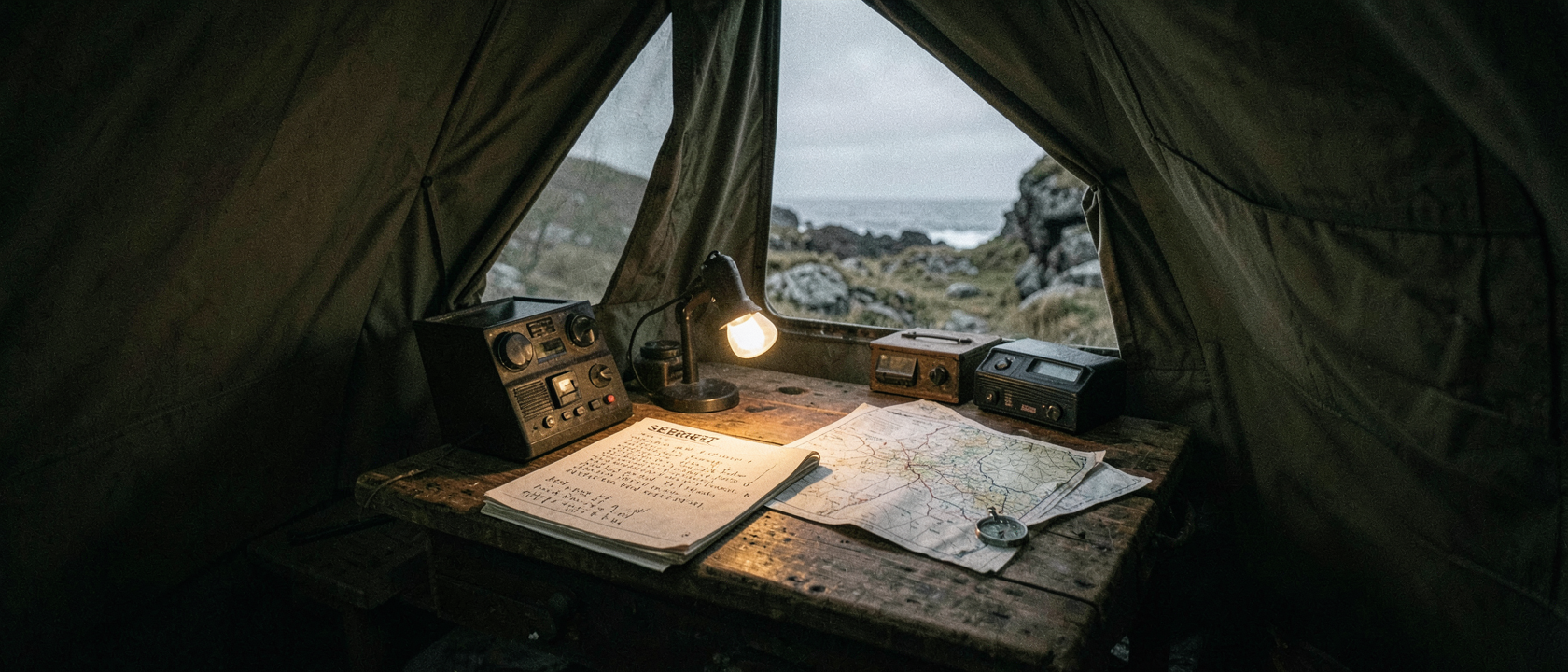
The National Archives released it as an educational source on March 26, 2024, together with a companion photograph catalog, ADM 202/930/3, showing supplies loaded for the voyage, training aboard SS Canberra, and the landing at San Carlos. An accompanying video features William Butler, the Archives’ Head of Military Records, walking through the same pages. The diary’s cover carries the classification marking “SECRET (ORIGINAL),” with a printed line instructing whoever filled it in to strike out “DUPLICATE” if it did not apply. The required format runs to a narrative plus annexes lettered A through Z: duty officer’s logs, signals, operation orders, intelligence reports, even a listed but unelaborated “Top Secret Supplementary Diary.” Every entry is grid references, call signs, and timings. Nothing about the layout anticipates anything unusual. That is what makes the page for May 22, 1982, worth reading twice.
The Night Entry
At 0200 hours on May 22, B Company reported movement on the shoreline near Fern Valley Creek, on East Falkland. The sighting came through the unit’s infrared watching system, an IWS device used for night surveillance. The entry records two men standing waist-deep in the water and a third figure ashore. It gives nothing beyond that: no description of clothing, no direction of travel, no estimate of distance. It reads exactly like every other line on the page.
A search followed once there was enough daylight to see the ground. The diary states that it revealed nothing: no tracks, no equipment, no bodies, no confirmation that anyone had been standing in that water at all. The entry does not guess at who the three figures were or what became of them. It simply moves to the next line.
The Same Day, Elsewhere in the Diary
Later that morning, at 0909 hours, a separate entry assigns 40 Cdo RM responsibility for defending a Rapier surface-to-air missile detachment at Lookout Hill, grid reference 595882. A Company took the task, operating under the call sign “c/s 31.” At 1050, the commanding officer ordered rifle companies to make maximum use of their general-purpose machine guns against enemy aircraft, since the companies were otherwise well protected from air attack. At 1130 came a caution against firing on helicopters without positive identification: the enemy operated Augusta Bell light attack helicopters that could, at a distance, be mistaken for the British Lynx.
Nothing in the diary ties this entry to the one before it. The two share a date and nothing else. Read on its own, the air-defense tasking is routine coordination, because that is exactly what the paperwork says it is.
No Inquiry Attached
This is a contemporaneous log, not an investigation. No board of inquiry is attached to the May 22 entries in the released extract. No intelligence summary follows up the Fern Valley Creek sighting. No signal traffic is appended to explain the Lookout Hill order beyond its own three lines. None of that is a redaction; it is simply what kind of document this is. A war diary’s job was to record that something was seen and that an order was given. Explaining either was never part of its brief.
What the Record Never Says
Two things stay open here, and the diary keeps them apart from each other. It never identifies what was in the water at Fern Valley Creek: not friendly troops, not the enemy, not an animal, not a fault in the IWS equipment. The entry ends at “revealed nothing” and does not go further. Separately, no later page records what became of the Lookout Hill Rapier detachment: no stand-down, no contact report, no note that the position was ever tested or relieved. The tasking order is the last word on it in this extract. Both threads stop where the page stops, not where an answer does.
Why There Might Be Nothing More
The diary’s own rules explain a good part of the silence. Its annex key lists supporting material, among it operation orders, intelligence reports, and signal logs, with certain items marked for inclusion only while a unit was engaged in active operations. If no annex was produced for a given event, or one was produced and not kept, the file holds less than a reader might expect by default, not because something was removed. That is an ordinary, administratively boring explanation, and it has no problem attached to it. It does not tell us what happened at Fern Valley Creek or at Lookout Hill. It only accounts for why nothing further survives to read.
What Stays, and What Doesn’t Resolve
What the archive actually holds is two entries from one page: a sighting, dated and cataloged, and an order, dated and cataloged. Both are real, available to anyone who requests ADM 202/930/1. Neither is connected to the other except by the date they share. The record does not say what the sentries at Fern Valley Creek saw, and it does not say how the Lookout Hill deployment ended. On the strength of this file, nobody knows. That is the condition of the document, not a shortfall in the research behind it.