
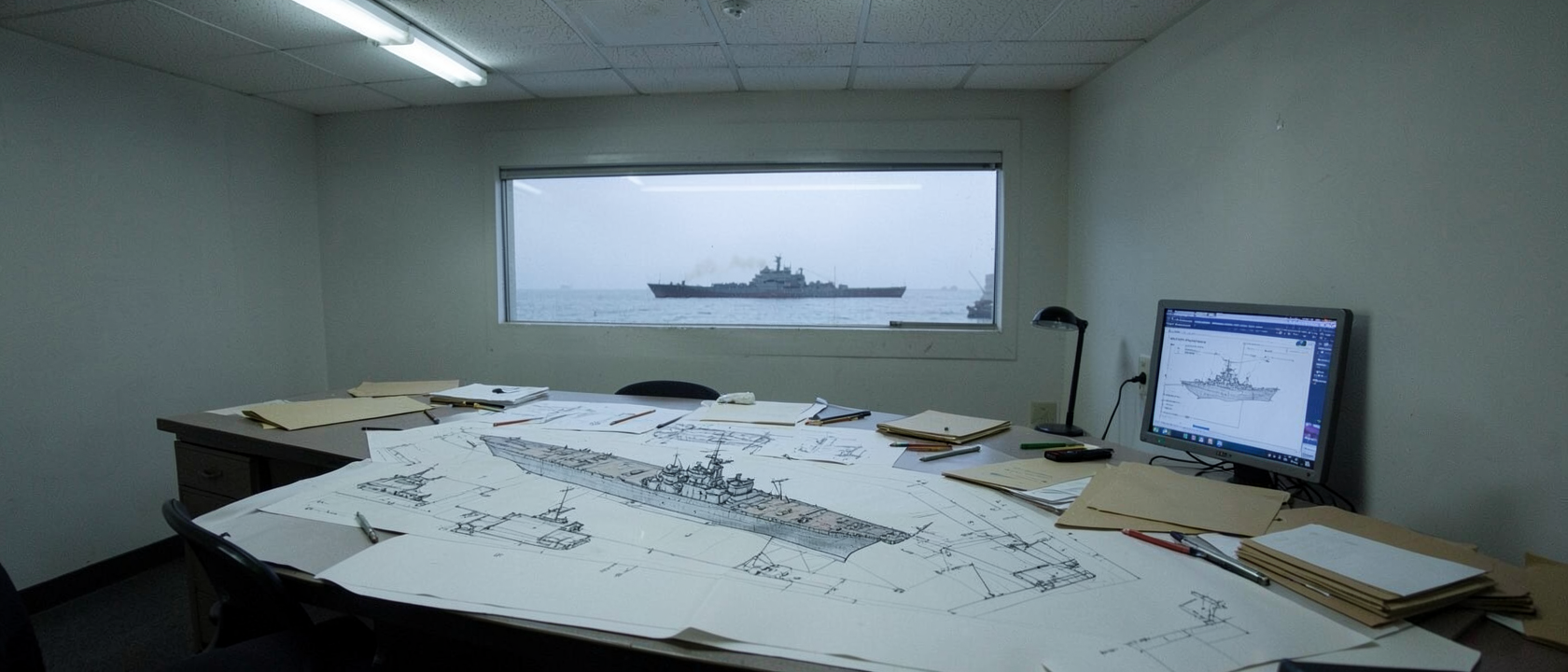
Some documents describe something that was built. This one describes something that was only ever supposed to work on paper, and the paper is specific enough that it reads like an engineering drawing rather than a pitch. A 42-page technical report, filed at a U.S. Navy design center, lays out a ship meant to launch swarms of drones, catch them out of the sky, and send the next batch up before the first one is even stowed. The report exists. What became of the idea after it was written does not appear to exist anywhere in the record that has surfaced.
The Report
The document is titled “UAV Mothership,” report number NSWCCD-CISD-2009/004, produced by the Ship Systems Integration and Design Department at the Naval Surface Warfare Center Carderock Division in West Bethesda, Maryland. Four authors are listed on the cover: Daniel Hanks, Cayle Bradley, Joanne Daniel, and Joanmarrie McKelvey. A fifth name, Josh Raanan, appears on the same record’s listing pages at the Defense Technical Information Center (DTIC), the Pentagon’s central archive for technical and research reports, where the file is also catalogued under accession number ADA518429. The work covered ran from May 18 to July 24, 2009, and the final report carries the July 24 date. It is marked “Approved for Public Release: Distribution Unlimited,” which means it was never classified. It sat, unread by most people, until researcher John Greenewald published a summary of it through The Black Vault on October 17, 2024, fifteen years after it was written.
The Ship on Paper
The vessel is a monohull built on the LPD-17 amphibious transport dock form, chosen for its stability and open deck space; the report also notes that SWATH or trimaran hulls might improve seakeeping in later versions. Fixed-wing drones would launch from a compressed-air catapult system adapted from land-based launchers and mounted on the top deck, specifically to avoid bow-slamming in rough water. Six launchers could put a 50-drone swarm in the air in about 35 minutes. Recovery used deployable catch nets on the flight deck, rated to sea state 5, a standard scale of ocean roughness used in ship design, with one swarm landing as the next launched.
Total capacity: up to 100 small fixed-wing drones, with the Swift Killer Bee (KB4) and Insitu Integrator cited as examples, plus 12 larger rotorcraft UAVs such as the Boeing A-160 Hummingbird and Northrop Grumman MQ-8 Fire Scout, plus five manned SH-60 Seahawk helicopters. Power came from four Wärtsilä diesel generators driving a fully electric system with hybrid contra-rotating propulsion pods, cruising at 22 knots (40.7 km/h) with a range of 4,500 nautical miles (8,334 km). The report states plainly that naval tests had shown this propulsion type to be 6 to 15 percent more efficient than conventional drives.
The Authors’ Own Hedge
None of this is presented as a decision. The authors write that the Navy “may conclude that a swarm is indeed the most effective strategy” for combat surveillance, a sentence built on “may,” not “will.” The report describes itself as feeding into further Navy modeling, not as a funding request or a program proposal. There is no program designation attached to it, no procurement line, no claim anywhere in the text that a ship like this was ever meant to be built as drawn. It reads as a feasibility study answering the question of whether such a ship could exist on paper, and concluding that it could.
The Risks the Report Names Itself
The caveats come from the same document, not from outside critics. The report flags that catch-net recovery in rough seas was untested and that the reliability of fixed-wing launch and recovery operations aboard ship generally was unresolved. On the propulsion pods, the authors write that further study was needed into “noise and magnetic signature reduction for pods to fulfill the mission of a US Naval combatant.” And the twelve-slot rotorcraft capacity depends partly on an assumption: that the A-160 Hummingbird could be built with folding rotors for compact storage, a feature the report itself notes did not exist in the aircraft as built in 2009.
The Trail After 2009
Nothing in the surfaced material says what happened after the final report date. There is no mention of funding, prototyping, sea trials, or formal adoption. No later Navy program is named as a successor, no cancellation memo appears, and no follow-up Carderock study is referenced anywhere in what has been released. A later academic survey of drone-mothership concepts around the world does list the 2009 Carderock study among several conceptual designs that, in the survey’s own phrase, “did not undergo the detailed design process.” That is a classification in the literature, not an explanation. The absence after July 2009 is simply an absence. It is not evidence the idea was shelved, and it is not evidence it was quietly carried forward elsewhere. It is a stop in the paper trail.
A Publisher’s Afterword
When Greenewald published the report in 2024, he added his own framing: that technological advances since 2009 suggested the Navy could now bring the concept to life in ways barely imaginable when it was written. That line belongs to Greenewald and The Black Vault, written fifteen years after the report and with no Navy statement attached to it. It is commentary on a document, not a new fact about the document, and it should be read as exactly that.
What the Record Actually Gives You
There is a file number, a date, four named authors and a fifth name on the index page, a list of specific risks the authors admitted against their own design, and a clean stop in the paper trail after July 2009. None of it requires taking anyone’s word for anything: a reader can check the report number, read the hedged language in the authors’ own sentence about swarms, and see for themselves that the caveats about nets and pods and folding rotors came from Carderock, not from a skeptic outside it. The ship, on paper, could launch fifty drones in well under an hour. What happened to the idea afterward simply isn’t in the file. The record stops after July 2009, and that stop is the only fact available about what came next.