
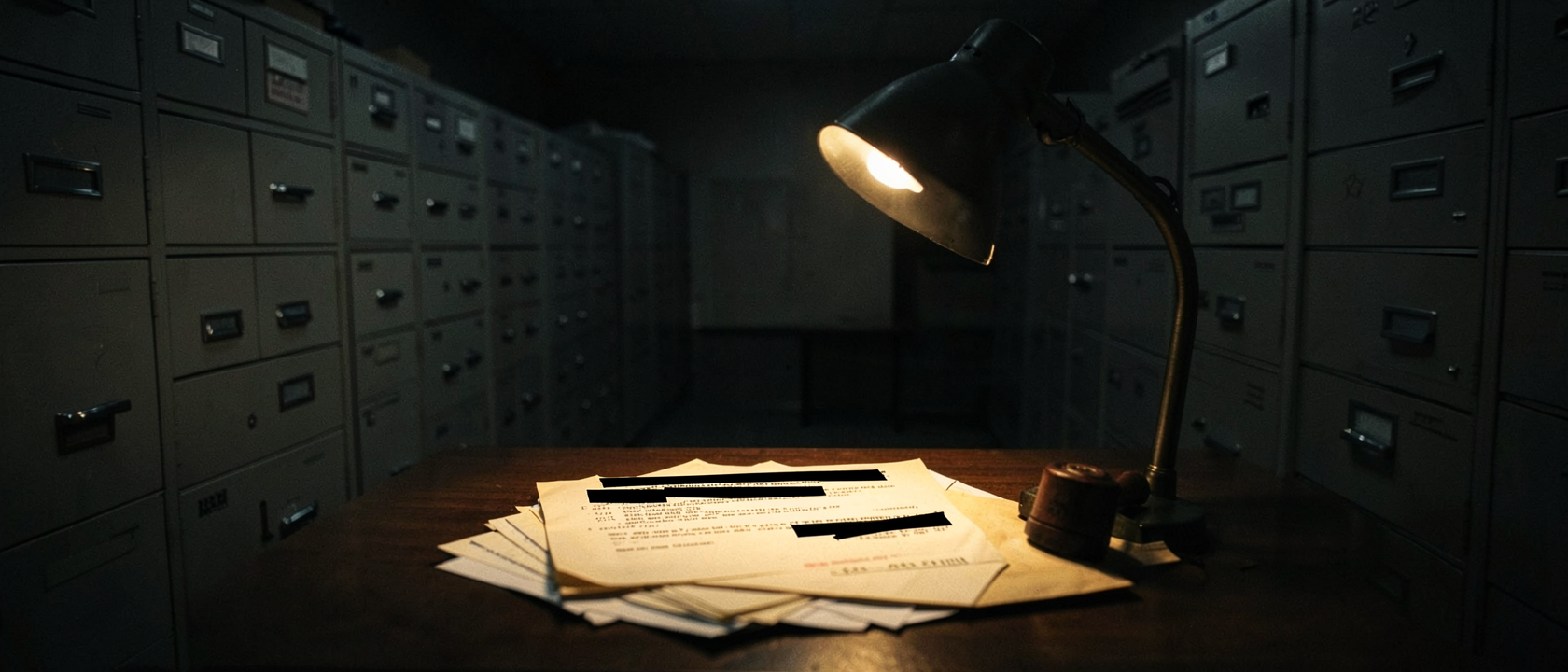
Most redactions arrive with their reasoning attached: an exemption number, a line about national security, a note that another agency holds the real interest in the material. The Black Vault’s latest Freedom of Information Act (FOIA) release on the Elizondo-Tipton email exchange has an exemption number. What it lacks is any explanation for using it, since the material being protected had already been public for years.
A Three-Year Paper Trail
On May 5, 2021, John Greenewald of The Black Vault filed FOIA case 21-F-0964 with the Department of Defense (DoD), requesting email correspondence between Luis Elizondo, who has said he led the Pentagon’s AATIP program, and Neill Tipton, then Director of Defense Intelligence, Collection and Special Programs within the Office of the Under Secretary of Defense for Intelligence. At the DoD’s request, the search was narrowed to emails between the two men containing terms such as “AATIP,” “UAP,” and “unidentified.” The department’s first answer, in December 2021, was that no records existed. Greenewald appealed. He cited a specific email sent September 25, 2017, at 11:23 a.m., in which Elizondo used the word “AATIP” directly in a message to Tipton, and argued that this alone should have produced at least one responsive document. The DoD’s final response letter was dated March 29, 2024. The Black Vault published its account of that response on May 15, 2024, in a report titled “New FOIA Release Highlights Redactions in Key AATIP Correspondence: What is the Pentagon Hiding?”
An Email About Handing Off a Program
The correspondence under review was sent the same day Elizondo submitted his first resignation letter from the Pentagon. In it, he told Tipton he was passing along a memo, also written by him, that “helps [Tipton] better assume the new responsibilities for AATIP.” Read on its own terms, the exchange is a handover between two officials, not a disclosure of classified operations. It moved through FOIA review as ordinary unclassified correspondence, which matters for what happened to it later.
Already in Print
None of this was unknown to the public by the time the 2024 response arrived. Popular Mechanics published a partial version of the email chain in 2020. Elizondo filed a complaint with the DoD Inspector General on May 3, 2021, naming Tipton along with Pentagon spokesperson Susan Gough and former defense intelligence official Garry Reid, and some of the same emails were reportedly part of that complaint. The New York Post printed further portions of the chain in 2022. By 2024, the AATIP reference and at least part of the memo had been sitting in public reporting for roughly four years.
An Exemption With No Explanation Attached
The 2024 response does cite a legal basis for its redactions. The AATIP reference in one email, and the entire memo, were withheld under FOIA exemption (b)(5), the provision that shields an agency’s internal, pre-decisional deliberations from release. What the letter does not do is address the fact that the same material had already surfaced through Popular Mechanics, an Inspector General complaint, and a national newspaper. Citing an exemption is standard FOIA practice. Explaining why years-old, already-public material still counts as pre-decisional is not, and in this case nothing in the letter attempts it.
No Verdict From Anyone
Neither the Department of Defense, the Inspector General, nor Congress has issued any public finding about what the emails or the memo actually show. Elizondo’s May 2021 complaint alleged that Tipton, Gough, and Reid “conducted retribution and provided false information to the public,” and accused them separately of “abusing government authority” and “illegal destruction of information.” Those are allegations contained in the complaint, not conclusions reached by any investigator. What happened to the complaint afterward does not appear in anything The Black Vault has published: not closed, not substantiated, not mentioned again.
Four Things Still Open
First, nothing in the record explains why material that had been public since 2020 was judged to require protection in 2024. Second, the memo’s actual content remains unknown beyond the single line already quoted in Elizondo’s own email, since it was withheld in full. Third, the outcome of the May 2021 Inspector General complaint has not been reported by the DoD, by Congress, or by Elizondo. Fourth, the complaint itself gives no reason why Tipton was named alongside Gough and Reid, given that Elizondo is reported to have spoken well of him right up to his own retirement.
One Researcher’s Reading
Greenewald titled his report “What is the Pentagon Hiding?” His argument, laid out in the piece itself, is that redacting material already public for years is difficult to reconcile with a routine review, and that the distance between the earlier openness and the later secrecy is itself worth pointing out. That is Greenewald’s reading of the record, offered after the fact. It is not a finding reached by the DoD or by any oversight body, and no such body has responded to it either way.
The Ordinary Explanations
There are dull ways this could have happened without anyone deciding to hide anything. A FOIA analyst reviewing the case in 2024 may simply have applied exemption (b)(5) more strictly than whoever cleared the material that reached Popular Mechanics or the New York Post. Internal guidance on AATIP-related releases could have shifted across the three years between the original request and the final letter, for reasons unrelated to this case. That span is also long enough for ordinary inconsistency between processors, or plain oversight, to explain a change in treatment. None of these possibilities addresses the specific fact sitting in the file: the AATIP reference and the memo were already public, through three separate outlets, before the Department of Defense decided they needed to be withheld. The response itself offers no reasoning that touches on that fact at all.