
A Pentagon Office Explains Its Own Math
Dr. Sean Kirkpatrick spent a Senate hearing explaining, under oath, how an unidentified object usually turns out to be something ordinary, and how often it doesn’t quite turn out to be anything at all yet. That second category, not the first, is the part of the transcript worth reading closely.
The transcript itself
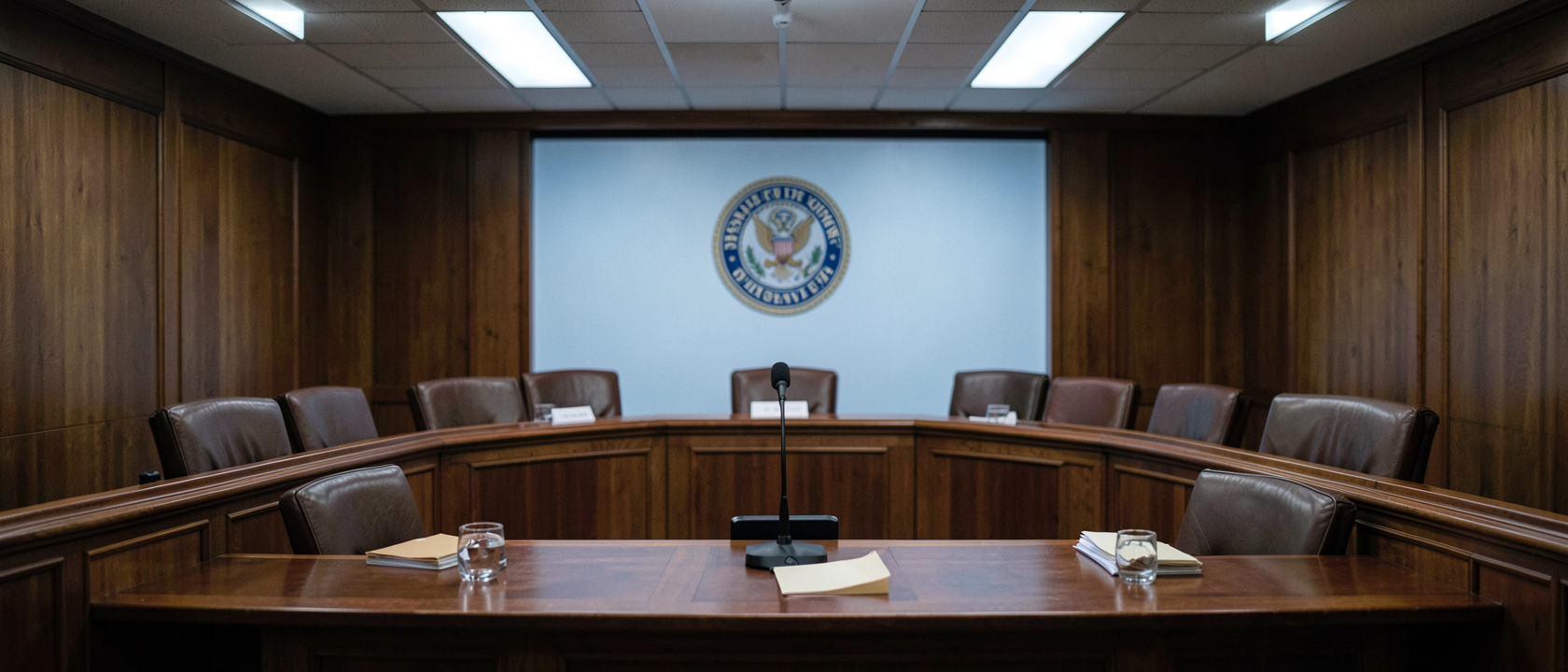
The document is a public transcript of a hearing held April 19, 2023, by the Senate Armed Services Subcommittee on Emerging Threats and Capabilities, titled “Unidentified Anomalous Phenomena (UAP) Public Hearing, In Full.” It was published the next day, April 20, 2023, by researcher John Greenewald at The Black Vault, with an editorial note that the transcript may contain errors. Senator Kirsten Gillibrand chaired the session; Senator Joni Ernst served as ranking member. The sole witness was Dr. Sean Kirkpatrick, director of the All-domain Anomaly Resolution Office, known as AARO. The hearing had a closed portion that preceded the public one. No classified annex is part of this release, only the open-session record.
Why there is an office at all
AARO was stood up by the Department of Defense in 2022, with sources giving either July 15 or July 20 as the formal date, a discrepancy the available record does not resolve. The fiscal year 2023 National Defense Authorization Act later fixed a direct reporting line from AARO’s director to the Deputy Secretary of Defense. In her opening remarks, Gillibrand placed this against two older threads: activity connected to former Senator Harry Reid, which she described as having begun more than a decade before the hearing and surfacing in media reporting in 2017, and a separate pattern of military pilots encountering unidentified objects in controlled U.S. airspace going back at least eight years. Neither thread is re-examined at the hearing. Both are entered as background already accepted into the public record.
What Kirkpatrick said the office does
Kirkpatrick described a staff organized across four functions: operations, scientific research, integrated analysis, and strategic communications. He did not give an exact headcount in the portion of the transcript available here. He testified that AARO was tracking a total of 650 cases as of that week, and stated for the record that the office had found no credible evidence of extraterrestrial activity, off-world technology, or objects defying known physics. He also told the committee that AARO had been pulled into the administration’s “tiger team” response during the high-altitude balloon incursion from the People’s Republic of China, and that the Department of Defense had adjusted radar filter settings during that episode to detect and track a wider range of objects than standard settings allowed. He presented a slide of UAP reporting trends from 1996 through 2023 and showed two previously unpublished videos, one depicting what he called an apparent spherical object recorded by electro-optical sensors on a U.S. platform.
The ordinary explanation, and its limit
Kirkpatrick testified that most reports AARO receives resolve to balloons, drones, sensor clutter, or natural phenomena, the categories most people would expect. But he drew a specific distinction the committee record preserves clearly: a meaningful share of cases are logged as unresolved due to lack of data, which is not the same status as confirmed mundane or confirmed anomalous. AARO’s stated policy, in his telling, is that it will not close a case it cannot scientifically defend in either direction. That line is the one piece of the hearing worth sitting with. It is the office saying, under oath, that “we don’t know yet” is a formal category in its casework, not a way of avoiding an answer.
What the transcript leaves open
Four matters are raised in the hearing and left unanswered in it. Gillibrand asked whether AARO was directly consulted by Pentagon leadership during the North American shootdown incidents and received no clear answer in the transcript. Full research and development funding for AARO remains unresolved; she stated that the administration’s FY23 and FY24 budget requests covered only operating costs, which is why she, Senator Marco Rubio, and fourteen other senators wrote to Secretary of Defense Lloyd Austin seeking relief. The implementation status of the public safe-disclosure process that Congress had mandated, intended to let witnesses report information without fear of consequences tied to prior nondisclosure agreements, is referenced as required but not detailed. And how AARO would obtain authority over raw sensor data and radar filter settings going forward is posed as a question by Gillibrand, not something Kirkpatrick answers in the available excerpt.
A claim made after the fact, not under oath
Separate from Kirkpatrick’s testimony, Gillibrand characterized the government’s response to the PRC balloon as irresponsibly slow, and attributed the delay to lingering stigma around UAP reporting generally. She quoted former Deputy Secretary of Defense David Norquist as having suggested that if such objects had simply been labeled “made in China” from the start, the government’s response would have been far more aggressive. That is Gillibrand’s characterization of a conversation, entered into the hearing by the chair. It is not something Kirkpatrick said, confirmed, or was asked to confirm, and the transcript does not treat it as testimony.
What stands
What the record shows is an office nine months old, reporting a case count, a staff organized by function, and a policy of not closing files it can’t defend. What it does not show, at least in this open-session transcript, is a final conclusion about any specific case, the funding fight’s resolution, or whether the disclosure process Congress ordered was actually running. The transcript ends roughly where those questions start.