
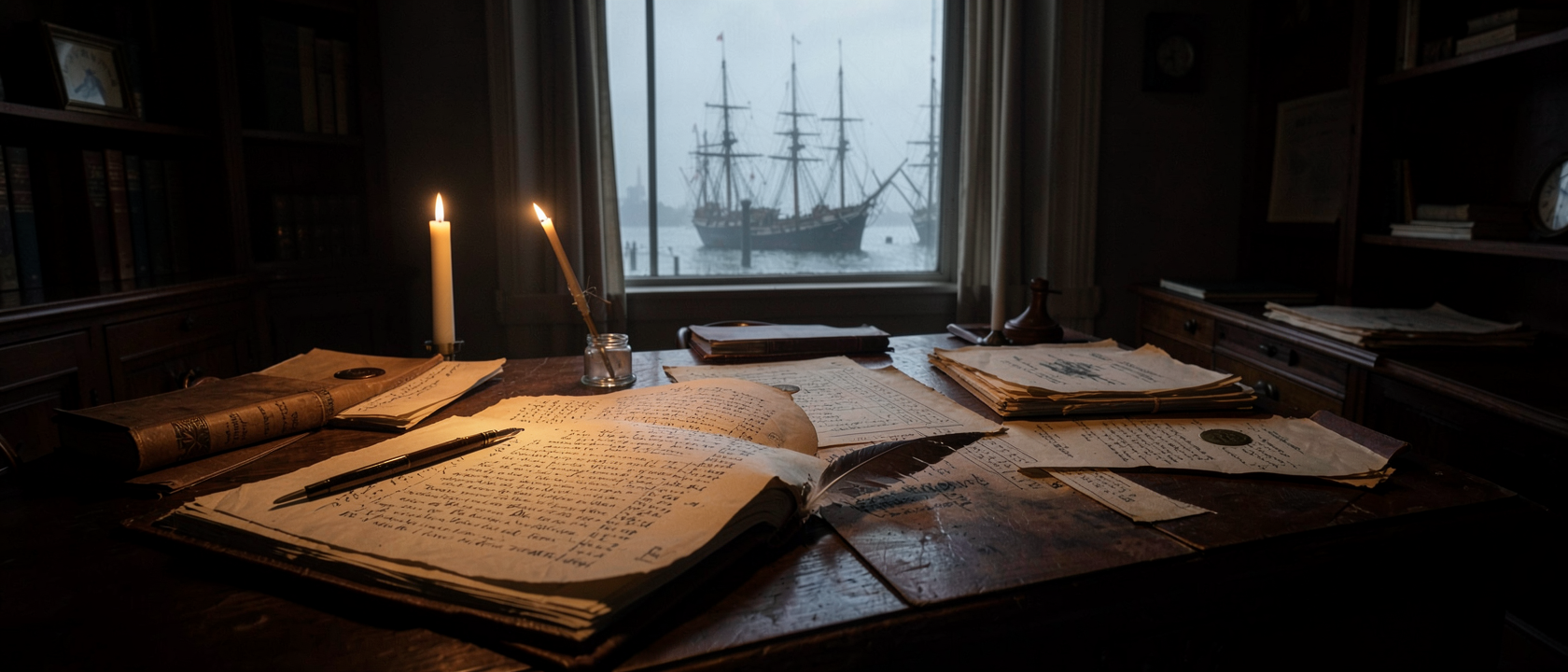
A ledger, not a story
The Book of Negroes is a single bound volume held by the National Archives in Kew under the catalog reference PRO 30/55/100. British officers opened it at New York on April 15, 1783, and a certifying office in London closed it out on February 19, 1784. It reads nothing like a diary or a court transcript. Each entry gives a name, an age, a short physical description, and a remark noting prior enslavement or free birth, filed under the ship a person boarded and that ship’s destination. It is an inspection list, compiled to check people onto vessels, not to tell anyone’s story.
The clause behind the list
The register exists because of a single sentence in the 1783 peace treaty between Britain, France, and the United States. Its Seventh Article barred British forces from “carrying away any Negroes, or other Property of the American Inhabitants” on withdrawal. An order issued at British headquarters in New York on April 15, 1783, instructed every officer and ship’s captain under command to comply with it. To enforce the clause, a joint Anglo-American board was convened to hear individual ownership disputes before anyone boarded a ship.
Two hearings, named
On July 24, 1783, the board heard a claim from Gerard G. Beekman for two children, Peter and Elizabeth, recorded as already “lately embarked with their Father” for Nova Scotia. On August 2, 1783, it heard a claim from Thomas Smith for a woman listed as Betty, also recorded under the name Elizabeth Truant. Present on the British side were Captain Armstrong, Major Phillips, and Captain Cooke; for the United States, Lieutenant Colonel Smith.
What the board actually decided
The board’s ruling in the Beekman case survives in full: Peter and Elizabeth were delivered into Beekman’s custody. Other individuals produced a document the ledger abbreviates as “G.B.C.”, General Birch’s Certificate, issued by Brigadier General Samuel Birch to confirm a prior promise of freedom under British protection. Where that certificate was presented, the board confirmed the person free and cleared them to sail. A certifying note signed in London on February 19, 1784, by Gilfillan and William Armstrong states that inspectors examined the vessels on November 30, 1783, and counted 142 men, 90 women, and 54 children aboard, with ship captains denying under oath that they carried any American property. That count of 286 covers only the vessels checked on that single date. The volume’s own running total for the whole embarkation period, cited elsewhere in the catalog description, is 3,000. The certification does not explain how the two figures relate, and the National Archives does not either.
The hearing that stops short
Betty Truant’s case is one of the few in the surviving minutes where a named individual appears twice in the paperwork: once in the claim brought by Thomas Smith, once producing General Birch’s certificate in her own defense. What the record does not contain is a ruling. Peter and Elizabeth’s outcome is written down in plain terms. Betty Truant’s is not. The hearing is dated, the claimant is named, the certificate she offered is described, and then the page moves on. Nothing in the surviving material says what the board decided or what happened to her afterward.
A number that doesn’t sort people
The “G.B.C.” notation tells a reader which individuals carried documentary proof of freedom. Its absence does not tell a reader the opposite. The ledger was built to settle property claims brought by named American claimants, not to classify every passenger as free or enslaved, and the National Archives’ own description makes this point directly: many people listed in the Book remained the property of departing British colonists even as they traveled beside Black Loyalists who were unambiguously free. A clean count of how many of the 286 people inspected on November 30, 1783, fell into each category cannot be drawn from the document as it stands, because it was never built to answer that question.
Where the ledger ends
The Book of Negroes stops at the rail of the ship. It does not record where any of these vessels made landfall in Nova Scotia, whether the people named in it received the land grants promised to Black Loyalist settlers, or what legal status they held once ashore. That silence matches the document’s stated job, an embarkation inspection roll, and nothing in the record suggests it was withheld or cut short. It simply ends where the inspection ended.
The National Archives’ own caveat
In its current public description of the volume, the National Archives states plainly that the Book of Negroes “does not represent an abolitionist victory.” This is the Archives’ institutional framing, written for cataloguing and public display in the present, not a conclusion reached by the 1783 board. The same page carries a note that the document discusses enslavement as both trade and condition and contains racist language, presented, in the Archives’ words, “to accurately represent our records.” A novel inspired by the Book, published by Lawrence Hill in 2007 and titled after it, drew on roughly 3,000 named people in the register; that is a later literary work built on the record, not part of it.
What stays, what doesn’t
From PRO 30/55/100 itself, a reader can verify names, ages, physical descriptions, G.B.C. status where it was recorded, the November 30, 1783, inspection tally of 142 men, 90 women, and 54 children, and the February 19, 1784, certification that closed the volume. What cannot be verified from it is what became of Betty Truant, a clean division of the 286 or the 3,000 into free and enslaved, or the fate of anyone after the ships reached Nova Scotia. The paperwork answers the question it was written to answer. On everything after the gangplank, it is quiet, and the quiet is simply where the record stops.