
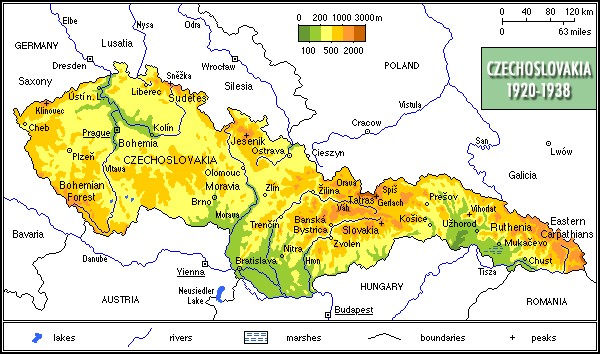
Czechoslovakia was a landlocked republic in Central Europe that existed from 28 October 1918 until its dissolution at the end of 1992, spanning two languages, multiple ethnic communities, and four distinct political systems. At its greatest extent the country covered 127,900 km² and, as recorded in the 1921 census, held 13,611,349 inhabitants drawn from Czech, Slovak, German, Magyar, Ruthenian, and Polish communities. Founded at the close of the First World War from territories of the Habsburg Empire, it became one of the few functioning democracies in interwar Central Europe before occupation, communist rule, and eventual peaceful dissolution shaped its final decades. The republic left behind two successor states, the Czech Republic and Slovakia, and a political and cultural record that historians continue to study as a case in both democratic consolidation and its collapse.
Key facts
- Capital: Prague
- Continent: Europe
- Population: 15,700,000
- Area: 127,900 km²
- Official language: Czech; Slovak
- Currency: Czechoslovak koruna
- Head of state: Tomáš Garrigue Masaryk; Edvard Beneš; Emil Hácha; Edvard Beneš
- Founded: 28 October 1918
Foundation and the First Republic
Czechoslovakia came into formal existence on 28 October 1918, born from the wreckage of the Austro-Hungarian Empire at the end of the First World War. Its first president was Tomáš Garrigue Masaryk, and international recognition of the new state was consolidated when its sovereignty was affirmed in the Treaty of Saint-Germain-en-Laye, signed in September 1919. The republic moved quickly to establish a legal framework: women were granted suffrage even before the adoption of the Constitution of 1920, making Czechoslovakia one of the early European states to extend voting rights to women at the outset of its constitutional life rather than as a later amendment.
The census of 15 February 1921 recorded 13,611,349 inhabitants. Of those, 8,760,937 were classified as Czechoslovaks, 3,123,568 as Germans, 745,431 as Magyars, 461,466 as Ruthenians, and 75,852 as Poles. That ethnic breadth shaped the republic’s politics from the beginning, and managing minority rights within a single framework was a persistent challenge throughout the interwar period.
Czechoslovakia’s interwar foreign policy rested heavily on regional alignment. Foreign Minister Edvard Beneš negotiated the Little Entente, an alliance formed with Yugoslavia and Romania in 1921, designed primarily to counter Hungarian revanchism following the post-war territorial settlements. Beneš, who would serve as head of state in two separate periods, made this alliance the cornerstone of a foreign policy that sought collective security rather than reliance on any single great power.
Geography and Economy
The country was drained by two main river systems pulling in opposite directions: the Elbe (Labe), which carried water northward to the North Sea, and the Danube, which carried water southward to the Black Sea. This hydrological split reflected the broader geographic position of Czechoslovakia as a state bridging the northern European plain and the Danubian basin.
The economy was built on metallurgy, mechanical engineering, and the chemical industry. Agriculture, relatively highly mechanized by regional standards, cultivated wheat, barley, sugar beets, potatoes, and flax. Among the country’s most significant industrial assets was the Škoda Works, founded in Plzeň, which ranked as one of the largest armaments complexes in Europe. After the republic’s founding in 1918, Škoda expanded well beyond armaments, moving into the manufacture of steam locomotives, aircraft, ships, and steam turbines.
After the Communist Party took power in 1948, the economy was reorganized along centrally planned lines, with heavy industry prioritized over consumer goods. By the 1980s the system had produced stagnation: shortages of consumer goods accumulated and industrial productivity declined, conditions that fed the discontent underlying the political upheaval at the decade’s end.
Occupation and the Second World War
Germany occupied the remainder of Czechoslovakia in March 1939, establishing the Protectorate of Bohemia and Moravia on 16 March 1939, in violation of the Munich Agreement. Emil Hácha served as head of state of the rump state under occupation. Edvard Beneš led a government-in-exile and would return to lead the reconstituted republic after the war.
Czechoslovakia emerged from the Second World War as an original member of the United Nations, admitted on 24 October 1945, a date that marked both its re-entry into international life and the formal beginning of the postwar order.
Communist Rule and the Prague Spring
Communist consolidation after 1948 reshaped every aspect of public life. The centrally planned economy redirected investment toward heavy industry, and political liberalization was suppressed for two decades. The most dramatic attempt to change that course came in January 1968, when Alexander Dubček became first secretary of the Communist Party and initiated a period of reform that became known as the Prague Spring.
The liberalization lasted until 20 August 1968, when Soviet-led forces invaded Czechoslovakia. The invasion killed approximately 137 civilians. Dubček was removed from leadership, and the reforms were reversed under the policy known as normalization. In 1969, the country was reorganized as a federative system comprising the Czech Socialist Republic and the Slovak Socialist Republic, a structural change that acknowledged national distinctions without restoring political freedom.
Culture and International Recognition
Czechoslovakia produced internationally recognized cultural figures across its decades of existence. The Czech poet Jaroslav Seifert was awarded the 1984 Nobel Prize in Literature, cited by the Nobel Committee for poetry that, in the committee’s words, was “endowed with freshness, sensuality and rich inventiveness” and provided “a liberating image of the indomitable spirit and versatility of man.” Seifert’s recognition came during the normalization period, when state cultural policy was at its most restrictive, and it drew international attention to Czech literary life.
Dissolution and Successor States
Czechoslovakia dissolved peacefully at the end of 1992. On 19 January 1993, both the Czech Republic and Slovakia were admitted as separate member states of the United Nations, formally succeeding Czechoslovakia in the international body of which the original state had been a founding member since 24 October 1945. The dissolution was carried out through political negotiation rather than conflict.
Did you know
- Gerlachovský štít, Czechoslovakia’s highest peak at 2,655 metres, was renamed Stalin Peak in 1949 and only had its traditional name restored in 1959. During the 20th century it served successively as the highest point of the Kingdom of Hungary, of Czechoslovakia, and of Slovakia. (karpaty.rocks)
Data sources
- Wikidata
- scalar.usc.edu
- vlada.gov.cz
- fao.org
- foreignaffairs.com
- worldhistory.org
- un.org
- rferl.org
- worldhistoryedu.com
- baike.baidu.com
- private-prague-guide.com
- globalsecurity.org
- nobelprize.org
Data updated: 2026-10-31